
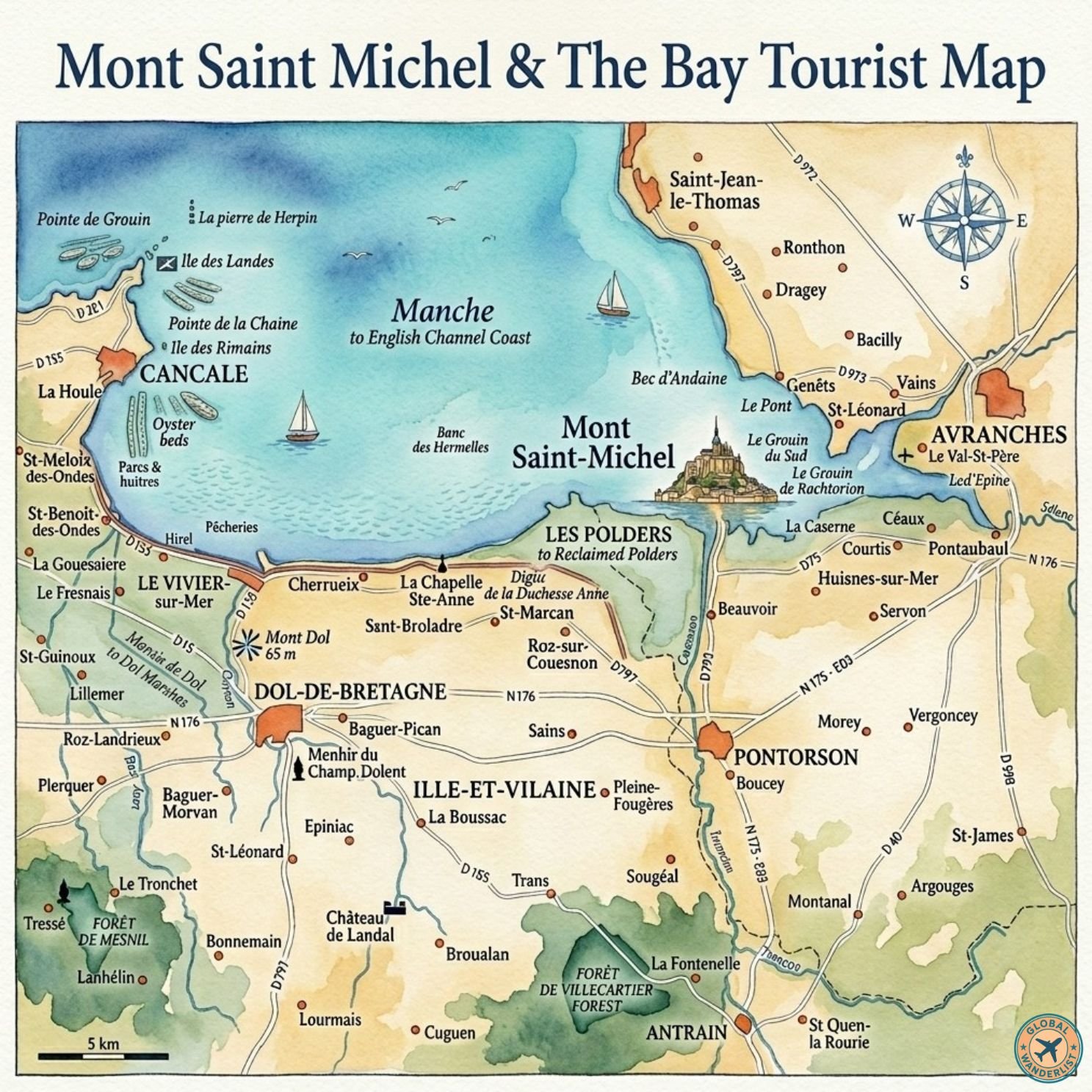
Mont Saint-Michel rises from tidal flats like a vision from a medieval manuscript, drawing millions of visitors each year to its abbey and winding streets. Yet the surrounding bay holds far more than this single icon, with oyster villages, wild coastline, and ancient market towns spread across the border between Normandy and Brittany. This corner of France rewards travelers who look beyond the abbey itself and explore the wider landscape that surrounds it.
This guide covers the bay’s essential destinations, from the famous mount to its quieter coastal villages and countryside towns. Below is a quick reference table, followed by detailed information on each area.
| Place | Category | Best Known For | Recommended Visit Duration |
|---|---|---|---|
| Mont Saint-Michel | Abbey and village | Medieval architecture, dramatic tides | Half day to full day |
| Cancale | Coastal village | Oyster beds, seafood dining | Half day |
| Avranches | Historic town | Manuscripts, hilltop views | Half day |
| Pontorson | Market town | Convenient base, river access | A few hours |
| Dol-de-Bretagne | Medieval town | Cathedral, ancient menhir | Half day |
| Wild Bay Coast | Coastal villages | Tidal flats, salt marsh sheep | Half day |
| Le Vivier-sur-Mer and Oyster Country | Coastal villages | Mussel farming, tractor bus tours | A few hours |
| Mont Dol and the Polders | Countryside and landmark | Volcanic hill, reclaimed farmland | A few hours |
| Ille-et-Vilaine Countryside | Rural villages | Neolithic monument, quiet farmland | A few hours |
| Forests and Castles | Woodland and estate | Historic château, forest trails | Half day |
Mont Saint-Michel
Mont Saint-Michel stands as one of the most recognizable landmarks in France, a rocky tidal island crowned by a Benedictine abbey first established in the 8th century. Its silhouette has inspired pilgrims, artists, and travelers for over a thousand years, and the surrounding bay produces some of the most extreme tidal variations in Europe. Walking its narrow streets and climbing toward the abbey remains one of the country’s defining travel experiences.
What to See in Mont Saint-Michel
- The abbey itself sits at the summit, combining Romanesque and Gothic architecture built up over several centuries. Guided tours explain the engineering feats required to construct it on such an isolated rock.
- The Grande Rue winds through the village below the abbey, lined with shops, small museums, and the historic church of Saint-Pierre. Arriving early morning helps you beat the heaviest crowds.
- The ramparts encircling the base of the mount offer sweeping views over the bay and its shifting sandbanks. Walking the full loop takes about 30 minutes at a relaxed pace.
- Watching the tides here reveals one of the most dramatic natural phenomena in France, since the water can rise faster than a person can run during peak tidal surges. Checking tide schedules before your visit is essential for safety and planning.
- The causeway connecting the mount to the mainland offers striking photo opportunities, especially when the tide is out and reflections stretch across the wet sand.
Cancale
Cancale anchors the western edge of the bay as one of France’s most celebrated oyster producing villages. Its harbor, La Houle, has supplied oysters to French tables since Roman times, and the surrounding waters remain some of the most productive shellfish beds in the country. The town’s relaxed, working harbor atmosphere makes it a favorite stop for food loving travelers.
What to See in Cancale
- The oyster beds along Cancale’s shoreline stretch for miles, visible at low tide from the coastal path above. Local producers often sell oysters directly from small stalls near the harbor.
- La Houle harbor remains an active fishing port, with boats bringing in the day’s catch each morning. Watching the activity here offers a genuine slice of Breton coastal life.
- The coastal path connecting Cancale to Pointe du Grouin offers dramatic clifftop views over the bay and out toward the Channel Islands. Allow about two hours for the full walk.
- Île des Rimains and Île des Landes sit just offshore, visible from the coastal trail and home to protected seabird colonies. Binoculars add to the experience for birdwatchers.
- Sampling fresh oysters directly at the harbor remains the essential Cancale experience, often enjoyed standing at outdoor tables with a simple squeeze of lemon.
Avranches
Avranches sits on a hilltop overlooking the bay, offering some of the best panoramic views of Mont Saint-Michel from a distance. The town holds a significant place in medieval intellectual history, having preserved an extraordinary collection of illuminated manuscripts originally from the Mont Saint-Michel abbey library. Its gardens and quiet streets make for a pleasant, less crowded alternative base.
What to See in Avranches
- The Scriptorial d’Avranches houses medieval manuscripts once held at the Mont Saint-Michel abbey, offering rare insight into monastic scholarship. The collection ranks among the most significant of its kind in France.
- The Jardin des Plantes provides sweeping views over the bay toward Mont Saint-Michel, especially striking at sunset. It offers one of the best photography spots in the entire region.
- Avranches’s public gardens and quiet residential streets reward slow wandering, offering a calmer pace than the crowds at the mount itself.
- The town’s position on higher ground made it historically significant during both medieval conflicts and the Battle of Normandy in 1944, adding layers of history to a visit.
Pontorson
Pontorson serves as a practical, well connected base for exploring the wider bay area, sitting along the Couesnon River just inland from Mont Saint-Michel. Its position at a crossroads of regional routes makes it convenient for travelers using it as a hub rather than a final destination. The town itself offers a relaxed, small town atmosphere away from the busier tourist areas.
What to See in Pontorson
- The Couesnon River, which historically shifted the border between Normandy and Brittany, flows directly through town. A walk along its banks offers a quiet, low key activity.
- Notre-Dame Church in Pontorson dates back centuries and reflects the town’s role as a regional religious center before the rise of Mont Saint-Michel’s fame.
- Pontorson’s central position makes it an efficient base for day trips to Mont Saint-Michel, Avranches, and Dol-de-Bretagne without constant repacking.
- The town’s Saturday market offers a genuine taste of regional produce and local life, worth timing a visit around if your schedule allows.
Dol-de-Bretagne
Dol-de-Bretagne marks the Breton side of this border region, a medieval town with deep religious and prehistoric roots. Its cathedral once served as the seat of a bishopric with outsized influence over Breton history, while a nearby standing stone points to settlement here thousands of years earlier. The town’s compact center makes for an easy, rewarding stop.
What to See in Dol-de-Bretagne
- Cathédrale Saint-Samson dominates the town center with its imposing granite facade, reflecting Dol’s historic importance as a religious center. Its interior holds centuries of Breton ecclesiastical history.
- The Menhir du Champ Dolent stands as one of the tallest standing stones in France, predating the cathedral by thousands of years. It sits just outside town and makes for an easy short visit.
- Dol’s medieval old town features well preserved half timbered houses along its main street, offering a glimpse into centuries of Breton architecture.
- The surrounding Ille-et-Vilaine countryside spreads out from Dol in every direction, offering scenic drives through quiet farmland dotted with small villages.
Wild Bay Coast
The stretch of coastline running from Saint-Jean-le-Thomas through Genêts and toward Avranches showcases the bay at its wildest and least developed. Salt marshes here support grazing sheep whose meat, known as pré-salé, has earned a distinct culinary reputation. This coastal corridor offers some of the most dramatic and least crowded views of Mont Saint-Michel from a distance.
What to See in Wild Bay Coast
- Genêts serves as a traditional starting point for guided walks across the bay’s tidal flats toward Mont Saint-Michel, an experience that requires a knowledgeable guide given the area’s dangerous quicksand and fast tides.
- The salt marshes near Genêts and Le Pont support flocks of grazing sheep, whose pré-salé meat is considered a regional delicacy shaped by the salty grasses they feed on.
- Bec d’Andaine offers one of the closest mainland viewpoints to Mont Saint-Michel, especially striking during sunset when the tidal flats reflect the sky.
- Saint-Jean-le-Thomas and nearby Dragey-Ronthon offer quiet beach access along this stretch of coast, popular with local families rather than tourist crowds.
- Villages like Bacilly and Vains dot this coastal corridor, each offering small scale charm and easy access to walking trails along the bay’s edge.
Le Vivier-sur-Mer and Oyster Country
Le Vivier-sur-Mer anchors a stretch of coastline famous for mussel farming, using distinctive wooden bouchot poles visible for miles at low tide. This working coastal landscape offers a different rhythm from the more polished tourist stops nearby, rooted firmly in the rhythms of shellfish farming. Villages along this shore, including Hirel and Cherrueix, add further texture to the area.
What to See in Le Vivier-sur-Mer and Oyster Country
- The bouchot mussel poles stretching across the tidal flats near Le Vivier-sur-Mer represent a centuries old farming method unique to this coast. Tractor bus tours take visitors out onto the flats to see the farming process up close.
- Cherrueix has become known among kitesurfers for its wide, wind exposed beach, offering a lively contrast to the area’s quieter fishing villages.
- Hirel and the surrounding fishing hamlets, including Saint-Benoît-des-Ondes and Saint-Méloir-des-Ondes, offer a genuine look at small scale Breton coastal life away from major tourist routes.
- La Chapelle Sainte-Anne provides a small but scenic religious landmark along this stretch, worth a brief stop for those exploring the coastal road.
Mont Dol and the Polders
Mont Dol rises unexpectedly from the flat farmland surrounding Dol-de-Bretagne, a volcanic outcrop that once stood as an island before centuries of land reclamation connected it to the mainland. The surrounding polders, painstakingly reclaimed from the sea, now support rich agricultural land. This area offers a fascinating look at how human engineering has reshaped the bay over centuries.
What to See in Mont Dol and the Polders
- Mont Dol rises to about 65 meters, offering surprisingly expansive views over the flat surrounding countryside given its modest height. A small chapel and windmill sit near its summit.
- The polders stretching toward the bay represent centuries of land reclamation work, transforming former tidal marshland into productive farmland. Roz-sur-Couesnon and Saint-Marcan sit within this reclaimed landscape.
- The Digue de la Duchesse Anne, a historic dike, marks one of the key engineering efforts that shaped this reclaimed coastline. It offers an interesting stop for those curious about the region’s land management history.
- Sant-Broladre, a small village within the polder region, reflects the quiet agricultural character that now defines much of this reclaimed land.
Ille-et-Vilaine Countryside
The rural countryside surrounding Dol-de-Bretagne spreads across the Ille-et-Vilaine department, dotted with small villages and quiet farmland. This area rewards travelers willing to slow down and explore beyond the bay’s major landmarks, offering a genuine look at rural Breton life. Villages here rarely draw large crowds, making for a peaceful contrast to Mont Saint-Michel’s busier streets.
What to See in Ille-et-Vilaine Countryside
- Baguer-Pican and Baguer-Morvan offer small scale Breton village charm, with modest churches and quiet streets typical of the wider region.
- La Boussac and Épiniac reflect the area’s agricultural character, surrounded by fields and small scale farms that define much of the regional landscape.
- Trans and Pleine-Fougères sit further into the countryside, offering scenic driving routes through farmland dotted with hedgerows, a traditional Breton landscape feature.
- Sains, a smaller village within this rural stretch, adds to the area’s collection of quiet, unhurried countryside stops worth a brief detour.
Forests and Castles
The wooded areas surrounding Antrain and the villages of Broualan, Le Tronchet, and Lanhélin offer a green, forested contrast to the bay’s open coastal landscape. Château de Landal anchors this area with centuries of aristocratic history, while the Forêt de Villecartier and Forêt de Mesnil provide extensive walking and cycling trails. This inland pocket rewards travelers seeking a quieter, nature focused stop.
What to See in Forests and Castles
- Château de Landal showcases centuries of French château architecture, surrounded by parkland and historic gardens. Its grounds offer a scenic stop for those interested in regional history.
- Forêt de Villecartier provides extensive trails through mixed woodland, popular with hikers and cyclists seeking a break from coastal sightseeing. A small lake within the forest adds to its appeal.
- Forêt de Mesnil, near the villages of Tressé and Lanhélin, offers additional quiet walking trails away from the bay’s busier tourist routes.
- Antrain serves as a convenient gateway to this forested area, with a historic center reflecting its role as a regional market town over the centuries.
Beyond the Mount
Mont Saint-Michel deserves its reputation as one of France’s most extraordinary landmarks, but the surrounding bay offers far more depth than a single day trip can capture. Oyster harbors, wild salt marshes, and quiet forested châteaux all sit within easy reach of the famous abbey, connected by scenic coastal roads and rural lanes. Few regions in France reward slower exploration quite like this border country between Normandy and Brittany.
Give yourself at least two or three days to properly explore beyond the mount itself, checking tide schedules carefully if you plan any bay walks. Whether you come for the abbey’s medieval grandeur, a plate of fresh Cancale oysters, or a quiet forest trail near Antrain, this region leaves a lasting impression well beyond its most famous silhouette.