
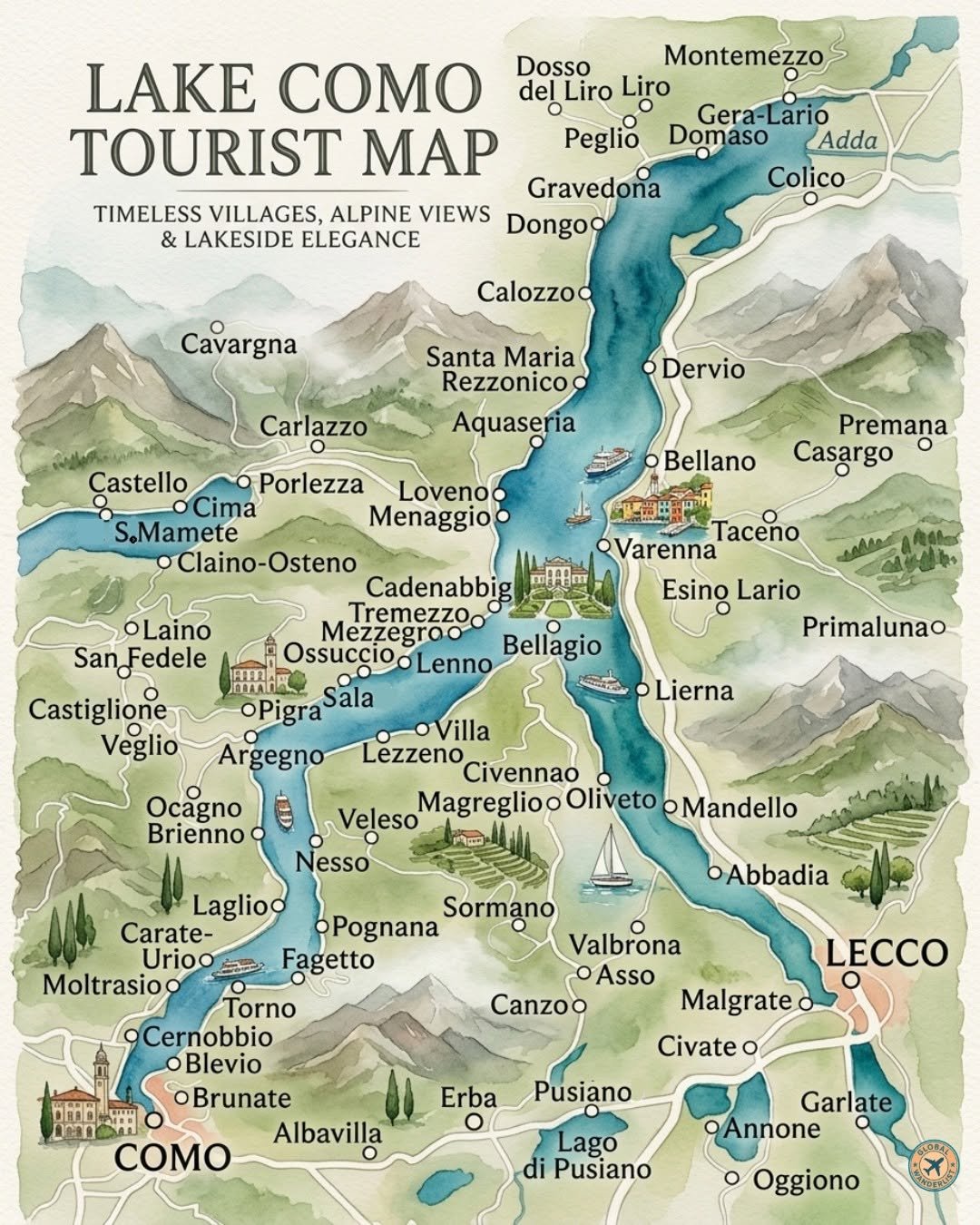
Lake Como has drawn travelers for centuries, from Roman aristocrats to modern-day film stars. Steep, forested mountains frame the water on nearly every side, while grand villas and pastel villages line the shore below. Few lakes anywhere combine this much natural drama with layered human history.
Each town around the lake carries its own character, shaped by centuries of trade, silk production, and aristocratic patronage. Some destinations draw crowds for their gardens and film history, while others remain quiet fishing villages barely touched by tourism. That range is exactly what makes exploring the full lake so rewarding.
This guide moves around the shoreline, covering the towns that define Lake Como’s reputation.
Destination Summary Table
| Place | Category | Best Known For | Recommended Visit Duration |
|---|---|---|---|
| Como | City | Duomo, funicular, silk history | 1-2 days |
| Cernobbio | Town | Villa d’Este, Villa Erba | Half day |
| Brunate | Hilltop village | Panoramic viewpoints | 2-3 hours |
| Torno and Moltrasio | Villages | Villa Pliniana, quiet lakeside charm | Half day |
| Laglio | Village | Celebrity villas | 1-2 hours |
| Argegno and Nesso | Villages | Gorge, cable car views | Half day |
| Ossuccio and Isola Comacina | Village and island | Lake’s only island, sanctuary path | Half day |
| Lenno | Village | Villa del Balbianello | 2-3 hours |
| Tremezzo | Village | Villa Carlotta gardens | Half day |
| Menaggio | Town | Hiking, lakeside promenade | Full day |
| Bellagio | Village | Villa Melzi, “Pearl of the Lake” | Full day |
| Varenna | Village | Villa Monastero, Castello di Vezio | Full day |
| Bellano | Village | Orrido gorge | 2-3 hours |
| Upper Lake (Gravedona, Domaso, Colico) | Towns | Windsurfing, historic churches | Half day |
| Lecco and Mandello del Lario | Cities | Literary history, Moto Guzzi | 1 day |
Como
Como sits at the lake’s southwestern tip, serving as the main gateway for most visitors arriving by train. The city’s Gothic-Renaissance cathedral dominates the skyline, a testament to centuries of wealth built partly on silk production. Como remains one of Italy’s leading silk manufacturers today.
Como suits first-time visitors who want strong transit connections without sacrificing lake scenery.
What to See in Como
- Como Cathedral: This Duomo blends Gothic and Renaissance styles, built over nearly 400 years.
- Como funicular: A historic railway climbing to Brunate, offering some of the best panoramic views on the lake.
- Piazza Cavour: The city’s main lakefront square, lined with cafés and ferry docks.
- Tempio Voltiano: A small museum honoring Alessandro Volta, the inventor born in Como.
- Basilica di San Fedele: A Romanesque church with an unusual polygonal apse, tucked into the old town.
- Silk Museum: Explores Como’s centuries-long history as one of Europe’s top silk producers.
Cernobbio
Cernobbio sits just north of Como, known internationally for its luxury villas and understated elegance. Villa d’Este, now a historic hotel, has hosted royalty and celebrities for generations. The town’s residential streets feel quiet compared to the busier ferry stops further north.
Cernobbio suits travelers seeking refined relaxation over heavy sightseeing.
What to See in Cernobbio
- Villa d’Este gardens: These meticulously maintained grounds rank among the lake’s most photographed landscapes.
- Villa Erba: A historic villa once owned by director Luchino Visconti’s family, now used for exhibitions.
- Lakeside promenade: A peaceful walking path connecting Cernobbio toward nearby Moltrasio.
- Historic town center: Small piazzas and understated architecture reflect the town’s quiet, residential character.
- Boat rentals: Several operators offer small boat rentals for exploring the surrounding shoreline independently.
Brunate
Brunate perches high above Como, reached by a funicular railway built in 1894 that still operates today. The short, steep ride delivers sweeping panoramic views over the entire southern lake basin. A historic lighthouse marks the village’s highest point.
Brunate suits travelers wanting big views without a demanding hike.
What to See in Brunate
- Volta Lighthouse: Climbing this lighthouse rewards visitors with the widest panoramic views in the area.
- Como funicular ride: The journey itself is a highlight, climbing steeply through forested hillside.
- Hiking trails: Several routes connect Brunate to nearby peaks and quieter mountain villages.
- Historic Belle Époque villas: Brunate’s hillside streets are lined with elegant early 20th-century architecture.
- San Maurizio church: A small church offering additional elevated views over the lake basin.
Torno and Moltrasio
Torno and Moltrasio sit along the lake’s eastern shore, both quiet villages largely untouched by heavy tourism. Torno holds Villa Pliniana, a striking villa named for an intermittent spring described by the Roman writer Pliny the Younger. Moltrasio has strong musical history, once home to composer Vincenzo Bellini.
These villages suit travelers wanting authentic lakeside life away from the busiest towns.
What to See in Torno and Moltrasio
- Villa Pliniana: This historic villa’s mysterious intermittent spring has fascinated visitors since Roman times.
- Chiesa di San Giovanni Battista: Torno’s Romanesque church features a notable carved marble portal.
- Moltrasio lakeside promenade: A quiet walking path offering unobstructed views across the water.
- Bellini’s villa site: A reminder of Moltrasio’s connection to one of opera’s most celebrated composers.
- Small stone harbors: Both villages retain simple, functional harbors used by local fishermen.
Laglio
Laglio remains a small, quiet village best known internationally for its celebrity association, particularly George Clooney’s lakeside villa. Beyond that fame, the village offers a genuinely peaceful stretch of shoreline. Steep, wooded hills rise directly behind the narrow lakeside road.
Laglio suits travelers passing through for scenery rather than extended sightseeing.
What to See in Laglio
- Villa Oleandra area: Visible from the water, this stretch of shoreline draws curious boat tours.
- Quiet lakeside walk: A short waterfront path offers peaceful views with far fewer crowds than Bellagio.
- Small village church: A modest local church reflects the village’s understated, residential character.
- Boat tour photo stops: Several lake cruises pause near Laglio for a look at the shoreline’s famous villas.
Argegno and Nesso
Argegno serves as the gateway to the Val d’Intelvi, with a cable car climbing to the hilltop village of Pigra for panoramic views. Nesso sits just south, famous for the Orrido di Nesso, a dramatic gorge where a waterfall cuts beneath an ancient stone bridge. Both villages offer scenery well beyond typical lakeside postcards.
These stops suit travelers interested in dramatic natural landscapes over polished resort towns.
What to See in Argegno and Nesso
- Orrido di Nesso: This narrow gorge and waterfall, spanned by a centuries-old stone bridge, is one of the lake’s most striking natural sights.
- Argegno to Pigra cable car: A short ride delivering sweeping views over the western lake basin.
- Val d’Intelvi day trips: The valley behind Argegno offers quieter hiking away from the shoreline.
- Nesso’s old town: Narrow stone lanes cluster around the gorge, largely unchanged for centuries.
- Lakeside swimming spots: Both villages offer quieter, less crowded places to swim than the busier towns further north.
Ossuccio and Isola Comacina
Ossuccio sits on the western shore, serving as the departure point for boats to Isola Comacina, the lake’s only island. The island holds the ruins of early Christian churches, abandoned after a medieval conflict left it destroyed. Behind Ossuccio, a UNESCO-listed sanctuary path climbs through the hills.
History enthusiasts and hikers both find meaningful stops in this area.
What to See in Ossuccio and Isola Comacina
- Isola Comacina ruins: Archaeological remains here reveal a settlement destroyed during a 12th-century conflict.
- Sacro Monte di Ossuccio: This UNESCO World Heritage pilgrimage path features chapels climbing a wooded hillside.
- Santa Maria Maddalena church: Ossuccio’s lakeside church offers a graceful bell tower visible from the water.
- Island boat excursions: Small ferries run regularly from Ossuccio’s shore to Isola Comacina.
- Lakeside walking path: A pleasant route connects Ossuccio toward neighboring Lenno.
Lenno
Lenno sits along a gentle curve of shoreline, home to Villa del Balbianello, one of the lake’s most photographed properties. The villa’s terraced gardens and dramatic promontory setting have appeared in several major films. A charming lakeside piazza gives the village its own quiet appeal beyond the villa.
Lenno suits travelers prioritizing one standout attraction alongside a relaxed village visit.
What to See in Lenno
- Villa del Balbianello: Famous for its film appearances, this villa’s gardens rank among the lake’s most scenic.
- Lenno’s lakeside piazza: A relaxed square lined with cafés, ideal for a slower afternoon.
- Romanesque baptistery: A small, historic religious structure near the village center.
- Short boat rides to Isola Comacina: Lenno offers another convenient departure point for reaching the island.
- Village waterfront promenade: Quiet views across the lake toward Bellagio and Menaggio.
Tremezzo
Tremezzo sits just north of Lenno, framed by some of the lake’s most elaborate 19th-century gardens. Villa Carlotta anchors the village, celebrated for its neoclassical interiors and vivid springtime azalea displays. The overall atmosphere here feels deliberately slow and elegant.
Tremezzo suits romantic travelers and garden enthusiasts seeking a refined, unhurried stay.
What to See in Tremezzo
- Villa Carlotta gardens: Famous for sweeping azalea and rhododendron displays each spring.
- Neoclassical villa interiors: The villa itself houses sculpture and period furnishings worth a slower look.
- Lakeside promenade: A flower-lined walking path connects Tremezzo toward neighboring Cadenabbia.
- Ferry connections: Tremezzo offers quick boat access across to Bellagio, just minutes away.
- Evening lakefront dining: Restaurants here take full advantage of unobstructed sunset views.
Menaggio
Menaggio sits roughly midway up the western shore, functioning as a hub for outdoor activity rather than pure sightseeing. Hiking trails climb directly into the hills above town, and a public lido draws swimmers in summer. The atmosphere feels sportier and more casual than towns further south.
Menaggio suits active travelers and those seeking good value without sacrificing lake access.
What to See in Menaggio
- Via dei Monti Lariani: A scenic hiking trail climbing into the hills above the lake.
- Menaggio lido: A popular public swimming area with lake views.
- Historic town center: Compact streets hold small shops and casual restaurants.
- Ferry connections to Varenna and Bellagio: Menaggio makes an easy base for exploring the central lake by boat.
- Golf course: One of Italy’s oldest golf clubs sits just outside town, framed by mountain views.
Bellagio
Bellagio sits at the point where the lake’s three branches meet, earning its reputation as the “Pearl of Lake Como.” Steep, stepped streets climb past boutique shops toward manicured villa gardens above. This remains the most photographed and recognizable town on the entire lake.
Bellagio suits travelers wanting the classic, postcard version of a Lake Como visit.
What to See in Bellagio
- Villa Melzi gardens: Sculpture-lined paths wind along the shoreline within this elegant 19th-century estate.
- Villa Serbelloni grounds: Guided walks here offer some of the best panoramic views on the lake.
- Historic stepped streets: Bellagio’s steep lanes are lined with boutiques selling local silk goods.
- Harbor-front cafés: A popular spot for an evening aperitivo while watching ferries arrive.
- Punta Spartivento: The town’s tip offers a distinctive view where the lake’s branches visibly divide.
Varenna
Varenna sits on the eastern shore, often considered more peaceful than Bellagio directly across the water. Pastel buildings line a narrow lakeside walkway, while a medieval castle watches from the hillside above. Many travelers consider this the lake’s most romantic town.
Varenna suits couples and travelers wanting beauty without the heaviest crowds.
What to See in Varenna
- Passeggiata degli Innamorati: This scenic lakeside walkway connects Varenna’s harbor areas along the water.
- Castello di Vezio: A hilltop castle offering panoramic views and occasional falconry demonstrations.
- Villa Monastero: Known for its botanical gardens stretching directly along the shoreline.
- Historic old town: Narrow medieval lanes climb steeply from the harbor toward the upper village.
- Ferry access: Varenna offers quick boat connections to both Bellagio and Menaggio.
Bellano
Bellano sits further up the eastern shore, defined more by natural drama than polished tourism. The Orrido di Bellano, a narrow gorge carved through solid rock, sits just steps from the town center. This remains a working lake town, less shaped by tourism than its southern neighbors.
Bellano suits travelers wanting a more local, less curated lake experience.
What to See in Bellano
- Orrido di Bellano: Suspended walkways let visitors walk directly above a churning underground river gorge.
- Historic silk mill: A reminder of the region’s industrial textile history along the shoreline.
- Quiet lakeside promenade: Less crowded than towns further south, ideal for an unhurried walk.
- Ferry connections: Boats link Bellano easily to Varenna and Menaggio across the water.
- Valsassina day trips: The valley behind Bellano offers hiking routes into the surrounding mountains.
Upper Lake: Gravedona, Domaso, and Colico
The lake’s northern reaches feel noticeably different from the busier southern towns, with wider water and stronger winds. Gravedona holds one of the lake’s most significant Romanesque churches, while Domaso has become a hub for windsurfing and sailing. Colico marks the lake’s northern tip, gateway to the Valtellina region beyond.
This stretch suits travelers seeking quieter towns and active water sports.
What to See in Gravedona, Domaso, and Colico
- Santa Maria del Tiglio: Gravedona’s striking Romanesque church features a distinctive black-and-white striped facade.
- Domaso windsurfing: Consistent northern winds make this one of the lake’s best spots for sailing and windsurfing.
- Palazzo Gallio: A Renaissance palace in Gravedona reflecting the town’s historic importance.
- Forte di Fuentes: Ruins of a 17th-century Spanish fortress near Colico, with views over the lake’s northern basin.
- Pian di Spagna nature reserve: A wetland area near Colico popular with birdwatchers.
Lecco and Mandello del Lario
Lecco anchors the lake’s southeastern branch, framed dramatically by the Resegone mountain range. The city holds deep literary significance as the setting for Alessandro Manzoni’s classic novel The Betrothed. Just north, Mandello del Lario is the birthplace of the Moto Guzzi motorcycle brand.
This area suits travelers interested in literary history, mountains, and mechanical heritage.
What to See in Lecco and Mandello del Lario
- Ponte Azzone Visconti: A medieval bridge crossing the Adda River at the heart of Lecco.
- Manzoni historical sites: Several locations throughout Lecco connect directly to the famous novel’s setting.
- Resegone hiking trails: Routes into the mountains behind Lecco offer some of the region’s best panoramic views.
- Moto Guzzi Museum: This Mandello del Lario museum traces over a century of Italian motorcycle history.
- Lungolago promenade: A relaxed lakeside walking path popular with both locals and visitors.
Practical Travel Advice
Ferries connect nearly every town on this list, making boat travel more reliable than driving during busy summer months. Roads around the lake are narrow and often congested, especially near Bellagio and Como. Early morning visits offer noticeably lighter crowds at the most popular villas.
Villa gardens look their best in late spring, particularly during azalea and rhododendron season. Northern towns like Domaso and Colico offer cooler temperatures and better wind conditions for water sports. Booking accommodations well ahead is essential for July and August travel.
Final Thoughts
Lake Como offers far more than its most famous villas and photo stops. Quiet gorges, mountain viewpoints, and small fishing villages reward travelers willing to venture beyond Bellagio and Como. Take time to explore the full shoreline, and the lake’s variety will surprise you.