
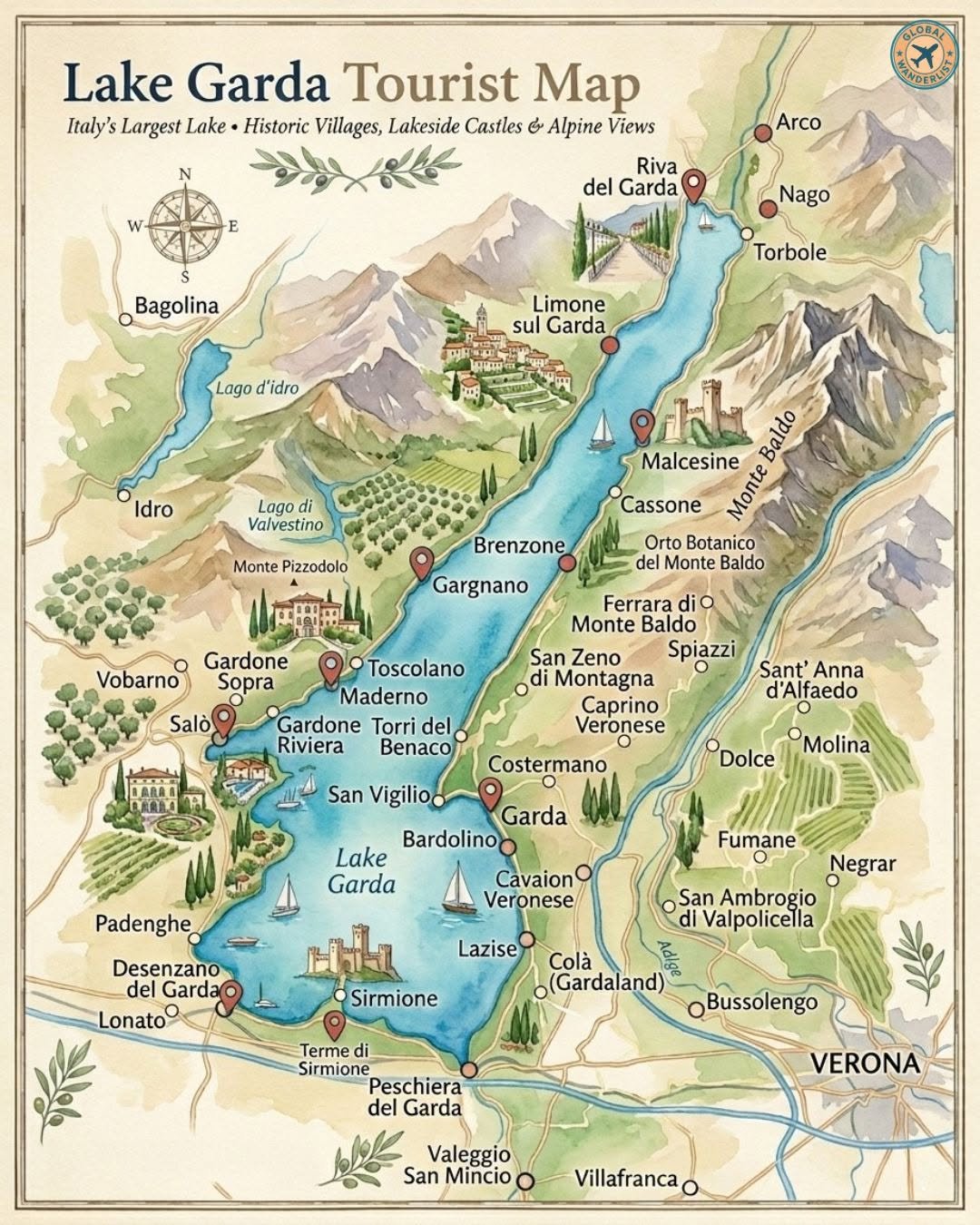
Lake Garda stretches across three Italian regions, and it earns every mile of that reach. Snowy peaks rise above the northern shore. Palm trees and lemon groves line the south.
This is Italy’s largest lake, and it has drawn visitors for over two thousand years. Roman poets wrote about it. Medieval lords built castles along its edges to defend it. Today those shores hold sailing schools, wine roads, thermal spas, and villages that still feel unhurried.
A trip here rewards travelers who mix famous stops with quieter ones. Malcesine and Sirmione draw crowds for good reason. But the Valpolicella hills and the lemon terraces near Limone offer just as much, minus the lines.
Quick Reference: Lake Garda at a Glance
| Place | Category | Best Known For | Recommended Visit Duration |
|---|---|---|---|
| Riva del Garda | Town | Alpine backdrop, historic center | 1 full day |
| Torbole sul Garda | Town / Beach | Windsurfing and kitesurfing | Half day |
| Arco | Town | Rock climbing, hilltop castle | Half day |
| Malcesine | Town / Castle | Scaliger Castle, cable car | 1 full day |
| Monte Baldo | Mountain | Hiking, paragliding, alpine views | Half to full day |
| Limone sul Garda | Town | Lemon houses, lakeside promenade | Half day |
| Gargnano | Town | Lemon terraces, sailing history | Half day |
| Gardone Riviera | Town | Vittoriale degli Italiani | Half day |
| Salò | Town | Renaissance architecture, lakefront | Half day |
| Lago d’Idro | Lake / Nature | Quiet mountain scenery | Half day |
| Sirmione | Town / Peninsula | Scaliger Castle, thermal springs | 1 full day |
| Desenzano del Garda | Town | Roman villa, nightlife | Half day |
| Garda | Town | Punta San Vigilio, lakeside piazza | Half day |
| Bardolino | Town | Bardolino DOC wine | Half day |
| Peschiera del Garda | Town | Venetian fortifications | 2-3 hours |
| Gardaland | Theme Park | Rides and family attractions | 1 full day |
| Verona | City | Roman Arena, Juliet’s balcony | 1-2 days |
| Valpolicella | Wine Region | Amarone and Valpolicella wines | Half to full day |
Riva del Garda
Riva del Garda sits at the lake’s northern tip, framed by cliffs rising straight from the water. The town has a long history as a trading post and later as a resort for Austro-Hungarian visitors. Its old town still shows that layered past in narrow streets and lakeside arcades.
What to See in Riva del Garda
- Torre Apponale: A 13th-century tower once used as a lighthouse. Climb it for sweeping views over the harbor.
- Rocca di Riva: A moated medieval fortress housing the town museum. Exhibits cover local archaeology and lake history.
- Piazza III Novembre: The main square, lined with arcaded buildings. It is the best spot for the evening stroll.
- Cascata del Varone: A dramatic waterfall carved through limestone. Walkways let you get close to the roaring water.
Torbole, Arco, and the Windsurfing Coast
Torbole sits just east of Riva and is considered a windsurfing capital of Europe. Two reliable daily winds, the morning Peler and afternoon Ora, create near-perfect conditions from spring through fall. Nearby Arco adds a different flavor, with a ruined hilltop castle and a reputation as a world-class climbing hub.
What to See in Torbole and Arco
- Torbole Beach: The launch point for windsurfing and kitesurfing lessons. Watching the colorful sails fill the bay is a show itself.
- Arco Castle: A crumbling fortress on a rocky outcrop above town. The climb up rewards visitors with panoramic valley views.
- Sarca River Delta: Where mountain water meets the lake near Torbole. It creates striking light and color at sunset.
- Arco Old Town: Cobblestone streets built around a central square. Small shops make it a pleasant stop between climbing routes.
Malcesine and the Scaliger Castle
Malcesine anchors the eastern shore with one of the lake’s most photographed skylines. Its Scaliger Castle rises from a rocky spur above the harbor, built by the Della Scala family who once ruled Verona. Goethe sketched the castle in 1786 and was briefly mistaken for a spy, a story locals still tell.
What to See in Malcesine
- Castello Scaligero: A well-preserved 13th-century fortress with climbable towers. It houses a natural history museum on Monte Baldo’s wildlife.
- Palazzo dei Capitani: The former residence of Venetian governors, now used for exhibitions. Its loggia overlooks the small harbor.
- Malcesine Old Town: Steep lanes packed with gelato shops and lake views. Visit early morning to avoid midday crowds.
- Cable Car Station: The base of the rotating cabin that climbs Monte Baldo in minutes. Book tickets early to skip long lines.
Monte Baldo and the Alpine Villages
Monte Baldo rises behind the eastern shore, nicknamed the “Garden of Europe” for its plant diversity. The rotating cable car from Malcesine reaches the summit area in about 15 minutes. Villages on the lower slopes, including San Zeno di Montagna and Spiazzi, offer quieter alternatives to the lakefront towns.
What to See on Monte Baldo
- Tratto Spino Summit Station: The cable car’s top stop, with trailheads fanning out in several directions. Views stretch to the Dolomites on clear days.
- Orto Botanico del Monte Baldo: A botanical garden preserving rare alpine species. It ranks among the richest sites in the Alps.
- Madonna della Corona Sanctuary: A church near Spiazzi built into a sheer cliff face. The setting alone justifies the winding drive up.
- Paragliding Launch Points: Several ridges near the summit serve tandem flights. Watching wings drift over the lake is a highlight.
Limone sul Garda and Its Lemon Houses
Limone sul Garda sits wedged between mountains and water. For centuries it grew lemons in terraced stone structures called limonaie, built to shelter citrus trees through alpine winters. Franciscan friars introduced the crop in the 13th century, and by the 1800s Limone exported lemons across northern Europe.
What to See in Limone sul Garda
- Limonaia del Castèl: A restored 18th-century lemon house with citrus trees still growing. Small exhibits explain the region’s lemon trade.
- Via Porto Ragni: A picturesque lane lined with old fishermen’s houses. It leads toward the small harbor museum.
- Lakefront Promenade: A flat walking path connecting Limone to nearby villages. It offers steady lake views with little elevation change.
- Tremosine Cliffs: A plateau above Limone with vertigo-inducing views. The nearby Ponale road suits scenic drives.
Gargnano and the Lemon Riviera
Gargnano stretches along the western shore in a scatter of small hamlets. Its lemon terraces once rivaled those of Limone, and several still operate today. Across the lake, Brenzone offers a quieter mirror image, with olive groves reaching toward the water.
What to See in Gargnano
- La Malora Lemon House: One of the few limonaie still in commercial operation. Guided visits explain the seasonal work of covering the trees.
- Gargnano Harbor: A working marina that has hosted sailing regattas for decades. Wooden boats dock alongside modern yachts.
- Brenzone sul Garda: A cluster of hamlets across the lake with olive-covered hillsides. Its small church of San Zeno dates back centuries.
- Toscolano Maderno Beach: A wide sandy stretch, unusual for this rocky shoreline. The nearby valley traces the area’s paper-mill history.
Gardone Riviera and the Vittoriale degli Italiani
Gardone Riviera became a fashionable winter resort in the 19th century, drawing European nobility to its mild climate. The town’s biggest draw is the Vittoriale degli Italiani, the eccentric estate built by poet Gabriele D’Annunzio starting in 1921. He lived there until his death in 1938, filling the grounds with war memorabilia and a warship’s prow.
What to See in Gardone Riviera
- Vittoriale degli Italiani: D’Annunzio’s house, gardens, and war relics on a hillside estate. Set aside two hours to see the museums properly.
- Giardino Botanico Heller: A lush botanical garden with sculptures among exotic plants. It is a peaceful counterpoint to the Vittoriale.
- Gardone Sopra: The quieter upper village, with stone houses and fewer visitors. It rewards a short uphill walk.
- Lungolago d’Annunzio: The lakeside promenade named for the poet. Grand hotel facades line one side of the walk.
Salò and the Renaissance Waterfront
Salò curves around a wide bay on the western shore, its promenade among the longest on the lake. The town has a long civic history as a seat of local government under the Venetian Republic. Its cathedral and old palazzos reflect that historic importance.
What to See in Salò
- Duomo di Salò: A Gothic cathedral with a Renaissance facade decades in the making. Inside, look for altarpieces by local Renaissance artists.
- Palazzo della Magnifica Patria: A former government building housing a small museum. Its architecture reflects Salò’s historic administrative role.
- Isola del Garda: Visible offshore, this private island holds a Venetian-Gothic villa and gardens. Guided boat tours run seasonally from the harbor.
- Salò Market: A weekly market selling local produce, cheese, and crafts. It is a good stop for picnic supplies before a lake walk.
The Western Hills and Lago d’Idro
Behind Salò and Gardone, the land rises into a quieter region of orchards and small lakes. Vobarno and Bagolina sit among olive groves that supply much of the area’s prized oil. Further inland, Lago d’Idro offers cooler mountain scenery away from Garda’s busier shoreline.
What to See in the Western Hills
- Lago d’Idro: A smaller alpine lake ringed by mountains. Its cooler water suits travelers avoiding Garda’s summer crowds.
- Lago di Valvestino: A narrow reservoir lake with turquoise water and dramatic cliffs. The scenic drive along its edge is memorable.
- Vobarno’s Olive Groves: Terraced hillsides producing extra virgin olive oil. Small producers welcome visitors for tastings by appointment.
- Monte Pizzodolo: A modest peak with hiking trails and lake views. It stays cooler than the shoreline in summer.
Sirmione and Its Thermal Springs
Sirmione occupies a narrow peninsula jutting nearly two miles into the southern lake. The Romans built a grand villa complex here, now known as the Grotte di Catullo, believed once owned by the poet Catullus. Centuries later, the Della Scala family built the Scaliger Castle at the peninsula’s entrance, one of Italy’s best-preserved water fortresses.
What to See in Sirmione
- Castello Scaligero: A 13th-century fortress with a still-intact fortified harbor. Climb the tower for views across the peninsula.
- Grotte di Catullo: Extensive Roman villa ruins spread across the peninsula’s tip. Olive trees now grow among the ancient walls.
- Terme di Sirmione: Thermal spa facilities using naturally heated sulfurous water. Several properties offer day passes for pools and treatments.
- Chiesa di San Pietro in Mavino: A small medieval church with faded frescoes. Its hilltop spot offers a fine viewpoint.
Desenzano del Garda
Desenzano sits at the lake’s southwestern corner and functions as a main transport hub. Its train station connects directly to Milan and Venice. A Roman villa discovered here in the 1920s revealed some of northern Italy’s finest surviving mosaics.
What to See in Desenzano del Garda
- Villa Romana: A Roman villa complex with extensive, well-preserved floor mosaics. It ranks among northern Italy’s most important Roman sites.
- Desenzano Harbor: A lively marina lined with restaurants and evening crowds. It is one of the best spots for people watching.
- Castello di Desenzano: A medieval castle open for climbing its walls. Views stretch across the harbor and southern basin.
- Lonato del Garda: A nearby hilltop town with its own castle and rare cyclorama museum. It makes an easy half-day detour.
Garda and Punta San Vigilio
The town of Garda gave the lake its name, though it remains smaller and calmer than some neighbors. Its lakefront piazza fills with cafes and evening strollers. Just outside town, the Punta San Vigilio peninsula adds one of the lake’s most romantic corners, owned for generations by the same noble family.
What to See in Garda
- Punta San Vigilio: A wooded peninsula with cypress avenues and a small historic villa. The walk to the point is a scenic highlight.
- Baia delle Sirene: A private beach within Parco San Vigilio, known for calm turquoise water. Early arrival helps in summer.
- Garda’s Lakefront Piazza: The town’s social heart, lined with restaurants and gelato shops. Evenings here have an easy rhythm.
- Rocca di Garda: A rocky outcrop with Neolithic archaeological finds. The short hike up rewards visitors with panoramic views.
Bardolino and the Wine Road
Bardolino sits along the lake’s southeastern shore, known across Italy for the light red wine carrying its name. Vineyards spread across the surrounding hills, and a marked wine road connects tasting rooms toward neighboring Lazise. June brings the Chiaretto wine festival, filling the waterfront with rosé tastings.
What to See in Bardolino
- Bardolino Wine Road: A signposted route through vineyards producing Bardolino DOC wine. Many estates pair tastings with local olive oil.
- Chiesa di San Severo: A Romanesque church with frescoes dating back centuries. Its plain facade hides a richly decorated interior.
- Lazise’s Medieval Walls: Well-preserved fortifications ringing the neighboring lakeside town. A harbor walk reveals the old customs house.
- Cavaion Veronese: A quiet inland village surrounded by vineyards. It suits travelers seeking a slower, rural pace.
Peschiera del Garda and Gardaland
Peschiera del Garda sits where the lake drains into the Mincio River, its star-shaped fortifications built under Venetian rule. Today the walls encircle a compact old town filled with canals and cafes. Just inland near Colà, Gardaland ranks among Europe’s largest theme parks.
What to See in Peschiera del Garda
- Venetian Fortifications: Star-shaped walls and bastions still ringing the old town. Walking the perimeter takes about an hour.
- Peschiera Canals: Waterways cutting through the historic center, once used for defense. They now host boat rentals and dining.
- Gardaland: A large theme park with roller coasters and family attractions. Plan a full day for the entry ticket.
- Parco Natura Viva: A nearby wildlife park with drive-through and walking sections. It pairs well with a Gardaland visit.
Verona and the Valpolicella Wine Country
Verona sits a short drive from the lake’s southeastern shore, known worldwide as the setting for Shakespeare’s Romeo and Juliet. Its Roman Arena still hosts opera performances each summer. North of the city, the Valpolicella region climbs into hills producing Amarone, one of Italy’s most celebrated reds.
What to See in Verona and Valpolicella
- Verona Arena: A remarkably intact Roman amphitheater used for concerts and opera. Evening performances rank among Italy’s great cultural experiences.
- Casa di Giulietta: The courtyard associated with Shakespeare’s Juliet and its famous balcony. It remains a required stop for first-timers.
- Piazza delle Erbe: Verona’s lively market square, built over the old Roman forum. Cafes and stalls make good people-watching.
- Valpolicella Wine Route: A scenic drive through vineyards producing Amarone and Ripasso wines. Tastings at family-run cellars are common.
- San Ambrogio di Valpolicella: A wine village known for marble quarries and cellars, at the heart of the Amarone zone.
Beyond the Postcards
Lake Garda rewards travelers who look past its most famous silhouettes. The Scaliger castles and lemon terraces earn their fame honestly, but the quiet hills above Vobarno and the wine roads around Fumane and Negrar hold their own rewards.
Give yourself time to slow down between stops. A lake this large was never meant to be rushed, and its smaller corners often leave the strongest impressions.