
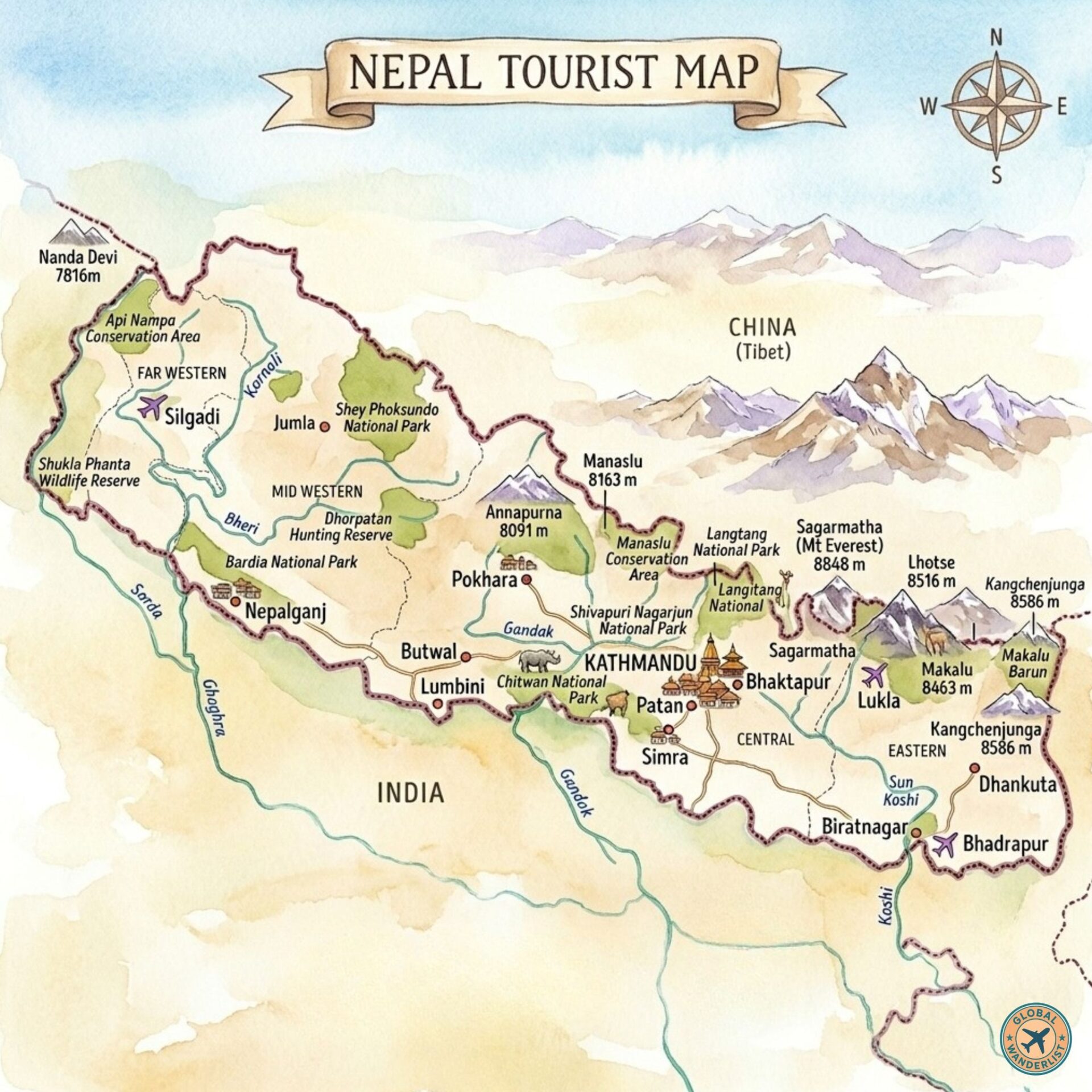
Nepal’s geography moves from tropical lowland jungle to the highest mountains on Earth within a remarkably short distance, and that dramatic shift defines how most trips get planned. The country splits roughly into the Terai lowlands, the Kathmandu Valley and central hills, and the Himalayan trekking regions further north. Understanding what each area actually offers makes it far easier to build a realistic itinerary.
This guide walks through Nepal’s major tourist regions, following the natural flow most travelers use when planning a route. Below is a region-by-region breakdown, including what to see and practical tips for timing your visit.
Region Overview
| Region | Key Areas | Best Known For |
| Kathmandu Valley | Kathmandu, Bhaktapur, Patan | Temple squares, Newari architecture |
| Western Hills | Pokhara, Annapurna Region | Lake views, accessible trekking |
| Eastern Himalaya | Everest Region, Kangchenjunga | High-altitude trekking, Sherpa culture |
| Northern Trekking Regions | Langtang, Manaslu, Upper Mustang | Remote treks, restricted areas |
| Terai Lowlands | Chitwan, Lumbini, Janakpur | Wildlife, pilgrimage sites |
| Far and Mid-Western Nepal | Rara Lake, Bardia National Park | Remote wilderness, fewer crowds |
Each of these regions could easily fill a standalone trip. Below is a closer look at what makes each one worth visiting.
The Kathmandu Valley
The Kathmandu Valley anchors nearly every Nepal itinerary, home to the capital city along with the neighboring historic towns of Bhaktapur and Patan. Each of the valley’s three main cities developed its own distinct architectural style during centuries of competing Newari kingdoms, resulting in an unusually dense concentration of temple squares and palaces within a small geographic area.
What to See in the Kathmandu Valley
- Visit Kathmandu Durbar Square, Bhaktapur Durbar Square, and Patan Durbar Square, each offering a distinctly different flavor of Newari architecture.
- Explore Swayambhunath and Boudhanath, two of the valley’s most significant Buddhist sites.
- Walk through Pashupatinath Temple, one of the holiest Hindu sites in the world, along the sacred Bagmati River.
Best Time to Visit
- Travel between September and November or March and May for the clearest skies and most comfortable temperatures.
- Avoid the monsoon season between June and August, when heavy rains can disrupt sightseeing.
- Visit temple squares early in the morning to avoid both crowds and the stronger midday sun.
The Western Hills: Pokhara and Annapurna
Pokhara serves as the gateway to western Nepal’s hill country and the Annapurna trekking region, set beside Phewa Lake with mountain views rising directly behind the city. This region offers some of the most accessible Himalayan scenery in the country, ranging from short day hikes to multi-week treks around the full Annapurna Circuit.
What to See in the Western Hills
- Take a boat ride on Phewa Lake, with the World Peace Pagoda visible on the opposite shore.
- Watch sunrise from Sarangkot, one of Nepal’s most celebrated and accessible Himalayan viewpoints.
- Trek into the Annapurna foothills, ranging from a short two-day village hike to the multi-week Annapurna Circuit.
Best Time to Visit
- Visit between October and November or March and April, the two peak trekking seasons for clear mountain views.
- Avoid the monsoon season between June and August, when trails can become slippery and views obscured by cloud cover.
- Book Annapurna trekking permits and guides in advance during peak season, since demand rises significantly in October and November.
The Eastern Himalaya: Everest and Kangchenjunga
Eastern Nepal is home to the world’s most famous trekking destination, the route to Everest Base Camp, along with the significantly less visited Kangchenjunga region near the border with India and Tibet. This area demands serious physical preparation and proper acclimatization, given the extreme altitudes involved.
What to See in the Eastern Himalaya
- Trek toward Everest Base Camp, passing through Namche Bazaar and Sherpa villages along the way.
- Explore the Kangchenjunga region for a far less crowded alternative, with equally dramatic high-altitude scenery.
- Visit Tengboche Monastery along the Everest route, one of the most significant Buddhist monasteries in the Khumbu region.
Best Time to Visit
- Trek between March and May or September and November, avoiding both monsoon rains and the coldest winter months.
- Allow extra acclimatization days regardless of season, since altitude sickness risk remains significant on any Everest region trek.
- Book flights to Lukla, the main gateway airstrip for the Everest region, well in advance given frequent weather-related delays.
Northern Trekking Regions: Langtang, Manaslu, and Upper Mustang
North of Kathmandu, several less crowded but equally dramatic trekking regions offer alternatives to the busier Everest and Annapurna routes. Langtang sits closest to the capital, making it accessible for shorter trips, while Manaslu and Upper Mustang require restricted area permits given their proximity to the Tibetan border.
What to See in the Northern Trekking Regions
- Trek through Langtang Valley for dramatic mountain scenery within a shorter overall route than Everest or Annapurna.
- Circle the Manaslu Conservation Area, a quieter alternative circuit gaining popularity among experienced trekkers.
- Visit Upper Mustang’s walled former capital, Lo Manthang, reflecting a distinctly Tibetan cultural influence.
Best Time to Visit
- Visit Langtang between March and May or October and November, similar to the timing for Everest and Annapurna.
- Consider Upper Mustang during the summer monsoon months, since this rain-shadow region stays relatively dry even when the rest of Nepal is wet.
- Arrange restricted area permits well in advance through a registered trekking agency for both Manaslu and Upper Mustang.
The Terai Lowlands
South of the mountains, Nepal’s Terai region offers a completely different landscape, flat and tropical, supporting significant wildlife populations and important pilgrimage sites. Chitwan National Park anchors the region’s wildlife tourism, while Lumbini and Janakpur draw religious pilgrims from across South Asia.
What to See in the Terai Lowlands
- Take a jungle safari in Chitwan National Park, with strong chances of spotting one-horned rhinos and a wide range of birdlife.
- Visit Lumbini, recognized as the birthplace of the Buddha and home to temples built by Buddhist nations worldwide.
- Explore Janakpur’s Janaki Mandir, a significant Hindu pilgrimage site tied to the Ramayana.
Best Time to Visit
- Visit between October and March, when temperatures in the lowland Terai are noticeably more comfortable than the hot, humid summer months.
- Avoid April through June if possible, since Terai temperatures can climb uncomfortably high during this period.
- Book Chitwan safaris in advance during peak season, since availability can be limited during the cooler winter months.
Far and Mid-Western Nepal
Nepal’s far western and mid-western regions remain the least visited by international tourists, offering genuine wilderness and a slower pace compared to the busier central and eastern trekking hubs. Rara Lake and Bardia National Park anchor this region’s appeal, both requiring more effort to reach but rewarding travelers with significantly fewer crowds.
What to See in Far and Mid-Western Nepal
- Trek or fly to Rara Lake, Nepal’s largest lake, set within a remote and largely untouched national park.
- Visit Bardia National Park for wildlife viewing, including tigers, in a far quieter setting than Chitwan.
- Explore the Shey Phoksundo National Park region for dramatic high-altitude lake scenery well off the standard tourist circuit.
Best Time to Visit
- Visit between October and April for the most comfortable and reliable weather across this region.
- Allow extra travel time and flexibility, since infrastructure and transport connections remain more limited than in central Nepal.
- Book domestic flights into this region well ahead, since services are less frequent than routes to Pokhara or Lukla.
Final Thoughts
Nepal’s tourist map reflects a country where dramatic elevation changes create an unusually wide range of experiences within a compact area. From the Kathmandu Valley’s temple squares to Everest’s high-altitude trails to Chitwan’s jungle wildlife, each region offers something distinct enough to justify its own dedicated time. Match your route to the season and trekking ambition that suits you, and Nepal’s extraordinary geographic range becomes the trip’s greatest strength.