
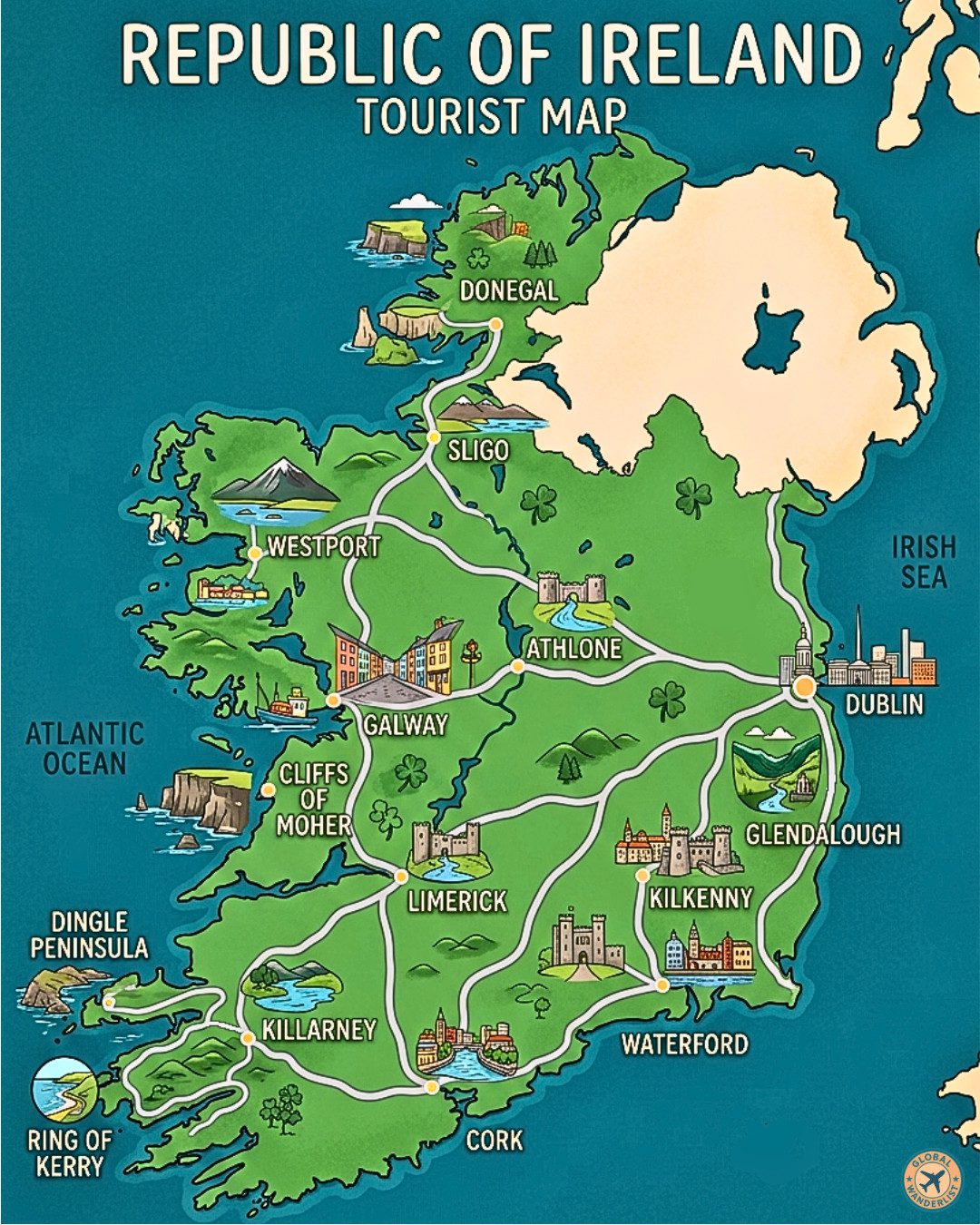
Ireland packs an astonishing amount of scenery, history, and culture into a small island. Rugged Atlantic cliffs give way to medieval castles, lively cities, and quiet monastic ruins within a single day’s drive. Few countries let travelers move between wild coastline and centuries-old heritage so easily.
The Republic of Ireland rewards both first-time visitors and repeat travelers. Its cities blend Georgian architecture with modern energy, while its countryside holds ancient stone forts and green valleys largely untouched by time. Music, storytelling, and warm hospitality tie every stop together, making the whole country feel like one connected story worth experiencing firsthand.
Trip Summary
| Place | Category | Best Known For | Recommended Visit Duration |
|---|---|---|---|
| Dublin | Capital City | Georgian architecture, Guinness Storehouse, Trinity College | 2-3 days |
| Galway | Coastal City | Bohemian culture, traditional music, Latin Quarter | 1-2 days |
| Cork | City | Food culture, English Market, harbor history | 1-2 days |
| Waterford | Historic City | Viking heritage, crystal craftsmanship | 1 day |
| Kilkenny | Medieval City | Kilkenny Castle, medieval mile | 1 day |
| Limerick | City | King John’s Castle, riverside history | 1 day |
| Athlone | Midlands Town | Athlone Castle, River Shannon | Half day |
| Sligo | Coastal Town | Yeats heritage, surfing beaches | 1 day |
| Donegal | Coastal Town | Donegal Castle, dramatic coastline | 1-2 days |
| Westport | Coastal Town | Croagh Patrick, Clew Bay views | 1 day |
| Killarney | Gateway Town | National park, lakes, jaunting cars | 2 days |
| Dingle Peninsula | Peninsula | Slea Head Drive, Irish-speaking culture | 1-2 days |
| Ring of Kerry | Scenic Drive | Coastal panoramas, ancient forts | 1 day |
| Cliffs of Moher | Natural Landmark | Dramatic sea cliffs, Atlantic views | Half day |
| Glendalough | Monastic Site | Sixth-century ruins, glacial lakes | Half day |
Dublin
Dublin anchors any Irish itinerary, blending centuries of history with a modern, walkable core. The city grew from a Viking settlement into a Georgian capital, and much of that layered past survives in its architecture. Trinity College’s cobbled quadrangles sit minutes from busy shopping streets and riverside pubs.
Literature runs deep here, with Dublin producing four Nobel laureates in the category. The city also serves as an easy base for day trips to nearby coastal towns and historic sites. Most major attractions cluster within a comfortable walking distance of each other.
What to See in Dublin
- Trinity College and the Book of Kells: This illuminated ninth-century manuscript sits inside one of Ireland’s oldest universities. The Long Room library above it holds thousands of ancient volumes and remains one of the most photographed rooms in the country.
- Guinness Storehouse: This seven-story attraction traces the history of Ireland’s most famous stout. The top-floor Gravity Bar rewards visitors with a full panoramic view over the city.
- Temple Bar: This cobblestone district buzzes with traditional music, art galleries, and lively pubs. It gets crowded on weekends, so an early evening visit offers a calmer experience.
- Dublin Castle: Once the seat of British rule in Ireland, this complex now hosts state functions and public tours. Its state apartments and Chapel Royal reveal centuries of political history.
- St. Stephen’s Green: This landscaped park offers a quiet break from the city center’s bustle. Locals often picnic here on sunny afternoons.
Galway
Galway carries a bohemian energy that feels distinct from Ireland’s other cities. Its narrow medieval streets host buskers, art studios, and some of the country’s best traditional music sessions. The city sits where the River Corrib meets Galway Bay, giving it a natural, scenic backdrop.
Founded as a walled Norman town, Galway later grew into a major trading port. Today it serves as the gateway to Connemara and the Aran Islands, making it a favorite base for exploring Ireland’s rugged west coast.
What to See in Galway
- Latin Quarter: This pedestrian district holds colorful shopfronts, live music, and independent cafes. It is the beating heart of Galway’s social life, day and night.
- Spanish Arch: This sixteenth-century archway once protected the city’s harbor from raiders. It now marks a popular riverside meeting point near the city center.
- Galway Cathedral: Completed in 1965, this striking building blends Renaissance and Romanesque styles. Its large dome dominates the skyline near the river.
- Salthill Promenade: This seaside walk follows Galway Bay toward the Atlantic. Locals famously kick the promenade wall for luck before turning back.
- Aran Islands day trip: A short ferry ride leads to these remote islands, known for ancient stone forts and Irish-speaking communities. Dun Aengus fort offers a dramatic cliff-edge setting.
Cork
Cork holds the title of Ireland’s second-largest city, though locals often call it the “real capital” with a wink. Its food scene has earned national recognition, anchored by a market that has fed the city for over two centuries. Cork’s hilly streets and colorful buildings give it a character distinct from Dublin’s grander avenues.
The city sits on the River Lee, which splits into two channels running through the center. This layout gives Cork several bridges and a genuinely walkable island-like core.
What to See in Cork
- English Market: This covered Victorian market has sold fresh food since 1788. Stalls offer everything from artisan cheese to fresh seafood, making it a favorite lunch stop.
- St. Fin Barre’s Cathedral: This Gothic Revival cathedral features intricate stonework and vivid stained glass. Its three spires make it visible from much of the city.
- Cork City Gaol: This restored nineteenth-century prison offers audio-guided tours through its original cells. It gives visitors a vivid sense of Victorian-era justice.
- Shandon Bells: Visitors can climb this bell tower and ring the bells themselves. The tower’s mismatched red and white sides reflect two different local stone sources.
- Elizabeth Fort: This star-shaped fort dates to the early seventeenth century. Its walls offer sweeping views over Cork’s rooftops.
Waterford
Waterford holds the distinction of being Ireland’s oldest city, founded by Viking settlers in 914 AD. Its compact historic core, known as the Viking Triangle, still follows the original street layout. Few Irish cities preserve this much tangible evidence of their founding era.
The city is equally known for its crystal, a craft tradition dating back to 1783. Waterford’s blend of ancient walls and skilled glassmaking makes it a distinctive stop on the southeast coast.
What to See in Waterford
- Reginald’s Tower: This thousand-year-old Viking tower is one of the oldest urban civic buildings in Ireland. It now houses exhibits on the city’s founding centuries.
- House of Waterford Crystal: Visitors can watch master craftsmen cut and blow glass by hand. The factory floor tour reveals techniques passed down through generations.
- Waterford Museum of Treasures: This museum walks through thirteen centuries of local history. Highlights include Viking artifacts and medieval charters.
- Christ Church Cathedral: This Georgian cathedral replaced an earlier medieval structure on the same site. Its elegant interior contrasts with the rougher Viking-era buildings nearby.
- Viking Triangle walking tour: A self-guided walk connects the city’s key historic sites. Bronze plaques in the pavement mark the original medieval street pattern.
Kilkenny
Kilkenny’s medieval character remains remarkably intact, earning it a reputation as Ireland’s best-preserved inland city. Narrow laneways, called slips, connect its main streets to hidden courtyards and old trade routes. The city grew around its castle and cathedral, both of which still dominate the skyline.
Beyond history, Kilkenny has built a modern reputation for craft beer and local food. Its compact size makes it easy to explore entirely on foot in a single day.
What to See in Kilkenny
- Kilkenny Castle: This Norman-era castle once belonged to the powerful Butler family for nearly 600 years. Its restored rooms and riverside gardens make for a full afternoon visit.
- Medieval Mile: This walking route connects the castle to St. Canice’s Cathedral. Historic buildings line nearly every step of the path.
- St. Canice’s Cathedral: This thirteenth-century cathedral includes a round tower visitors can climb. The views over Kilkenny’s rooftops make the climb worthwhile.
- Kilkenny Design Centre: This craft complex showcases work from Irish designers and artisans. It sits directly across from the castle entrance.
- Smithwick’s Experience: This former brewery site tells the story of Ireland’s oldest beer brand. Interactive exhibits trace over 300 years of brewing history.
Limerick
Limerick sits along the River Shannon, Ireland’s longest river, at a point where it has controlled trade routes for centuries. The city’s Norman castle still stands guard over the riverbank, a reminder of its strategic medieval importance. Limerick has worked hard in recent years to reshape its reputation through cultural investment and riverside redevelopment.
Its King’s Island district holds some of the city’s oldest architecture. Limerick also makes a practical base for exploring the nearby Shannon region and Clare countryside.
What to See in Limerick
- King John’s Castle: This thirteenth-century fortress overlooks the Shannon and houses interactive exhibits on Norman Ireland. Archaeological excavations remain visible beneath the courtyard.
- St. Mary’s Cathedral: This Romanesque cathedral is Limerick’s oldest building still in continuous use. Its carved oak choir stalls date back over 500 years.
- Hunt Museum: This museum holds an eclectic private art and antiquities collection. Pieces range from Bronze Age artifacts to works attributed to Picasso.
- Milk Market: This lively weekend market sells local food, crafts, and produce. It captures Limerick’s community spirit better than any single landmark.
- Thomond Park: This stadium is the spiritual home of Munster rugby. Match days bring an electric atmosphere even to casual visitors.
Athlone
Athlone sits almost exactly at the geographic center of Ireland, straddling the River Shannon. This central position made it a key crossing point and military stronghold throughout Irish history. The town’s castle has watched over the river since the thirteenth century.
Athlone works well as a midway stop between Dublin and Galway. Its riverside walks and relaxed pace offer a pleasant break from longer road trips.
What to See in Athlone
- Athlone Castle: This riverside fortress houses exhibits on the 1691 Siege of Athlone. Interactive displays bring one of Ireland’s key historic battles to life.
- River Shannon walks: Paths along both riverbanks offer easy, scenic walking. Boat trips from town also explore nearby Lough Ree.
- Sean’s Bar: This pub claims recognition as one of the oldest in Ireland, with records dating to 900 AD. Original wattle-and-daub wall sections remain visible inside.
- Luan Gallery: This contemporary art gallery sits directly on the riverbank. Rotating exhibitions feature both Irish and international artists.
- Lough Ree cruises: Boat tours explore this large lake just north of town. Monastic island ruins dot the water along several routes.
Sligo
Sligo carries deep literary weight as the spiritual home of poet William Butler Yeats. He spent childhood summers here, and the surrounding landscape shaped much of his imagery and imagination. Yeats is buried nearby at Drumcliffe, beneath the dramatic outline of Benbulben mountain.
Beyond its literary ties, Sligo has become a genuine surfing destination. Its Atlantic beaches draw both experienced surfers and complete beginners.
What to See in Sligo
- Yeats Memorial Building: This cultural center celebrates the poet’s life and work through exhibits and events. It anchors the town’s strong literary identity.
- Benbulben mountain: This distinctive flat-topped mountain rises dramatically over the surrounding countryside. It inspired several of Yeats’s most famous poems.
- Strandhill Beach: This popular surfing beach also offers seaweed baths for a different kind of relaxation. Sunset views here draw photographers year-round.
- Sligo Abbey: These thirteenth-century Dominican friary ruins sit right in the town center. Carved stone details survive remarkably well for their age.
- Carrowmore Megalithic Cemetery: This site holds one of Ireland’s largest collections of megalithic tombs. Some structures here predate the pyramids of Egypt.
Donegal
Donegal sits in Ireland’s rugged northwest, known for some of the country’s most dramatic coastal scenery. Its remote location has kept it less crowded than southern tourist routes, rewarding travelers willing to make the trip. The town itself grew around a Norman castle and a former Franciscan friary.
The wider county holds Slieve League, among Europe’s highest sea cliffs. Traditional Donegal tweed remains a point of local pride and craftsmanship.
What to See in Donegal
- Donegal Castle: This restored fifteenth-century castle combines Gaelic and Jacobean architectural styles. Its riverside setting makes it a striking photo stop.
- Slieve League cliffs: These sea cliffs rise even higher than the Cliffs of Moher, though they draw far fewer visitors. The One Man’s Pass trail offers a thrilling, exposed viewpoint for confident hikers.
- Donegal Abbey ruins: These Franciscan friary remains sit along the harbor’s edge. The site holds centuries of religious and political significance.
- The Diamond: This central town square hosts markets and local events. Shops selling handwoven tweed line its surrounding streets.
- Malin Head: Ireland’s northernmost point offers wild, windswept coastal views. It featured as a filming location in recent blockbuster movies.
Westport
Westport stands out as one of Ireland’s few planned towns, laid out in the 1780s with wide tree-lined streets. Its Georgian design gives it a more orderly feel than most Irish towns that grew organically over centuries. The Carrowbeg River runs directly through the town center, crossed by several stone bridges.
Westport sits beneath Croagh Patrick, Ireland’s holy mountain, and beside the scenic waters of Clew Bay. This combination of heritage, faith, and scenery has made it a consistent favorite among visitors.
What to See in Westport
- Croagh Patrick: This pilgrimage mountain draws thousands of climbers each year, especially on the last Sunday in July. Some pilgrims still climb barefoot as an act of devotion.
- Westport House: This historic estate combines a stately home with parkland and gardens. Its grounds once belonged to descendants of the legendary pirate queen Grace O’Malley.
- Clew Bay: This scenic bay reportedly holds an island for every day of the year. Boat tours offer close views of its many small, green islets.
- Great Western Greenway: This traffic-free cycling route follows an old railway line along the coast. It stretches over 40 kilometers through some of Mayo’s finest scenery.
- Westport town center: Colorful shopfronts and traditional pubs line the riverside streets. Live music sessions here run late into most summer nights.
Killarney
Killarney serves as the gateway to one of Ireland’s most beloved national parks. Its lakes, mountains, and old-growth oak woods have attracted visitors since the eighteenth century, well before mass tourism existed. Horse-drawn jaunting cars still carry visitors through the park, a tradition that has continued for generations.
The town itself stays busy year-round, filled with pubs, restaurants, and shops catering to travelers. It makes an ideal base for exploring both the national park and the wider Ring of Kerry route.
What to See in Killarney
- Killarney National Park: This park protects Ireland’s only native red deer herd along with ancient woodland. Its three lakes offer boating, walking, and cycling options for every fitness level.
- Ross Castle: This fifteenth-century castle sits directly on the shore of Lough Leane. Boat trips to nearby islands depart right from its lakeside grounds.
- Muckross House and Gardens: This Victorian mansion sits within beautifully landscaped gardens. Traditional farm demonstrations nearby show rural life from a century ago.
- Gap of Dunloe: This narrow mountain pass connects two valleys through dramatic glacial scenery. Many visitors walk or cycle through rather than drive.
- Torc Waterfall: This accessible waterfall sits just a short walk from the main road. It makes an easy stop for travelers short on time.
Dingle Peninsula
The Dingle Peninsula juts into the Atlantic as one of Ireland’s most scenic and culturally rich regions. It remains an official Irish-speaking area, where the language survives as a living, everyday tongue. Ancient stone forts and early Christian sites dot the landscape alongside working fishing harbors.
Dingle town itself offers a colorful, walkable base for exploring the wider peninsula. Its harbor has drawn attention partly thanks to Fungie, a wild dolphin that lived here for decades and became a local legend.
What to See in Dingle Peninsula
- Slea Head Drive: This circular coastal route passes ancient beehive huts, sea cliffs, and beaches. It ranks among Ireland’s most scenic drives, rivaling routes far more famous.
- Dingle town: Brightly painted shopfronts and traditional pubs line the harbor streets. Live traditional music sessions happen most nights of the week.
- Gallarus Oratory: This dry-stone church has survived intact for over a thousand years without mortar. Its perfect construction still puzzles modern engineers.
- Blasket Islands: These abandoned islands once housed a thriving Irish-speaking community. A visitor center on the mainland tells their story in detail.
- Inch Beach: This long, sandy beach stretches across a natural sand spit. It has appeared in several major films thanks to its dramatic backdrop.
Ring of Kerry
The Ring of Kerry stands as one of the world’s great scenic drives, circling the Iveragh Peninsula for roughly 179 kilometers. The route passes through small villages, past ancient stone forts, and along dramatic coastal cliffs. Most visitors drive it counterclockwise, following the same direction as tour buses to avoid narrow-road conflicts.
The drive typically takes a full day when factoring in stops. Weather here shifts quickly, so flexibility matters more than a strict schedule.
What to See on the Ring of Kerry
- Staigue Fort: This Iron Age stone fort remains remarkably intact after nearly 2,500 years. Its thick circular walls once protected an ancient local chieftain.
- Kerry Cliffs: These lesser-known cliffs rival the Cliffs of Moher in height and drama, with far smaller crowds. Views extend out to the Skellig Islands on clear days.
- Skellig Ring: This shorter detour loop offers views toward the Skellig Islands, famous for their appearance in recent film franchises. The narrow roads here suit smaller vehicles best.
- Ladies View: This scenic overlook takes its name from Queen Victoria’s traveling companions, who admired it during an 1861 visit. The lakes below stretch toward Killarney National Park.
- Kenmare town: This colorful town marks a common starting or ending point for the drive. Its stone circle and craft shops make a worthwhile stop.
Cliffs of Moher
The Cliffs of Moher rank among Ireland’s most photographed natural landmarks, rising 214 meters above the crashing Atlantic. They stretch for roughly 8 kilometers along the County Clare coastline, formed from layers of shale and sandstone over 300 million years old. On clear days, views extend to the Aran Islands and the mountains of Connemara.
An eco-friendly visitor center sits built into the hillside to minimize its visual impact on the landscape. From here, marked paths lead toward O’Brien’s Tower, a nineteenth-century viewpoint near the cliffs’ highest section.
What to See at Cliffs of Moher
- O’Brien’s Tower: Built in 1835, this stone tower offers the best elevated view of the cliffs. Climbing to the top costs a small additional fee.
- Cliffs of Moher Visitor Experience: This underground center covers the geology, wildlife, and history of the cliffs. Interactive exhibits suit both children and adults.
- Hag’s Head: This southern viewpoint offers a quieter perspective away from the main crowds. The rock formation here resembles a seated figure, giving the headland its name.
- Doolin to Liscannor coastal walk: This full trail covers around 20 kilometers along the cliff edge. Shorter sections work well for visitors wanting a taste without the full commitment.
- Puffin viewing season: Between April and July, puffins nest along the cliff ledges. Binoculars help spot them from the designated viewing platforms.
Glendalough
Glendalough holds one of Ireland’s most important early Christian monastic sites, founded by Saint Kevin in the sixth century. The name means “valley of two lakes,” an apt description of its glacial setting deep in the Wicklow Mountains. Ruins here include a well-preserved round tower, several church buildings, and a scattering of ancient gravestones.
The surrounding valley offers walking trails ranging from easy lakeside strolls to more demanding mountain routes. Glendalough sits close enough to Dublin for an easy day trip, though an overnight stay allows for deeper exploration.
What to See in Glendalough
- Round Tower: This thousand-year-old tower stands over 30 meters tall and once served as both a bell tower and a refuge during raids. It remains one of the best-preserved examples in Ireland.
- Upper and Lower Lake: These twin glacial lakes anchor the valley’s scenery. Walking trails circle both, offering different perspectives on the surrounding mountains.
- St. Kevin’s Church: This small stone church features a distinctive round bell tower built into its roofline. Locals nicknamed it “St. Kevin’s Kitchen” due to its chimney-like appearance.
- Reefert Church: This quieter ruin sits a short walk from the main monastic site. Fewer visitors make it here, offering a more peaceful atmosphere.
- Spinc Trail: This more strenuous hiking route climbs above the valley for sweeping panoramic views. Wooden boardwalks protect the fragile boglands along the way.
Exploring Beyond the Main Stops
Ireland rewards travelers who wander past its most famous landmarks. Small villages, quiet coastal roads, and unmarked ruins often hold as much character as the sites drawing the biggest crowds. A slower pace, especially in the west and northwest, reveals a side of the country that guidebooks rarely capture in full.
Public buses and trains connect major towns, though renting a car gives far more flexibility for reaching remote coastal spots. Weather changes quickly across the island, so packing layers and rain gear matters regardless of season. Whether following the well-worn path or venturing further off it, Ireland’s landscape and history reward every extra mile traveled.