
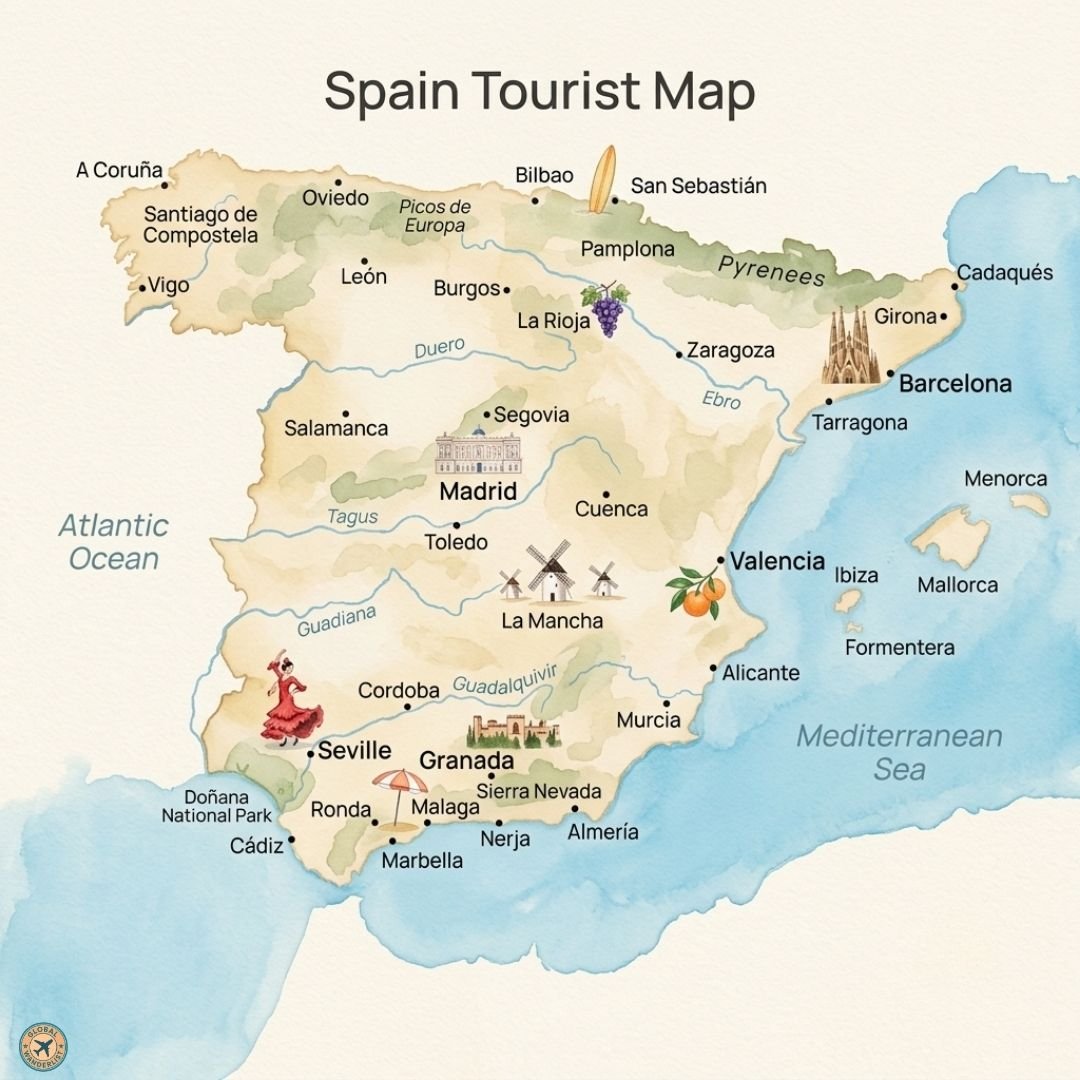
Spain packs more variety into one country than almost anywhere in Europe. Snow-capped mountains sit a few hours from Mediterranean beaches. Medieval cities neighbor futuristic architecture and endless vineyards.
Few countries offer this range of culture, food, and scenery. You can hike the Pyrenees in the morning and sip Rioja wine by evening. Every region has its own language, cuisine, and personality.
This guide walks through Spain’s most iconic destinations, region by region. Use it to plan a first trip or to fill gaps in a well-traveled itinerary.
Spain Destination Quick Reference
| Place | Category | Best Known For | Recommended Visit Duration |
|---|---|---|---|
| A Coruña | Coastal city | Atlantic beaches, Tower of Hercules | 1-2 days |
| Santiago de Compostela | Pilgrimage city | Camino de Santiago finish line | 1-2 days |
| Vigo | Port city | Seafood, Cíes Islands access | 1 day |
| Oviedo | Historic city | Pre-Romanesque architecture | 1-2 days |
| Picos de Europa | Mountain range | Hiking, dramatic peaks | 2-3 days |
| Bilbao | Modern city | Guggenheim Museum | 1-2 days |
| San Sebastián | Coastal city | Beaches, Basque cuisine | 2-3 days |
| Pamplona | Historic city | Running of the Bulls | 1-2 days |
| Pyrenees | Mountain range | Alpine scenery, skiing | 2-4 days |
| Cadaqués | Coastal town | Whitewashed charm, Dalí ties | 1 day |
| Girona | Historic city | Medieval old town, Jewish quarter | 1-2 days |
| Barcelona | Major city | Gaudí architecture, beaches | 3-4 days |
| Tarragona | Historic city | Roman ruins | 1 day |
| León | Historic city | Gothic cathedral | 1 day |
| Burgos | Historic city | Gothic cathedral, Camino stop | 1 day |
| La Rioja | Wine region | Wine tasting, vineyards | 2 days |
| Zaragoza | Historic city | Basilica del Pilar | 1-2 days |
| Salamanca | University city | Plaza Mayor, architecture | 1-2 days |
| Segovia | Historic city | Roman aqueduct, castle | 1 day |
| Madrid | Capital city | Museums, nightlife, parks | 3-4 days |
| Toledo | Historic city | Medieval streets, three cultures | 1 day |
| Cuenca | Historic city | Hanging houses | 1 day |
| La Mancha | Rural region | Windmills, Don Quixote | 1 day |
| Valencia | Major city | City of Arts and Sciences, paella | 2-3 days |
| Menorca | Balearic island | Quiet beaches, nature | 3-4 days |
| Ibiza | Balearic island | Nightlife, coves | 3-4 days |
| Mallorca | Balearic island | Beaches, mountains | 4-5 days |
| Formentera | Balearic island | Turquoise water, calm pace | 2-3 days |
| Alicante | Coastal city | Beaches, castle views | 1-2 days |
| Murcia | Regional city | Baroque architecture | 1 day |
| Córdoba | Historic city | Mezquita | 1-2 days |
| Granada | Historic city | Alhambra palace | 2 days |
| Seville | Major city | Flamenco, Real Alcázar | 2-3 days |
| Ronda | Mountain town | Dramatic gorge, historic bridge | 1 day |
| Málaga | Coastal city | Picasso Museum, beaches | 2 days |
| Nerja | Coastal town | Caves, coastal walkway | 1 day |
| Almería | Coastal city | Desert scenery, film history | 1 day |
| Marbella | Coastal town | Luxury resorts, old town | 1-2 days |
| Cádiz | Coastal city | Ancient history, beaches | 1-2 days |
| Doñana National Park | Nature reserve | Wildlife, wetlands | 1 day |
| Sierra Nevada | Mountain range | Skiing, highest peaks | 1-2 days |
Visit durations assume a first-time traveler with moderate interest in each destination.
A Coruña: Atlantic Breezes and Ancient Lighthouses
A Coruña sits on Galicia’s rugged Atlantic coast. Strong maritime winds and fresh seafood define daily life here. The city blends fishing traditions with elegant glass-fronted buildings.
Its most famous landmark has guided sailors for nearly two thousand years. Locals take pride in a laid-back, coastal identity distinct from inland Spain.
What to See in A Coruña
- The Tower of Hercules is the oldest working Roman lighthouse in the world, still guiding ships today.
- Riazor Beach sits right in the city center, ideal for a quick swim between sightseeing stops.
- The old town’s glass balconies give A Coruña its nickname, the City of Glass.
- Domus Science Museum offers interactive exhibits perfect for families with curious kids.
Santiago de Compostela: The Pilgrim’s Final Destination
Santiago de Compostela marks the end of the Camino de Santiago pilgrimage route. Walkers arrive here after weeks on the trail. The city’s cathedral holds the remains of Saint James, according to tradition.
Granite streets and baroque facades give the old town a solemn beauty. Even non-pilgrims feel the emotional weight of this place.
What to See in Santiago de Compostela
- Santiago Cathedral anchors the city with its ornate baroque facade and famous incense ceremony.
- Praza do Obradoiro fills with exhausted, joyful pilgrims completing their journey each afternoon.
- The Museum of Pilgrimage explains centuries of Camino history and tradition.
- Mercado de Abastos showcases fresh Galician seafood and produce in a lively market setting.
Vigo: Galicia’s Working Port with Island Access
Vigo is Galicia’s largest city, built around a busy fishing harbor. It feels more industrial than its neighbors, but rewards visitors with excellent seafood. Ferries here connect to one of Spain’s most beautiful protected islands.
The city center mixes granite buildings with a modern waterfront. Vigo works well as a quick stop or a launch point for island exploration.
What to See in Vigo
- The Cíes Islands offer pristine beaches often compared to the Caribbean, reachable by short ferry.
- Casco Vello, the old quarter, is packed with oyster bars serving catch straight from the bay.
- Monte do Castro park offers panoramic harbor views and Iron Age ruins.
- Vigo’s modern waterfront promenade makes for an easy evening stroll.
Oviedo: Pre-Romanesque Treasures in the Green North
Oviedo sits inland in Asturias, surrounded by green hills and mountains. It predates much of Spain’s later Islamic influence, preserving unique ninth-century architecture. The city feels clean, compact, and walkable.
Asturian cider culture runs deep here. Locals pour it from shoulder height into wide glasses, a tradition worth watching at least once.
What to See in Oviedo
- Santa María del Naranco showcases rare pre-Romanesque architecture found almost nowhere else in Europe.
- Oviedo Cathedral houses the Holy Chamber, a treasury of medieval relics.
- Calle Gascona, known as cider boulevard, is lined with traditional Asturian taverns.
- Bronze statues scattered through downtown add playful character to daily walks.
Picos de Europa: Dramatic Peaks Between Three Regions
The Picos de Europa straddle Asturias, Cantabria, and Castile and León. Sharp limestone peaks rise steeply from green valleys. This range offers some of northern Spain’s most dramatic hiking terrain.
Small mountain villages dot the lower slopes. Weather changes quickly here, so proper gear matters even in summer.
What to See in Picos de Europa
- Naranjo de Bulnes is a striking limestone peak that draws serious climbers from across Europe.
- Lagos de Covadonga offers glacial lakes framed by jagged mountain scenery.
- The Cares Gorge trail cuts through dramatic cliffs along a historic irrigation channel.
- Fuente Dé’s cable car lifts visitors nearly 3,000 feet in under four minutes.
Bilbao: From Industrial City to Architectural Icon
Bilbao transformed dramatically over the past three decades. Once known for steel and shipping, it now draws travelers for cutting-edge architecture. The Nervión River runs through its revitalized center.
Basque culture and cuisine remain strong here despite the modern makeover. Pintxo bars fill every evening with locals and visitors alike.
What to See in Bilbao
- The Guggenheim Museum Bilbao features Frank Gehry’s titanium-clad design, a landmark of modern architecture.
- Casco Viejo, the old town, offers classic pintxo bars along seven historic streets.
- La Ribera Market sits along the riverbank, one of Europe’s largest covered markets.
- Mount Artxanda’s funicular delivers sweeping views over the entire city.
San Sebastián: Basque Beaches and Culinary Excellence
San Sebastián curves around a stunning bay lined with golden sand. Belle Époque buildings frame the waterfront. Few Spanish cities pair scenic beauty with such serious food culture.
This city holds more Michelin stars per capita than almost anywhere on earth. Pintxo hopping here counts as a legitimate evening activity.
What to See in San Sebastián
- La Concha Beach is often ranked among Europe’s finest urban beaches, framed by green hills.
- Monte Igueldo offers panoramic bay views, reached by a vintage funicular railway.
- Parte Vieja, the old quarter, packs dozens of pintxo bars into a few compact blocks.
- The San Telmo Museum explores Basque history and identity in a renovated monastery.
Pamplona: History Beyond the Bull Run
Pamplona is best known internationally for its July bull-running festival. Outside those chaotic days, it offers a peaceful, walkable old town. Sturdy medieval walls still ring the historic center.
Navarra’s capital blends Basque and Spanish influences. Green parks and quiet plazas balance the city’s wilder reputation.
What to See in Pamplona
- The old town walls offer scenic walking paths with views over the surrounding countryside.
- Plaza del Castillo serves as the social heart of the city, ringed by cafes.
- Pamplona Cathedral combines Gothic architecture with a striking neoclassical facade.
- The Running of the Bulls route can be walked year-round, minus the actual bulls.
The Pyrenees: Spain’s Alpine Frontier
The Pyrenees form a dramatic natural border between Spain and France. Jagged peaks, glacial lakes, and remote villages define this mountain range. Skiing dominates winter, while hiking takes over in summer.
Aragón and Catalonia both claim stunning sections of these mountains. Ordesa National Park ranks among Spain’s most spectacular protected areas.
What to See in the Pyrenees
- Ordesa y Monte Perdido National Park offers canyon trails rivaling anything in the Alps.
- Aigüestortes National Park features hundreds of glacial lakes across a compact area.
- Baqueira-Beret draws skiers each winter with reliable snow and long runs.
- Traditional stone villages like Ainsa offer a quiet base for exploring the range.
Cadaqués: A Whitewashed Village That Inspired Dalí
Cadaqués sits on a remote stretch of Catalonia’s Costa Brava. Winding lanes and whitewashed houses tumble toward a rocky bay. Salvador Dalí lived and worked nearby for much of his life.
The town’s isolation kept it free from heavy development. Artists and writers have long found inspiration in its dramatic coastal light.
What to See in Cadaqués
- The Salvador Dalí House Museum in nearby Portlligat reveals the artist’s eccentric former home.
- Cap de Creus Natural Park offers rugged cliffs and one of Spain’s most dramatic coastlines.
- The town’s whitewashed streets make for some of the Costa Brava’s best photography.
- Small pebble coves around town offer quiet swimming away from crowds.
Girona: Medieval Beauty Along the Onyar River
Girona’s old town rises above the Onyar River in a stack of colorful facades. Narrow medieval streets and a well-preserved Jewish quarter give it deep historical texture. The city gained global fame after appearing in a major television series.
Girona pairs easily with Barcelona as a day trip or standalone stop. Its compact size makes it easy to explore on foot.
What to See in Girona
- The Cathedral of Girona features one of the widest Gothic naves in the world.
- El Call, the historic Jewish quarter, ranks among Europe’s best preserved medieval districts.
- The Arab Baths recreate the atmosphere of medieval bathing culture.
- Colorful riverside houses along the Onyar create one of Catalonia’s most photographed views.
Barcelona: Gaudí’s Playground by the Sea
Barcelona blends beach culture with world-class architecture and design. Antoni Gaudí’s fantastical buildings define much of the skyline. The city balances Catalan identity with cosmopolitan energy.
Wide boulevards connect historic neighborhoods to modern beachfronts. Few cities offer this much variety within a single metro system.
What to See in Barcelona
- The Sagrada Família remains Gaudí’s unfinished masterpiece, still under construction after over a century.
- Park Güell offers mosaic-covered terraces with sweeping views across the city.
- The Gothic Quarter preserves centuries of narrow medieval streets near the waterfront.
- Barceloneta Beach provides easy sand and sea access minutes from downtown.
Tarragona: Rome’s Ancient Foothold in Spain
Tarragona once served as a major Roman provincial capital. Ruins scattered throughout the modern city reveal its ancient importance. A dramatic amphitheater sits directly above the Mediterranean.
The city offers a quieter alternative to nearby Barcelona. History lovers find remarkable value in its well-preserved Roman remains.
What to See in Tarragona
- The Roman Amphitheater overlooks the sea, one of Spain’s most scenic ancient ruins.
- Tarragona Cathedral combines Romanesque and Gothic styles atop a former Roman temple site.
- The Passeig Arqueològic circles part of the ancient Roman walls.
- Platja del Miracle offers a sandy beach within walking distance of the old town.
León: Gothic Grandeur and Camino Heritage
León sits along the Camino de Santiago in northern Castile. Its cathedral houses some of Europe’s finest stained glass. The city retains a relaxed, unhurried pace year-round.
Leonese cuisine and tapas culture rival better-known regions. Free tapas often accompany drink orders here, a local tradition worth seeking out.
What to See in León
- León Cathedral contains over 1,700 square feet of stunning stained glass windows.
- Basílica de San Isidoro houses royal tombs decorated with remarkably preserved medieval frescoes.
- Barrio Húmedo, the old quarter, offers free tapas with nearly every drink order.
- Casa Botines, designed by Gaudí, adds Modernist flair to the historic center.
Burgos: A Gothic Cathedral on the Pilgrim Road
Burgos anchors another major stop along the Camino de Santiago. Its cathedral ranks among Spain’s most elaborate Gothic structures. The city center feels grand despite its moderate size.
El Cid, Spain’s legendary medieval hero, is buried here. History and pilgrimage culture shape much of daily life in Burgos.
What to See in Burgos
- Burgos Cathedral, a UNESCO World Heritage Site, took centuries to complete and shows it.
- The Museum of Human Evolution connects to nearby Atapuerca, a major archaeological site.
- Paseo del Espolón offers a shaded riverside walk popular with locals each evening.
- The Arco de Santa María forms a grand stone gateway into the old town.
La Rioja: Spain’s Premier Wine Country
La Rioja produces some of Spain’s most celebrated red wines. Rolling vineyards stretch across a landscape shaped by the Ebro River. Historic bodegas welcome visitors for tours and tastings.
Small towns throughout the region pair wine culture with excellent, simple cooking. This is a slower, more rural side of northern Spain.
What to See in La Rioja
- Bodega tours across the region offer tastings straight from centuries-old wine cellars.
- Haro’s historic quarter hosts the wild Batalla del Vino wine fight each June.
- The Frank Gehry-designed Marqués de Riscal winery adds striking modern architecture to the countryside.
- San Millán de la Cogolla’s monasteries mark the birthplace of written Spanish.
Zaragoza: A Crossroads Capital on the Ebro
Zaragoza sits roughly midway between Madrid and Barcelona. The city blends Roman, Islamic, and Christian layers of history. Its riverside basilica dominates the skyline for miles.
Zaragoza often gets overlooked by first-time visitors. Those who stop find a confident, underrated city with excellent tapas culture.
What to See in Zaragoza
- The Basilica del Pilar sits dramatically along the Ebro River, one of Spain’s most important religious sites.
- The Aljafería Palace showcases stunning Islamic architecture from the medieval Taifa period.
- El Tubo, the old quarter’s tapas district, packs dozens of bars into narrow alleys.
- Roman ruins scattered downtown reveal the city’s origins as Caesaraugusta.
Salamanca: Golden Stone and Centuries of Scholars
Salamanca centers on one of Europe’s oldest universities. Golden sandstone buildings glow warmly at sunset across the historic center. Students have filled these streets since the thirteenth century.
The city’s main square ranks among Spain’s most beautiful. Nightlife here stays lively thanks to a large student population.
What to See in Salamanca
- Plaza Mayor is widely considered one of Spain’s most stunning baroque squares.
- The University of Salamanca facade hides a famous hidden frog carving students still search for.
- The Old and New Cathedrals stand connected, spanning centuries of architectural style.
- Casa de las Conchas features hundreds of carved stone shells decorating its facade.
Segovia: Roman Engineering Meets Fairy-Tale Architecture
Segovia sits on a rocky plateau in Castile and León. A massive Roman aqueduct still stands at its center, remarkably intact. The city’s castle reportedly inspired a famous animated film design.
Roast suckling pig remains a signature local dish. Segovia makes an easy day trip from Madrid.
What to See in Segovia
- The Roman Aqueduct rises nearly 100 feet, built without mortar almost 2,000 years ago.
- The Alcázar of Segovia features fairy-tale turrets perched dramatically above the countryside.
- Segovia Cathedral, one of Spain’s last Gothic cathedrals, dominates the main square.
- The Jewish Quarter preserves narrow medieval streets near the old city walls.
Madrid: Spain’s Grand Capital
Madrid sits at the geographic heart of Spain, high on a central plateau. The capital offers world-class museums, elegant parks, and legendary nightlife. Its energy runs late into the night, every night.
Wide boulevards connect royal palaces to modern business districts. Madrid rewards visitors who wander beyond the obvious highlights.
What to See in Madrid
- The Prado Museum houses one of the world’s finest collections of European painting.
- Retiro Park offers boating lakes, gardens, and a stunning glass pavilion.
- Plaza Mayor anchors the historic center with centuries of layered architecture.
- The Royal Palace remains Europe’s largest by floor area, still used for state ceremonies.
Toledo: A City Shaped by Three Faiths
Toledo sits on a hilltop above the Tagus River, an easy day trip from Madrid. Christian, Muslim, and Jewish communities shaped the city for centuries. Narrow stone streets wind through layers of history.
Toledo’s skyline looks almost unchanged from centuries past. Sword making and marzipan remain local specialties worth sampling.
What to See in Toledo
- Toledo Cathedral ranks among Spain’s finest Gothic buildings, filled with priceless religious art.
- The Alcázar of Toledo offers commanding views and a museum on Spanish military history.
- Santa María la Blanca synagogue reveals striking Islamic-style architecture within a Jewish house of worship.
- The Mirador del Valle viewpoint captures Toledo’s entire skyline across the river.
Cuenca: Houses That Hang Over the Gorge
Cuenca sits dramatically perched above two deep river gorges. Its famous hanging houses cantilever directly over the cliff edge. The old town feels like a natural extension of the rock itself.
Modern and contemporary art museums add unexpected depth here. Cuenca remains one of Spain’s most underrated historic destinations.
What to See in Cuenca
- The Hanging Houses (Casas Colgadas) appear to defy gravity above the Huécar Gorge.
- The Museum of Abstract Spanish Art occupies one of the hanging houses itself.
- Cuenca Cathedral mixes Gothic and later architectural styles in an unusual facade.
- The San Pablo Bridge offers dramatic views across the gorge to the old town.
La Mancha: Windmills and Don Quixote Country
La Mancha stretches across Spain’s central plateau, famous through Cervantes’ novel. Whitewashed windmills still dot the horizon in several villages. The landscape feels vast, quiet, and deeply traditional.
This region also produces excellent cheese and wine. It works well as a scenic stop between Madrid and Andalusia.
What to See in La Mancha
- Consuegra’s windmills line a ridge above town, the region’s most iconic Quixote-era image.
- Campo de Criptana offers additional preserved windmills with fewer crowds.
- Local bodegas throughout the region offer affordable wine tastings.
- Manchego cheese producers welcome visitors for tastings straight from the source.
Valencia: Futuristic Architecture and Birthplace of Paella
Valencia sits along Spain’s eastern coast, blending old and new dramatically. A former riverbed now hosts a striking complex of modern architecture. The city also claims paella as its original invention.
Valencia offers excellent beaches without Barcelona’s crowds. Orange groves surround the city, reflected in its produce and drinks.
What to See in Valencia
- The City of Arts and Sciences features futuristic buildings designed by Santiago Calatrava.
- Valencia Cathedral reportedly holds the cup used at the Last Supper, according to tradition.
- The Central Market ranks among Europe’s largest and most beautiful covered markets.
- Malvarrosa Beach offers wide golden sand just minutes from downtown.
Menorca: The Balearics’ Quiet Escape
Menorca offers a calmer alternative to its livelier island neighbors. Development stays limited, protecting dozens of pristine coves. UNESCO recognized the entire island as a biosphere reserve.
Prehistoric stone monuments dot the countryside here. Menorca suits travelers seeking nature over nightlife.
What to See in Menorca
- Cala Macarella offers turquoise water framed by pine-covered cliffs, among the island’s finest beaches.
- The prehistoric Talayotic sites reveal Bronze Age stone structures found nowhere else.
- Mahón’s harbor ranks among the world’s deepest natural ports.
- Ciutadella’s old town charms visitors with narrow lanes and a Gothic cathedral.
Ibiza: Beyond the World-Famous Nightlife
Ibiza built its global reputation on legendary clubs and beach parties. Beyond that scene, the island holds a UNESCO-listed old town and quiet coves. Hippie markets and sunset rituals add a different kind of energy.
Daytime Ibiza feels surprisingly peaceful in many areas. The island rewards visitors who explore past its party image.
What to See in Ibiza
- Dalt Vila, Ibiza’s fortified old town, offers Renaissance walls and sweeping sea views.
- Cala Comte delivers postcard-worthy sunsets over calm, clear water.
- Es Vedrà, a dramatic rock formation, draws visitors for its striking silhouette and legends.
- The Hippie Market at Las Dalias sells handmade crafts in a relaxed open-air setting.
Mallorca: The Largest Balearic Island
Mallorca combines beach resorts with a dramatic mountain range and a historic capital. The Serra de Tramuntana offers some of Spain’s best coastal hiking. Palma’s cathedral rises directly above the harbor.
The island suits a wide range of travel styles. Families, hikers, and beach lovers all find something here.
What to See in Mallorca
- Palma Cathedral, known as La Seu, dominates the waterfront with soaring Gothic architecture.
- The Serra de Tramuntana mountains offer dramatic hiking trails along the northwest coast.
- Sóller’s vintage wooden train connects the mountains to the coast in scenic style.
- Cap de Formentor delivers some of the Mediterranean’s most striking cliffside viewpoints.
Formentera: Slow Living and Turquoise Water
Formentera sits just south of Ibiza, reachable only by boat. Its beaches rank among the clearest in the Mediterranean. Development remains minimal, keeping the pace deliberately slow.
Bicycles are a common way to explore the island. Formentera suits travelers seeking relaxation over sightseeing.
What to See in Formentera
- Ses Illetes Beach regularly ranks among Europe’s best beaches for its clarity and color.
- Cap de Barbaria lighthouse offers a dramatic, windswept end-of-the-world feeling.
- Es Caló’s small fishing harbor provides a quiet, authentic island atmosphere.
- Cycling routes across the flat island make exploring easy without a car.
Alicante: Sun, Sand, and a Hilltop Fortress
Alicante anchors Spain’s Costa Blanca with reliable sunshine most of the year. A hilltop castle overlooks the city’s palm-lined promenade. The old quarter climbs steeply toward the fortress above.
Beaches here stay busy but rarely feel overcrowded. Alicante makes a relaxed base for exploring the wider coast.
What to See in Alicante
- Santa Bárbara Castle offers sweeping views from its hilltop perch above the city.
- El Postiguet Beach sits right downtown, ideal for a quick swim between errands.
- The Explanada de España promenade features a distinctive wave-patterned tiled walkway.
- Santa Cruz, the old quarter, charms visitors with colorful, flower-lined stairways.
Murcia: An Underrated Baroque Capital
Murcia sits inland from Spain’s southeastern coast, often overlooked by tourists. Its cathedral blends multiple architectural styles across centuries. The city offers strong food culture and relaxed pricing.
Fertile farmland surrounds Murcia, earning the region its nickname as Europe’s orchard. Locals take pride in an authentic, less touristy identity.
What to See in Murcia
- Murcia Cathedral combines Gothic, Renaissance, and Baroque elements in one striking building.
- The Salzillo Museum showcases remarkable religious sculpture from the eighteenth century.
- Plaza de las Flores offers a lively spot for tapas among locals.
- The Real Casino de Murcia surprises visitors with opulent, unexpected interior design.
Córdoba: Islamic Spain’s Architectural Masterpiece
Córdoba once served as the capital of Islamic Spain, a center of learning and culture. Its great mosque later became a cathedral, blending two religious traditions in one structure. Narrow whitewashed lanes fill the old Jewish quarter nearby.
Flower-filled courtyards define much of the city’s charm. Spring brings a famous patio festival worth timing a visit around.
What to See in Córdoba
- The Mezquita-Catedral combines a forest of horseshoe arches with a Renaissance cathedral at its core.
- The Alcázar of the Christian Monarchs offers stunning gardens and historic royal history.
- Calleja de las Flores is a tiny, flower-draped alley perfect for photos.
- The Roman Bridge crosses the Guadalquivir River with views back toward the mosque.
Granada: The Alhambra’s Timeless Home
Granada sits beneath the Sierra Nevada mountains in Andalusia. The Alhambra palace complex ranks among the world’s greatest architectural achievements. Snow-capped peaks often frame the city’s skyline in winter.
Granada also preserves a distinct free tapas tradition. Its Albaicín quarter offers some of Spain’s best sunset views.
What to See in Granada
- The Alhambra combines Islamic palaces, gardens, and fortifications across a hilltop complex.
- The Albaicín quarter’s winding streets lead to stunning Alhambra viewpoints at sunset.
- Granada Cathedral houses the tombs of Spain’s Catholic Monarchs nearby.
- Sacromonte’s cave neighborhoods offer authentic flamenco performances in unusual settings.
Seville: Flamenco, Orange Trees, and Andalusian Passion
Seville embodies classic Andalusian culture more than perhaps any other city. Flamenco originated in its working-class neighborhoods. Orange trees line streets throughout the historic center.
The Guadalquivir River runs through downtown, once a major trading route. Seville’s Easter and spring festivals rank among Spain’s most spectacular.
What to See in Seville
- The Real Alcázar features stunning Mudéjar architecture and royal gardens still in use today.
- Seville Cathedral, the world’s largest Gothic cathedral, houses Christopher Columbus’s tomb.
- Plaza de España showcases a dramatic semicircular building with tiled alcoves for each province.
- Triana’s neighborhood across the river offers authentic flamenco and ceramic workshops.
Ronda: A Town Split by a Dramatic Gorge
Ronda perches dramatically above a deep gorge in the mountains near Málaga. A stone bridge connects the old and new sides of town. The drop below reaches nearly 400 feet.
Ronda holds deep bullfighting history at one of Spain’s oldest rings. Its dramatic setting has drawn writers and artists for generations.
What to See in Ronda
- The Puente Nuevo bridge spans the El Tajo gorge, one of Spain’s most photographed landmarks.
- Ronda’s bullring ranks among the oldest and most historically significant in the country.
- The Arab Baths preserve remarkably intact medieval bathing architecture.
- Viewpoints along the gorge’s edge offer some of Andalusia’s best panoramic photography.
Málaga: Picasso’s Sunny Birthplace
Málaga combines beach culture with an increasingly serious art scene. Pablo Picasso was born here, and the city honors him with a dedicated museum. A hilltop fortress overlooks the harbor and old town.
Málaga has transformed in recent years into a genuine cultural destination. Beaches sit within easy walking distance of major sights.
What to See in Málaga
- The Picasso Museum houses an extensive collection donated by the artist’s own family.
- The Alcazaba fortress offers Moorish architecture and views over the Mediterranean.
- Málaga Cathedral, nicknamed La Manquita, remains famously unfinished on one tower.
- Muelle Uno promenade blends shopping and dining along the modernized harbor.
Nerja: Coastal Beauty and Ancient Caves
Nerja sits along Andalusia’s Costa del Sol, smaller and calmer than Málaga. Dramatic caves nearby reveal prehistoric cave paintings and stunning rock formations. A cliffside walkway offers some of the coast’s best ocean views.
Nerja balances tourist infrastructure with genuine small-town charm. It works well as a relaxed coastal base.
What to See in Nerja
- The Balcón de Europa viewpoint offers sweeping Mediterranean views from a cliffside promenade.
- The Caves of Nerja reveal massive underground chambers with ancient rock art.
- Burriana Beach ranks among the region’s most popular for swimming and dining.
- The old town’s whitewashed streets invite an easy, unhurried wander.
Almería: Desert Landscapes Meet the Mediterranean
Almería offers a starkly different Andalusian landscape than its greener neighbors. Desert terrain surrounds the city, famously used in classic film productions. A Moorish fortress overlooks the coastline below.
Beaches here stay quieter than the busier Costa del Sol resorts further west. Almería suits travelers seeking dramatic, unusual scenery.
What to See in Almería
- The Alcazaba fortress ranks among the largest Moorish structures built in Spain.
- Tabernas Desert served as the backdrop for numerous classic Western films.
- Cabo de Gata Natural Park protects volcanic cliffs and secluded beaches nearby.
- The old town’s cathedral doubles as a fortress, reflecting the region’s turbulent history.
Marbella: Andalusian Glamour on the Costa del Sol
Marbella built its reputation on luxury resorts and upscale marinas. Beyond the glamour, a genuine old town preserves whitewashed Andalusian charm. Puerto Banús draws yacht enthusiasts and window shoppers alike.
The surrounding coastline offers reliably warm weather most of the year. Marbella suits travelers seeking polish alongside authentic local flavor.
What to See in Marbella
- Puerto Banús offers luxury yachts, designer shopping, and lively evening energy.
- Marbella’s old town charms visitors with flower-filled plazas and narrow whitewashed lanes.
- La Concha mountain provides a scenic hiking backdrop just outside the city.
- Golden Mile beaches connect Marbella to Puerto Banús along the coast.
Cádiz: One of Europe’s Oldest Cities
Cádiz claims a history stretching back over three thousand years. Ancient walls once protected this peninsula city from Atlantic storms and invaders. Golden beaches now wrap around much of its perimeter.
Carnival season transforms Cádiz into one of Spain’s liveliest celebrations. The city’s layered history rewards slow, curious exploration.
What to See in Cádiz
- Cádiz Cathedral’s golden dome dominates the skyline above the old town.
- La Caleta Beach offers a scenic swim framed by two historic fortresses.
- The Torre Tavira watchtower provides panoramic views across the entire peninsula.
- Central Market showcases fresh Atlantic seafood in a lively, historic setting.
Doñana National Park: Spain’s Wetland Wilderness
Doñana National Park protects one of Europe’s most important wetland ecosystems. Marshes, dunes, and forests support an extraordinary range of wildlife. Migratory birds pass through by the hundreds of thousands each year.
Guided tours remain the best way to explore its protected zones. Doñana offers a completely different side of southern Spain.
What to See in Doñana National Park
- Guided 4×4 tours reveal remote marshland and dune landscapes closed to independent visitors.
- Birdwatching here ranks among the best in Europe, especially during migration seasons.
- The park protects endangered species like the Iberian lynx in their natural habitat.
- Coastal dunes near the park offer a dramatic, windswept contrast to nearby beach resorts.
Sierra Nevada: Southern Europe’s Highest Peaks
Sierra Nevada rises dramatically above Granada, home to mainland Spain’s highest mountain. Snow covers the range for much of the year. Skiing here often pairs with a same-day visit to Granada’s warmer streets.
Summer transforms the range into excellent hiking terrain. Sierra Nevada offers a striking contrast to Andalusia’s sunbaked coastline.
What to See in Sierra Nevada
- Mulhacén, mainland Spain’s highest peak, rewards experienced hikers with sweeping summit views.
- The Sierra Nevada ski resort offers Europe’s southernmost major skiing destination.
- Alpine lakes and meadows appear each summer as the snow melts.
- Views from the range often stretch all the way to the Mediterranean coast.
Beyond the Highlights
Spain rewards travelers who venture past its most famous stops. Quiet villages, regional wines, and lesser-known coastlines offer just as much character. Every region tells a different chapter of the country’s story.
Plan enough time to slow down somewhere unexpected. Spain’s greatest moments often happen off the main tourist path.