
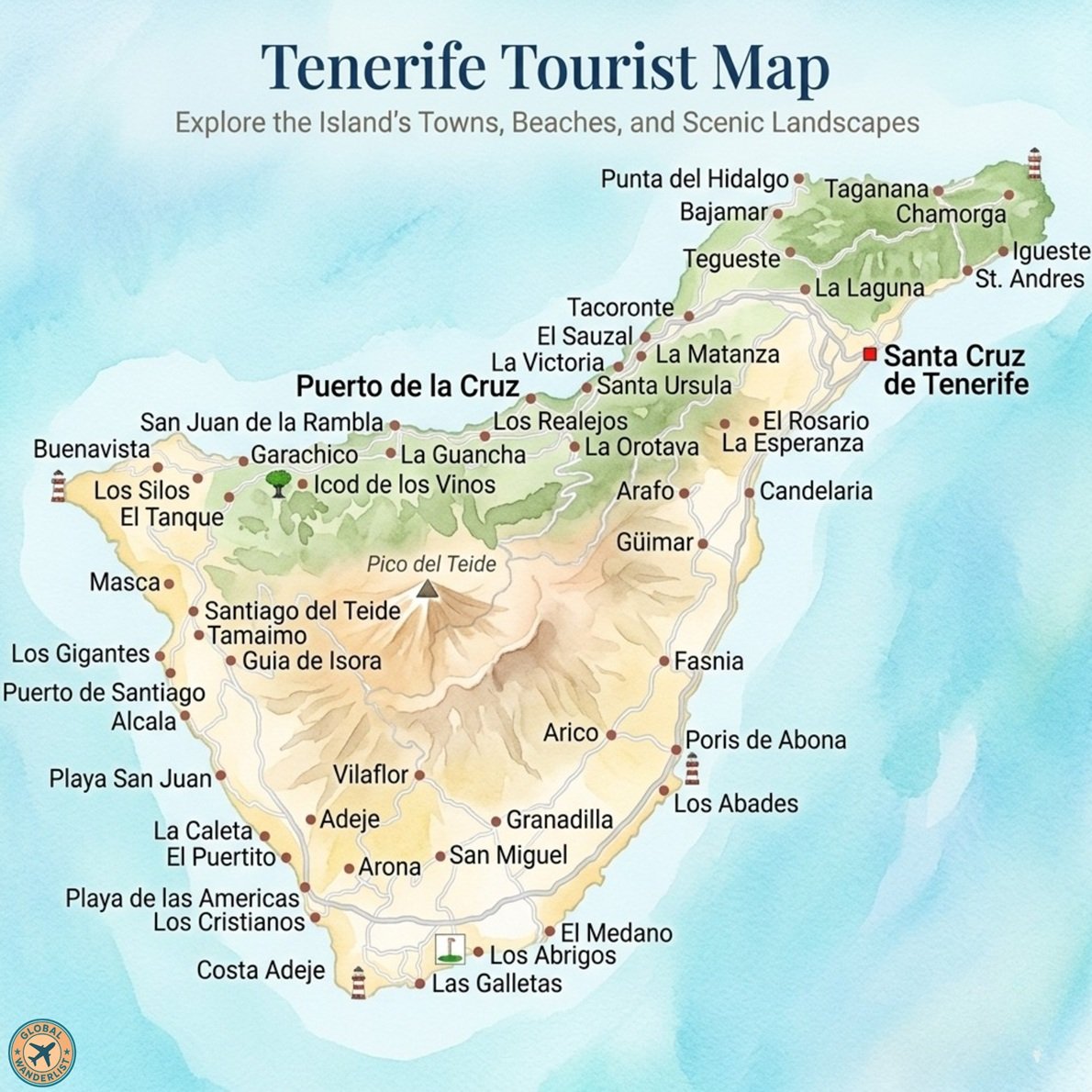
Tenerife packs an entire continent’s worth of scenery into one island. Snow-capped Mount Teide rises above black sand beaches. Colonial old towns sit a short drive from lava pools and pine forests. Few destinations offer this much variety in such a compact space.
The island formed through millions of years of volcanic activity, and that history still shapes daily life here. Fishing villages rebuilt after eruptions now welcome travelers instead of trade ships. Terraced hillsides that once grew sugar cane produce wine today. This guide walks through Tenerife’s main towns, natural landmarks, and coastal villages, with the context you need to plan a trip that goes beyond the resort strip.
Quick Overview
| Place | Category | Best Known For | Recommended Visit Duration |
|---|---|---|---|
| Santa Cruz de Tenerife | Capital City | Modern architecture, port, museums | 1 day |
| San Cristóbal de La Laguna | Historic City | UNESCO old town, university heritage | Half day to 1 day |
| Teide National Park | Natural Landmark | Spain’s highest peak, volcanic terrain | Half day to 1 day |
| Puerto de la Cruz | Coastal Town | Botanical gardens, lava pools, old harbor | 1 day |
| Garachico | Historic Village | Volcanic pools, rebuilt colonial center | Half day |
| Icod de los Vinos | Town | Ancient dragon tree, wine tradition | 2-3 hours |
| Masca and the Teno Mountains | Rural Village | Dramatic gorge hike, mountain scenery | Half day to 1 day |
| Los Gigantes and Puerto de Santiago | Coastal Resort | Towering sea cliffs, whale watching | Half day |
| Costa Adeje and Los Cristianos | Resort Region | Beaches, nightlife, southern sun | 2-4 days |
| Anaga Rural Park and the Northeast | Nature Reserve | Laurel forests, coastal villages | Half day to 1 day |
Santa Cruz de Tenerife
Santa Cruz de Tenerife has served as the island’s capital since 1723. It replaced La Laguna after centuries of political shifts. Today it blends modern architecture with a busy working port.
The city rewards a slow walk. Palm-lined plazas sit near striking contemporary buildings, and the waterfront promenade stretches for miles. Santa Cruz also hosts one of the world’s largest carnival celebrations each February.
What to See in Santa Cruz de Tenerife
- Auditorio de Tenerife is a striking concert hall shaped like a breaking wave. Designed by Santiago Calatrava, it has become the island’s architectural symbol.
- Plaza de España sits at the heart of the city, built above a large artificial lake. It connects easily to shopping streets and waterfront cafes.
- Parque García Sanabria offers shaded gardens filled with sculptures and seasonal flowers. It is a peaceful break from the city’s busy avenues.
- Museum of Nature and Man houses Guanche mummies and artifacts from the island’s pre-Hispanic past. It gives useful context before exploring rural Tenerife.
- Mercado de Nuestra Señora de África is a lively covered market selling tropical fruit, cheese, and fresh fish. Locals shop here daily, not just tourists.
- The carnival route through downtown comes alive every February with costumes and music rivaling Rio’s celebration.
Plan a full day here, ideally on foot. The tram system connects Santa Cruz easily with nearby La Laguna if you want to combine both in one trip.
San Cristóbal de La Laguna
San Cristóbal de La Laguna was founded in 1496 and became Tenerife’s first capital. Its street grid, laid out without defensive walls, later inspired colonial city plans across Latin America. UNESCO recognized the old town as a World Heritage Site in 1999.
Wooden balconies and pastel facades line narrow pedestrian streets here. The city still functions as a university hub, which keeps its historic core lively rather than museum-like.
What to See in San Cristóbal de La Laguna
- La Laguna Cathedral dates to the 16th century and blends neoclassical and neo-Gothic details. It holds the remains of Alonso Fernández de Lugo, the island’s conqueror.
- Royal Sanctuary of Christ houses one of the island’s most revered religious images. Pilgrims and visitors both stop here year-round.
- Palacio de Nava is a 16th-century noble residence showing off traditional Canarian courtyard architecture. Its facade alone is worth a photo stop.
- Calle Herradores and Calle Obispo Rey Redondo form the pedestrian heart of the old town, lined with tapas bars and small shops.
- House of the Captains General now serves as the town hall. Its stately design reflects the city’s former political power.
- A short walk leads toward Anaga Rural Park, making La Laguna a convenient base for exploring the northeast coast.
Give this city at least half a day. It pairs naturally with Santa Cruz, since the two sit only about fifteen minutes apart by car or tram.
Teide National Park
Teide National Park protects Mount Teide, a stratovolcano rising 3,718 meters above sea level. Measured from the ocean floor, it ranks as the third-tallest volcanic structure on Earth. UNESCO declared the park a World Heritage Site in 2007.
The landscape looks otherworldly. Black lava fields, twisted rock formations, and a wide caldera called Las Cañadas surround the peak. NASA has even used the terrain to test equipment meant for Mars.
What to See in Teide National Park
- The Teide cable car climbs to nearly 3,555 meters in about eight minutes, offering sweeping views across the entire island on a clear day.
- Roques de García is a cluster of dramatic volcanic rock towers, including the famous Roque Cinchado. The short walking trail here is one of the park’s most popular.
- Las Cañadas caldera spans about 17 kilometers across and gives visitors a sense of the volcano’s massive scale.
- Teide Observatory takes advantage of the park’s clear, unpolluted skies for serious astronomical research. Stargazing tours here are excellent.
- The rare Teide violet blooms only above 2,500 meters and grows nowhere else on Earth, a small reward for those who hike higher trails.
- Parador de Las Cañadas del Teide sits inside the park itself, making it possible to watch sunset and sunrise without a long drive back down.
Book cable car tickets in advance, since demand often outpaces availability. Bring warm layers, since temperatures drop sharply at altitude even in summer.
Puerto de la Cruz
Puerto de la Cruz was Tenerife’s original tourist destination, drawing European visitors as early as the 19th century. Long before the southern resorts existed, wealthy travelers came here for the mild climate and ocean views.
The town keeps a more traditional, less commercial feel than the south coast. Black volcanic sand beaches and a historic harbor give it real character.
What to See in Puerto de la Cruz
- Jardín Botánico was founded in 1788 to acclimatize tropical plants brought from the Americas. It remains one of Spain’s oldest botanical gardens.
- Loro Parque combines a zoo, aquarium, and conservation center, known especially for its parrot collection and orca shows.
- Playa Jardín offers black volcanic sand and gardens designed by Canarian artist César Manrique.
- Lago Martiánez is a striking complex of seawater pools and gardens, also designed by Manrique, built directly along the coastline.
- The old harbor still holds fishing boats near restaurants serving fresh catch, keeping the town’s maritime roots visible.
- Casa de la Real Aduana, a former customs house, now serves as a cultural center and one of the oldest buildings in town.
Puerto de la Cruz works well as a quieter alternative to southern resorts, especially for travelers who want beach access alongside real local culture.
Garachico
Garachico tells one of Tenerife’s most dramatic stories. Founded in 1496, it grew into the island’s most important port during the 16th and 17th centuries, shipping malvasía wine across Europe. Everything changed on May 5, 1706, when the Trevejo volcano erupted and buried the harbor under lava.
Rather than disappear, the town rebuilt itself directly on the cooled volcanic rock. That resilience still defines Garachico’s character today.
What to See in Garachico
- El Caletón natural pools formed when lava met the Atlantic and hardened into rock basins. They remain one of the most popular swimming spots on the island.
- Castillo de San Miguel survived the 1706 eruption and now houses a small museum. Its walls offer a direct link to the town’s golden era.
- Plaza de la Libertad anchors the historic center, surrounded by rebuilt colonial buildings and the Church of Santa Ana.
- Roque de Garachico is a rocky islet just offshore, now a protected seabird nesting site visible from the promenade.
- The Convento de San Francisco reflects the wealth Garachico once held as a trading port, despite the damage it later suffered.
- Every five years, the town reenacts the eruption with the Fuegos del Risco, a fireball display down the mountainside.
Visit at low tide for the calmest swimming conditions in the natural pools. The town is compact enough to explore fully in a couple of hours.
Icod de los Vinos
Icod de los Vinos sits inland from Garachico and takes its name from the wine tradition that shaped the region for centuries. Vineyards still cover the surrounding hillsides, producing wines from volcanic soil.
The town’s biggest draw predates Tenerife’s tourism entirely. A massive dragon tree, believed to be several centuries old, has stood in the town center for generations.
What to See in Icod de los Vinos
- Drago Milenario is a massive dragon tree considered a natural monument and a symbol of the Canary Islands, despite disputes over its exact age.
- Parque del Drago surrounds the tree with gardens and viewpoints, giving visitors space to appreciate its unusual, spiky silhouette.
- San Marcos Church holds an important collection of religious art and anchors the town’s historic quarter.
- Local wine bodegas offer tastings of malvasía and listán wines grown on nearby volcanic terraces.
- Cueva del Viento nearby is one of the longest volcanic lava tube systems in the world, open for guided tours.
Pair a stop here with Garachico, since the two towns sit only about fifteen minutes apart on the north coast road.
Masca and the Teno Mountains
Masca sits at 650 meters altitude inside a volcanic gorge in the Teno Mountains. Until a road finally reached the village in the 1990s, residents traveled mainly by donkey or on foot. That isolation shaped a distinct, self-contained community of around ninety people.
The surrounding gorge, Barranco de Masca, has become one of the most famous hikes in the Canary Islands. Steep basalt walls tower on either side of the trail as it descends toward the sea.
What to See in Masca and the Teno Mountains
- Masca village itself is worth a slow walk, with traditional stone houses and dramatic ridge-top views over the ravine.
- Barranco de Masca hike descends roughly five kilometers through narrow volcanic walls to a black sand beach, ending with a boat ride to Los Gigantes.
- Mirador de Archipenque offers one of the best photo viewpoints over the coastline near Los Gigantes.
- Punta de Teno marks the island’s westernmost point, home to a small lighthouse and sweeping Atlantic views.
- The winding TF-436 road into Masca is itself a scenic experience, cutting through switchbacks with views toward La Gomera.
The gorge hike now requires advance booking and includes a mandatory shuttle and return boat. Wear sturdy footwear, since the terrain is rocky and often slippery.
Los Gigantes and Puerto de Santiago
Los Gigantes takes its name from the massive sea cliffs that dominate this stretch of coastline. These basalt walls rise as high as 600 meters in places, among the tallest cliffs in Europe. Early sailors reportedly believed the world ended here.
The nearby resort towns of Puerto de Santiago and Playa San Juan offer a quieter alternative to the busier southern strip, while still sitting close to major attractions.
What to See in Los Gigantes and Puerto de Santiago
- The Los Gigantes cliffs stretch for several kilometers and look most dramatic from a boat looking back toward shore.
- Los Gigantes Marina offers whale and dolphin watching trips, since resident pods live in the deep waters just offshore year-round.
- Playa de los Guios gives beachgoers a rare front-row view of the cliffs from black volcanic sand.
- Puerto de Santiago’s promenade connects several small beaches and makes for an easy coastal walk.
- Cueva la Vaca is a small natural pool near Los Gigantes, popular for a quick photo stop away from the main beaches.
Boat tours here tend to sell out in high season, so book ahead if whale watching is a priority.
Costa Adeje and Los Cristianos
Costa Adeje and Los Cristianos anchor Tenerife’s main resort region in the south. This area gets far less rain than the north, which explains its popularity for sun-focused vacations. Large hotels, golf courses, and beach clubs dominate the coastline here.
Despite the resort development, older fishing town roots remain visible in Los Cristianos, where ferries still depart for La Gomera.
What to See in Costa Adeje and Los Cristianos
- Playa del Duque is one of the south’s most polished beaches, backed by upscale hotels and palm-lined promenades.
- Siam Park ranks among the world’s top water parks, with Thai-inspired architecture and one of the tallest water slides anywhere.
- Los Cristianos harbor still runs regular ferries to La Gomera, keeping a working port feel alongside the resort scene.
- Playa de las Américas offers the liveliest nightlife strip in southern Tenerife, packed with bars and restaurants.
- Torviscas and Fañabé beaches provide calmer alternatives close to Costa Adeje’s main hotel zone.
- Arona and San Miguel de Abona, just inland, offer traditional villages worth a short detour from the coast.
This region works best as a multi-day base, especially for travelers prioritizing beach time and warm weather over historic sightseeing.
Anaga Rural Park and the Northeast
Anaga Rural Park covers the island’s northeastern tip with dense laurel forest, known as laurisilva. These forests date back millions of years, surviving from a time when much of southern Europe had a similar subtropical climate.
Small fishing villages dot the coastline below the ridge, largely untouched by mass tourism. The winding mountain roads here offer some of the island’s best hiking and viewpoints.
What to See in Anaga Rural Park and the Northeast
- Cruz del Carmen viewpoint offers wide views across the forested ridges toward the Atlantic, especially striking when clouds settle below the peaks.
- Taganana village sits on a dramatic slope facing the sea, one of the oldest settlements in the park.
- Chamorga, the park’s most remote hamlet, connects to several excellent hiking trails.
- Playa de Benijo offers a wild, black sand beach backed by jagged sea stacks, popular at sunset.
- Punta del Hidalgo and Bajamar combine natural rock pools with small coastal towns, ideal for a relaxed swim outside peak season.
- Igueste de San Andrés marks a quiet trailhead for hikes into the park’s least visited corners.
Roads through Anaga are narrow and winding, so allow extra driving time. Fog rolls in quickly at higher elevations, which adds to the forest’s mysterious atmosphere but can limit visibility.
Beyond the Highlights
Tenerife holds far more than its famous volcano and resort beaches. Villages like Vilaflor, Arico, and Güímar hold quiet plazas and traditional architecture well worth a detour. The southeastern coast around El Médano draws windsurfers to some of the island’s most consistent wind conditions.
Give yourself time to slow down between the major stops. A rental car opens up small towns like Candelaria, home to an important religious basilica, or coastal villages like Poris de Abona that rarely appear on typical itineraries. Tenerife’s real character often shows up in these quieter corners, far from the busiest attractions.