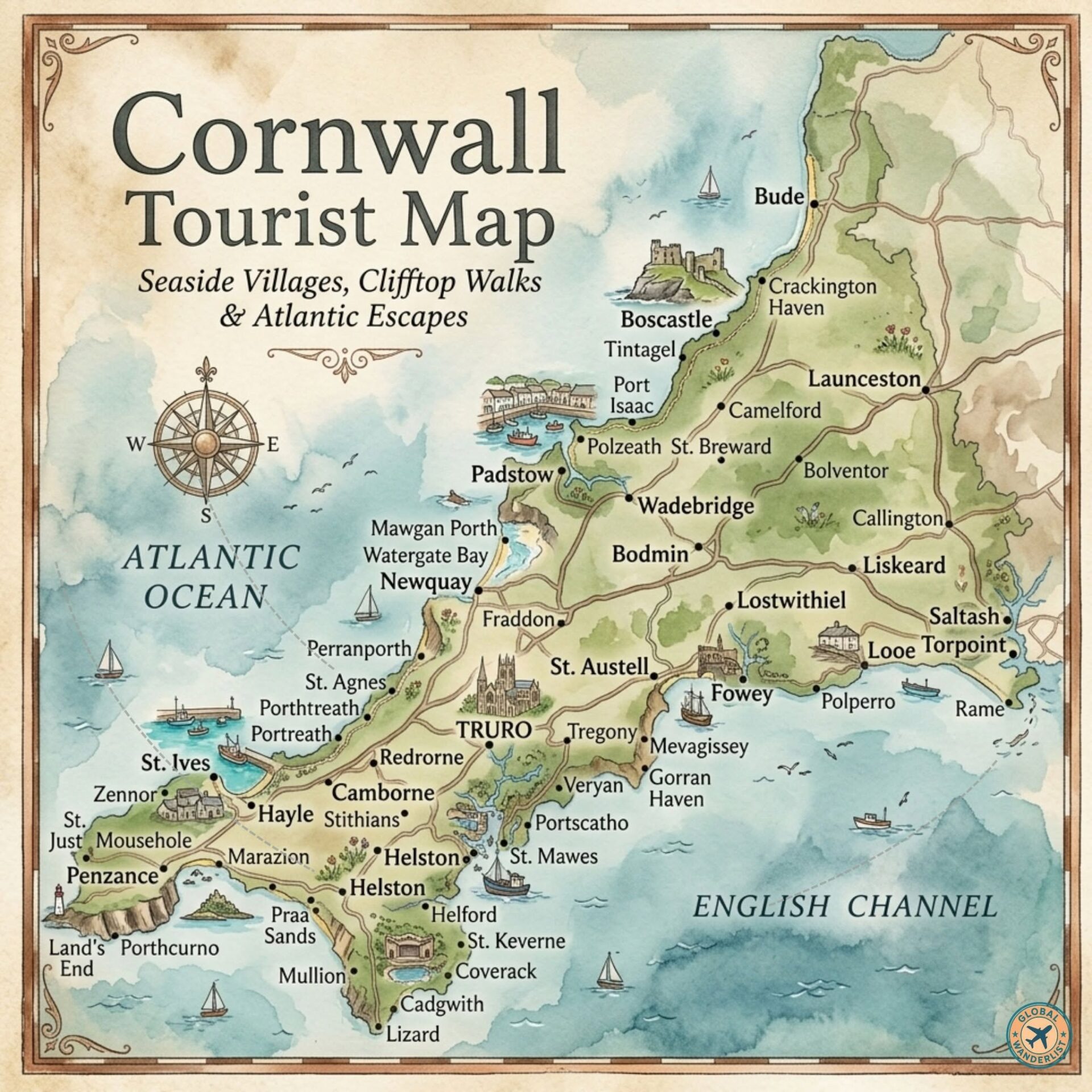
Cornwall stretches out into the Atlantic like a granite finger, wrapped in dramatic cliffs, fishing harbors, and some of England’s most beautiful coastline. Ancient legends of King Arthur mingle with working fishing villages, artist colonies, and sandy surf beaches across this compact peninsula. Few destinations in Britain pack this much scenery, history, and coastal charm into such an accessible region.
This guide covers Cornwall’s essential harbor towns, coastal villages, and inland market towns. Below is a quick reference table, followed by detailed information on each area.
| Place | Category | Best Known For | Recommended Visit Duration |
|---|---|---|---|
| Padstow and the North Coast Harbors | Harbor towns | Seafood dining, sailing, coastal walks | 1-2 days |
| Tintagel and the Legendary Coast | Historic coastline | Arthurian legend, dramatic cliffs | 1 day |
| Newquay and the Surf Coast | Beach towns | Surfing, wide sandy beaches | 1-2 days |
| St. Ives and the Far West | Artist coastal town | Galleries, turquoise coves | 1-2 days |
| Penzance and Land’s End | Historic town and headland | England’s westernmost point, dramatic cliffs | 1 day |
| The Lizard Peninsula | Coastal peninsula | England’s southernmost point, secluded coves | 1-2 days |
| Truro and Mid Cornwall | Cathedral city and countryside | Cathedral architecture, central location | 1 day |
| Fowey and the South Coast Villages | Fishing villages | Sheltered harbors, sailing history | 1-2 days |
| Bodmin Moor and the Eastern Borderlands | Moorland and market towns | Wild moorland, historic coaching towns | 1 day |
Padstow and the North Coast Harbors
Padstow anchors Cornwall’s north coast as one of its most celebrated harbor towns, long associated with celebrity chef Rick Stein and the region’s thriving seafood scene. Its working harbor still lands fresh catch daily, while narrow streets climb away from the water lined with galleries and bakeries. Nearby Rock and Polzeath add sandy beaches and watersports to the area’s appeal, connected to Padstow by a small ferry across the Camel Estuary.
What to See in Padstow and the North Coast Harbors
- Padstow’s harbor offers a lively mix of fishing boats and pleasure craft, with waterside restaurants serving the day’s catch just steps away.
- The Camel Trail, a flat and scenic cycling path, follows a former railway line from Padstow toward Wadebridge and beyond.
- Rock, just across the estuary, draws sailors and watersports enthusiasts with its sheltered waters and sandy beach.
- Polzeath offers one of Cornwall’s most popular surf beaches, with reliable Atlantic swells suited to beginners and experienced surfers alike.
- Port Isaac, a short drive up the coast, charms visitors with its tightly packed fishermen’s cottages and starring role as the filming location for Doc Martin.
Tintagel and the Legendary Coast
Tintagel carries deep mythological weight as the legendary birthplace of King Arthur, its dramatic clifftop castle ruins drawing visitors for centuries. The coastline here turns increasingly rugged, with Boscastle’s narrow harbor and Crackington Haven’s towering cliffs adding further drama further north. This stretch rewards travelers seeking Cornwall’s wilder, more atmospheric side.
What to See in Tintagel and the Legendary Coast
- Tintagel Castle sits dramatically split between mainland and headland, connected by a striking modern footbridge over the churning sea below.
- Merlin’s Cave, accessible at low tide beneath the castle ruins, adds another layer to the site’s deep Arthurian legend.
- Boscastle’s narrow, cliff-hemmed harbor remains one of Cornwall’s most picturesque, having been carefully restored after severe flooding in 2004.
- Crackington Haven offers dramatic cliff scenery and a quieter beach experience, popular with hikers walking the South West Coast Path.
- Bude, further north, combines a sandy beach with a historic sea lock canal, offering a good base for exploring this stretch of coastline.
Newquay and the Surf Coast
Newquay stands as Cornwall’s undisputed surf capital, drawing wave riders to its string of expansive sandy beaches along the Atlantic coast. Fistral Beach in particular has hosted major international surfing competitions, cementing the town’s reputation. Nearby Watergate Bay and Mawgan Porth extend the surf coast further south, while Perranporth and St. Agnes offer quieter alternatives.
What to See in Newquay and the Surf Coast
- Fistral Beach ranks among Britain’s premier surf spots, with consistent swells and multiple surf schools catering to beginners.
- Watergate Bay stretches for nearly two miles of open sand, popular for surfing, kitesurfing, and long beach walks at low tide.
- Mawgan Porth offers a slightly more sheltered beach experience, well suited to families and those newer to watersports.
- Perranporth combines a vast beach with dramatic dunes, plus a lively pub scene right on the sand.
- St. Agnes charms visitors with its mining heritage, dramatic coastal scenery, and the iconic Wheal Coates engine house perched above the cliffs.
- Porthtowan and Portreath round out this stretch with excellent surf conditions and a more low-key village atmosphere.
St. Ives and the Far West
St. Ives has drawn artists for well over a century, its turquoise coves and luminous coastal light inspiring painters like Barbara Hepworth and the wider St. Ives School. Steep, narrow streets wind down toward a harbor ringed by golden sand beaches, while the Tate St. Ives gallery anchors the town’s continued artistic reputation. The wilder villages of Zennor and St. Just extend this far western stretch of Cornwall toward Land’s End.
What to See in St. Ives and the Far West
- Tate St. Ives showcases modern and contemporary art in a striking building overlooking Porthmeor Beach, reflecting the town’s artistic legacy.
- Porthmeor Beach offers excellent surfing conditions right beneath the town, popular with both visitors and local surf schools.
- The Barbara Hepworth Museum and Sculpture Garden preserves the sculptor’s former home and studio, filled with her work amid a lush garden setting.
- Zennor offers a wilder, more remote coastal experience, with dramatic cliffs and a strong connection to Cornish folklore and mermaid legends.
- Hayle’s expansive Towans dunes and beach provide a quieter, family-friendly alternative to St. Ives’s busier shores.
- Mousehole, a small fishing village further south, remains one of Cornwall’s most charming harbor settlements, especially magical during its Christmas lights display.
Penzance and Land’s End
Penzance serves as the gateway to Cornwall’s far western tip, a historic market town with a lively harbor and Georgian architecture. From here, the coast road leads toward Land’s End, mainland England’s westernmost point, where dramatic granite cliffs plunge into the Atlantic. Porthcurno’s Minack Theatre, carved directly into the cliffside, ranks among Cornwall’s most extraordinary attractions.
What to See in Penzance and Land’s End
- Land’s End offers sweeping Atlantic views from mainland England’s westernmost point, with dramatic cliffs and, on clear days, sightlines toward the Isles of Scilly.
- The Minack Theatre at Porthcurno stages performances in a spectacular open-air amphitheater carved into the cliff face above the sea.
- St. Michael’s Mount, reached by causeway at low tide from nearby Marazion, offers a castle-topped tidal island reminiscent of France’s Mont Saint-Michel.
- Penzance’s Chapel Street features handsome Georgian and Regency architecture, worth a slow wander before heading further west.
- Porthcurno Beach itself offers strikingly turquoise water and pale sand, a beautiful stop beyond the famous theater above.
- St. Just and Mousehole add further coastal charm nearby, each offering a quieter, more local slice of far western Cornwall.
The Lizard Peninsula
The Lizard Peninsula juts out as mainland England’s southernmost point, a landscape of rare wildflowers, secluded coves, and dramatic serpentine rock formations. Helston serves as the peninsula’s main gateway town, while villages like Cadgwith and Coverack retain a genuine, working fishing harbor character. This corner of Cornwall rewards travelers willing to venture beyond the more heavily visited northern coast.
What to See in The Lizard Peninsula
- Lizard Point marks England’s southernmost tip, with a lighthouse, dramatic cliffs, and distinctive dark green serpentine rock formations found almost nowhere else.
- Cadgwith remains a genuine working fishing village, its thatched cottages and small cove harbor largely unchanged for generations.
- Coverack offers a quieter, more secluded beach experience, framed by the peninsula’s rugged coastal scenery.
- Kynance Cove, with its turquoise water and dramatic rock stacks, ranks among Cornwall’s most photographed beaches.
- Helford River offers a peaceful, wooded estuary setting, popular for kayaking and waterside walks away from the open coast.
- Mullion and Praa Sands provide additional sandy beach options along the peninsula’s western edge, both popular for swimming and coastal walks.
Truro and Mid Cornwall
Truro anchors Cornwall’s geographic center as its only city, distinguished by the soaring spires of its Victorian Gothic cathedral. This compact, walkable city serves as a practical base for exploring both coasts, with good rail connections to the rest of the country. Nearby St. Austell and the surrounding countryside add further depth, including access to the famous Eden Project just outside town.
What to See in Truro and Mid Cornwall
- Truro Cathedral dominates the city skyline with its three Gothic Revival spires, a relatively young cathedral completed in the early 20th century.
- The city’s Georgian and Victorian streets offer pleasant browsing among independent shops, cafes, and the Royal Cornwall Museum.
- St. Austell serves as a gateway to the Eden Project, Cornwall’s celebrated biome complex showcasing global plant ecosystems within a former china clay pit.
- Bodmin, a former county town, offers access to Bodmin Moor and a good stop for those exploring Cornwall’s wilder interior.
- Fraddon and the surrounding mid Cornwall countryside provide a quieter, more rural contrast to the busier coastal towns.
Fowey and the South Coast Villages
Fowey anchors Cornwall’s south coast as an elegant sailing town, its steep streets and sheltered harbor long favored by novelist Daphne du Maurier. Nearby Polperro and Looe offer classic, tightly packed fishing village charm, while Mevagissey and Gorran Haven extend the coastline’s appeal further west. This stretch of coast tends to feel calmer and more sheltered than the wilder Atlantic-facing north.
What to See in Fowey and the South Coast Villages
- Fowey’s harbor bustles with sailing activity, its steep streets lined with independent shops and cafes overlooking the water.
- Polperro remains one of Cornwall’s most picturesque fishing villages, its narrow streets and tiny harbor largely closed to cars.
- Looe combines a working fishing harbor with a sandy beach, split between the historic East and West Looe across the river.
- Mevagissey offers a genuine, still-active fishing harbor along with a good selection of seafood restaurants right on the water.
- St. Mawes and Portscatho, across the Fal Estuary, add further charm with their sheltered coves and relaxed sailing atmosphere.
- Veryan and Tregony round out this stretch with quiet countryside charm, both worth a stop for those exploring the Roseland Peninsula.
Bodmin Moor and the Eastern Borderlands
Bodmin Moor spreads across Cornwall’s wild interior, a landscape of granite tors, ancient stone circles, and windswept moorland that inspired Daphne du Maurier’s novel Jamaica Inn. Market towns like Launceston and Liskeard anchor the eastern edge of the county, historically serving as gateways between Cornwall and the rest of England. This inland region offers a striking contrast to the county’s busier coastal towns.
What to See in Bodmin Moor and the Eastern Borderlands
- Bodmin Moor’s granite tors and open moorland offer excellent hiking, with Brown Willy, Cornwall’s highest point, rewarding those who make the climb.
- Jamaica Inn at Bolventor, immortalized in du Maurier’s novel, still operates today and offers insight into the moor’s smuggling history.
- Launceston, once Cornwall’s county town, retains a Norman castle and handsome historic streets near the Devon border.
- Wadebridge serves as a useful stop along the Camel Trail, connecting cyclists between Padstow and the moor’s edge.
- Liskeard and Lostwithiel both offer well preserved market town architecture, worth a stop for those exploring Cornwall’s less touristed interior.
- Saltash and Torpoint mark Cornwall’s eastern gateway across the Tamar, with Rame Head offering a dramatic, lesser-visited headland nearby.
Beyond the Postcard Views
Cornwall rewards travelers who venture beyond its most photographed harbor towns. Ancient stone circles, wild moorland, and quiet fishing villages all sit within reach of the county’s famous coastline. Few destinations in Britain offer this much variety within such a compact, walkable peninsula.
Give yourself time to explore both coasts, since the wilder Atlantic north and the sheltered south each offer a distinctly different character. Whether you come for the surf beaches of Newquay, the Arthurian ruins at Tintagel, or a plate of fresh seafood in Padstow, Cornwall leaves a lasting impression well beyond its postcard views.