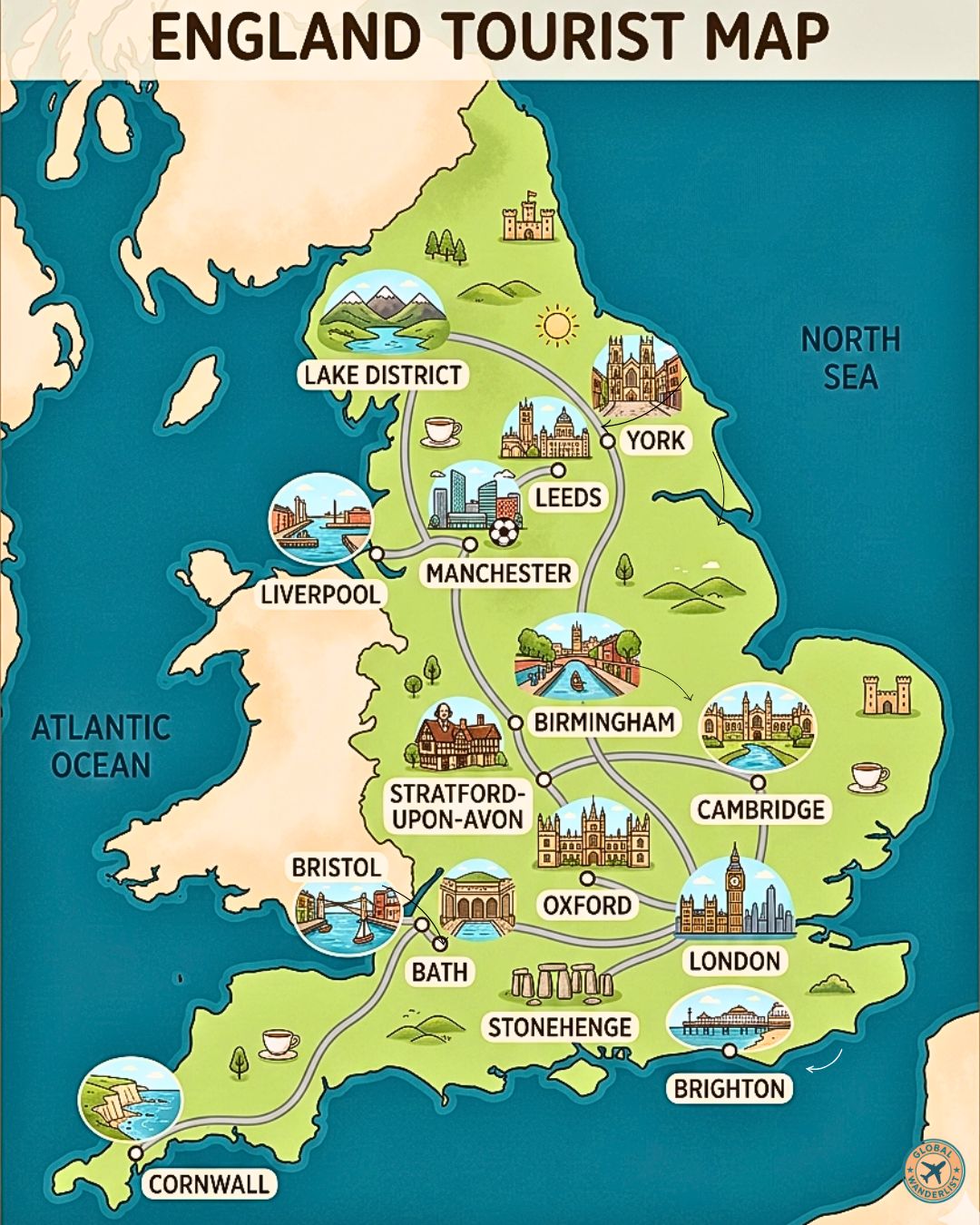
England packs cathedral cities, university towns, and ancient monuments into a country small enough to cross by train in a single day. Roman ruins sit beside industrial powerhouses turned cultural hubs, while rolling countryside connects it all through a dense, efficient rail network. Few countries offer this much historical depth and regional variety within such an easily navigable footprint.
This guide covers fifteen of England’s essential destinations, from the fells of the Lake District to the beaches of Cornwall. Below is a quick reference table, followed by detailed information on each place.
| Place | Category | Best Known For | Recommended Visit Duration |
|---|---|---|---|
| Lake District | National park | Mountains, lakes, literary heritage | 2-3 days |
| York | Historic city | Medieval walls, Gothic minster | 1-2 days |
| Leeds | Major city | Victorian architecture, shopping, nightlife | 1 day |
| Manchester | Major city | Music history, football, industrial heritage | 1-2 days |
| Liverpool | Port city | The Beatles, waterfront architecture | 1-2 days |
| Birmingham | Major city | Canals, jewelry quarter, diverse culture | 1 day |
| Stratford-upon-Avon | Historic town | Shakespeare’s birthplace, riverside charm | 1 day |
| Cambridge | University city | Historic colleges, punting on the river | 1 day |
| Oxford | University city | Historic colleges, dreaming spires | 1 day |
| Bristol | Port city | Street art, suspension bridge, harbor | 1-2 days |
| Bath | Historic city | Roman baths, Georgian architecture | 1 day |
| Stonehenge | Ancient monument | Prehistoric stone circle | Half day |
| London | Capital city | Iconic landmarks, museums, royal history | 3-5 days |
| Brighton | Seaside town | Pier, beach, bohemian culture | 1 day |
| Cornwall | Coastal region | Cliffside villages, beaches, surf culture | 2-3 days |
Lake District
The Lake District rises from northern England in a landscape of glacial lakes ringed by rugged fells. William Wordsworth found lifelong inspiration here, and the park remains deeply tied to Romantic era poetry. This combination of natural drama and literary heritage earned it UNESCO World Heritage status.
What to See in Lake District
- Windermere, England’s largest lake, offers scenic steamer cruises and a lively lakeside town at Bowness.
- Grasmere preserves Wordsworth’s former home at Dove Cottage, a pilgrimage site for literature lovers.
- Keswick provides an excellent base for fell walking, set beside the glassy waters of Derwentwater.
- Scafell Pike, England’s highest peak, challenges serious hikers with dramatic summit views.
- Ullswater offers historic steamer cruises alongside the scenic Aira Force waterfall walk.
York
York preserves one of the best examples of a medieval walled city in England, its cobbled streets encircled by nearly two miles of intact city walls. York Minster, one of the largest Gothic cathedrals in northern Europe, dominates the skyline and holds centuries of ecclesiastical history. The city’s Viking heritage adds another layer, reflected in its underground archaeological attractions.
What to See in York
- York Minster showcases stunning Gothic architecture and medieval stained glass, with a climbable tower offering city views.
- The Shambles, a narrow medieval street of overhanging timber buildings, ranks among England’s most photographed shopping lanes.
- York’s city walls offer a scenic two-mile walk, providing views over the historic center from above.
- The Jorvik Viking Centre brings the city’s Norse history to life through an immersive, ride-through museum experience.
- The National Railway Museum, free to enter, houses an extensive collection of historic locomotives and royal carriages.
Leeds
Leeds has transformed from a Victorian industrial powerhouse into one of northern England’s liveliest cultural cities. Grand 19th century architecture reflects its wealth as a former wool trading center, while a thriving music and nightlife scene defines its modern character. The city’s shopping arcades rank among the finest examples of Victorian retail architecture in the country.
What to See in Leeds
- The Victoria Quarter’s ornate glass-roofed arcades offer elegant shopping within a stunning piece of Victorian architecture.
- Leeds Art Gallery houses an impressive collection of British art, including significant works by Henry Moore.
- Kirkstall Abbey ruins provide a peaceful historic stop just outside the city center, set within a scenic park.
- Leeds’s live music scene draws visitors to venues ranging from intimate pubs to major arena concerts.
- Roundhay Park offers extensive green space, including a lake and tropical greenhouse, a favorite local escape.
Manchester
Manchester built its reputation as the world’s first industrial city, and that legacy still echoes through its converted mills and warehouses. The city has since become one of England’s premier destinations for music, football, and nightlife. Its two major football clubs and rich musical history, from Oasis to Joy Division, give Manchester a distinct cultural identity.
What to See in Manchester
- The National Football Museum traces the sport’s history within a striking modern building in the city center.
- Manchester’s Northern Quarter offers independent shops, street art, and a lively bar scene in a former industrial district.
- Old Trafford and the Etihad Stadium draw football fans for stadium tours even outside match days.
- The Museum of Science and Industry explores Manchester’s role in the industrial revolution through hands-on exhibits.
- Manchester Cathedral offers a quieter historic stop, with medieval architecture near the bustling city center.
Liverpool
Liverpool built its fortune as one of Britain’s great maritime trading ports, reflected today in its UNESCO recognized waterfront architecture. The city achieved global fame as the birthplace of the Beatles, whose legacy remains deeply woven into local culture. Liverpool’s revitalized docks now house major museums and a lively arts scene.
What to See in Liverpool
- The Royal Albert Dock combines historic maritime architecture with museums, restaurants, and waterfront views.
- The Beatles Story museum traces the band’s rise from Liverpool clubs to global fame.
- The Cavern Club, where the Beatles performed early gigs, still hosts live music in its atmospheric underground setting.
- Liverpool Cathedral, the largest cathedral in Britain, offers a tower climb with sweeping city and river views.
- The Museum of Liverpool explores the city’s social history, from its port heritage to its music scene.
Birmingham
Birmingham anchors England’s West Midlands as the country’s second largest city, built on a legacy of manufacturing and canal transport. It holds more miles of canal than Venice, now lined with bars and restaurants rather than industrial traffic. The city’s Jewelry Quarter reflects centuries of craftsmanship still practiced by independent jewelers today.
What to See in Birmingham
- Birmingham’s canal network offers scenic waterside walking and dining, particularly lively around Brindleyplace.
- The Jewelry Quarter showcases centuries of craftsmanship, with working workshops and a dedicated museum.
- The Birmingham Museum and Art Gallery houses an important collection of Pre-Raphaelite paintings, free to enter.
- Cadbury World, just outside the city center, offers a popular chocolate-themed attraction for families.
- The Bullring shopping center provides a striking modern architectural landmark alongside its extensive retail offerings.
Stratford-upon-Avon
Stratford-upon-Avon draws literature lovers worldwide as the birthplace of William Shakespeare, its half-timbered streets little changed since the playwright’s own time. The Royal Shakespeare Company still performs his works in a purpose-built theater on the River Avon. This small market town offers an easy day trip steeped in England’s greatest literary legacy.
What to See in Stratford-upon-Avon
- Shakespeare’s Birthplace preserves the house where the playwright was born, furnished to reflect the period.
- The Royal Shakespeare Theatre hosts performances of his plays year-round, right on the riverside.
- Holy Trinity Church holds Shakespeare’s grave, a quiet and moving stop for literary pilgrims.
- Anne Hathaway’s Cottage, just outside town, preserves the childhood home of Shakespeare’s wife amid a picturesque garden.
- The River Avon offers pleasant boat trips and riverside walks, a relaxed way to see the town.
Cambridge
Cambridge has educated scholars for over 800 years, its historic colleges lining the River Cam in a display of Gothic and Tudor architecture. Punting along the river past ancient college buildings ranks among England’s most iconic university town experiences. The city’s compact center makes it an easy and rewarding day trip from London.
What to See in Cambridge
- King’s College Chapel showcases stunning Gothic fan vaulting, one of the finest examples of English architecture.
- Punting on the River Cam offers a classic Cambridge experience, gliding past historic colleges and under ancient bridges.
- The Fitzwilliam Museum houses an outstanding art and antiquities collection, free to enter.
- The Bridge of Sighs, connecting two parts of St John’s College, offers a picturesque photo opportunity.
- Cambridge’s historic market square provides a lively stop for local produce and crafts.
Oxford
Oxford anchors England’s academic heritage as home to the oldest university in the English-speaking world. Its honey-colored spires and historic colleges have inspired the nickname City of Dreaming Spires. The city’s literary connections extend from Lewis Carroll to the Inklings, the writing group that included J.R.R. Tolkien.
What to See in Oxford
- Christ Church College combines a stunning dining hall with connections to both Lewis Carroll and the Harry Potter films.
- The Bodleian Library ranks among the oldest libraries in Europe, with stunning reading rooms open for tours.
- The Bridge of Sighs connects two parts of Hertford College, echoing its Venetian namesake.
- The Ashmolean Museum houses an extensive collection spanning art and archaeology, free to enter.
- Climbing the University Church tower offers sweeping views over Oxford’s historic skyline.
Bristol
Bristol built its wealth as a major port city, reflected today in its harbor district and Isambard Kingdom Brunel’s engineering legacy. The city has embraced a reputation for street art, most notably as the hometown of the artist Banksy. Its independent spirit shows through in a thriving food scene and colorful harborside neighborhoods.
What to See in Bristol
- The Clifton Suspension Bridge, designed by Brunel, offers a dramatic engineering landmark with sweeping gorge views.
- Bristol’s harborside features colorful waterfront buildings, museums, and a lively dining scene.
- Street art tours reveal Banksy’s hometown connections, along with work from many other contemporary artists.
- The SS Great Britain, Brunel’s historic steamship, offers an immersive maritime history experience.
- Clifton Village provides elegant Georgian architecture and independent shops near the suspension bridge.
Bath
Bath preserves an extraordinarily well kept Georgian cityscape built atop the site of Roman thermal baths first developed nearly 2,000 years ago. Its honey-colored limestone buildings and elegant crescents earned the city UNESCO World Heritage status. Bath’s spa heritage continues today, with the city remaining a popular destination for relaxation.
What to See in Bath
- The Roman Baths offer remarkably preserved ancient bathing complexes, with an audio tour explaining their history.
- The Royal Crescent showcases sweeping Georgian architecture, among the finest examples of the style in Britain.
- Bath Abbey’s Gothic architecture and soaring ceiling anchor the city center near the Roman Baths.
- The Thermae Bath Spa allows visitors to soak in naturally heated mineral waters, continuing a 2,000-year tradition.
- Pulteney Bridge, lined with shops, offers a picturesque crossing over the River Avon.
Stonehenge
Stonehenge stands as one of the world’s most recognizable prehistoric monuments, its massive stone circle dating back roughly 5,000 years. The site’s exact purpose remains debated among archaeologists, adding to its enduring mystery. Its position on Salisbury Plain, surrounded by open countryside, adds to its dramatic, timeless atmosphere.
What to See in Stonehenge
- The stone circle itself remains the main draw, with a roped perimeter allowing close viewing without touching the ancient stones.
- The visitor center offers context on the monument’s construction and purpose through interactive exhibits.
- Special access visits allow small groups to walk among the stones outside normal visiting hours, bookable in advance.
- The surrounding Stonehenge landscape includes numerous burial mounds, reflecting the site’s significance across centuries.
- Nearby Salisbury Cathedral, a short drive away, offers a worthwhile pairing with its own soaring Gothic spire.
London
London anchors England as one of the world’s great capital cities, blending centuries of royal history with cutting-edge culture and cuisine. Iconic landmarks sit within a remarkably walkable footprint, connected by an efficient Underground network. Few cities offer this much historical depth alongside such vibrant, modern energy.
What to See in London
- The Tower of London houses the Crown Jewels within a nearly thousand-year-old fortress, layered with royal and often grim history.
- The British Museum offers a free, world-class collection spanning ancient civilizations from around the globe.
- Buckingham Palace and the Changing of the Guard ceremony provide a quintessential London royal experience.
- The London Eye offers sweeping views over the Thames and the city’s skyline.
- Westminster Abbey has hosted coronations for nearly a thousand years, holding the tombs of kings and famous Britons alike.
- Camden Market and Borough Market showcase London’s diverse food and shopping culture in two very different settings.
Brighton
Brighton built its reputation as England’s most bohemian seaside town, its pebble beach and Victorian pier drawing visitors since the 19th century. The Royal Pavilion’s exotic architecture reflects the town’s history as a favored retreat for Prince Regent George IV. Today Brighton retains a distinctly alternative, artistic character alongside its traditional seaside charm.
What to See in Brighton
- Brighton Palace Pier offers classic seaside amusements, arcade games, and fairground rides right over the water.
- The Royal Pavilion showcases extraordinary Indo-Saracenic architecture, a striking and unexpected royal palace.
- The Lanes, a maze of narrow streets, house independent boutiques, antique shops, and cafes.
- Brighton Beach, though pebbled rather than sandy, remains a lively spot for sunbathing and people watching.
- The i360 observation tower offers sweeping coastal views from Britain’s tallest moving observation deck.
Cornwall
Cornwall stretches into the Atlantic as England’s dramatic southwestern tip, its cliffs, fishing harbors, and surf beaches drawing visitors for generations. Arthurian legend, artist colonies, and working fishing villages all coexist across this compact peninsula. Few English regions offer this much coastal variety within such an accessible distance.
What to See in Cornwall
- St. Ives combines turquoise coves with a thriving artist community, anchored by the Tate St. Ives gallery.
- Land’s End marks mainland England’s westernmost point, with dramatic cliffs and Atlantic views.
- Newquay offers England’s best surfing conditions, with wide sandy beaches suited to all skill levels.
- Tintagel Castle ruins sit dramatically split across a headland, tied to the legend of King Arthur’s birth.
- St. Michael’s Mount, a castle-topped tidal island near Marazion, offers a scenic and unusual day trip.
Beyond the Postcard Views
England rewards travelers who venture beyond its most famous landmarks. Ancient stone circles, industrial heritage cities, and dramatic coastline all sit within reach of a well connected rail network. Few countries offer this much regional variety within such a manageable, easily explored footprint.
Give yourself time to explore beyond London’s obvious highlights, since the country’s smaller cities and coastal regions often hold the most rewarding discoveries. Whether you come for the fells of the Lake District, the spires of Oxford, or the cliffs of Cornwall, England leaves a lasting impression well beyond its postcard views.