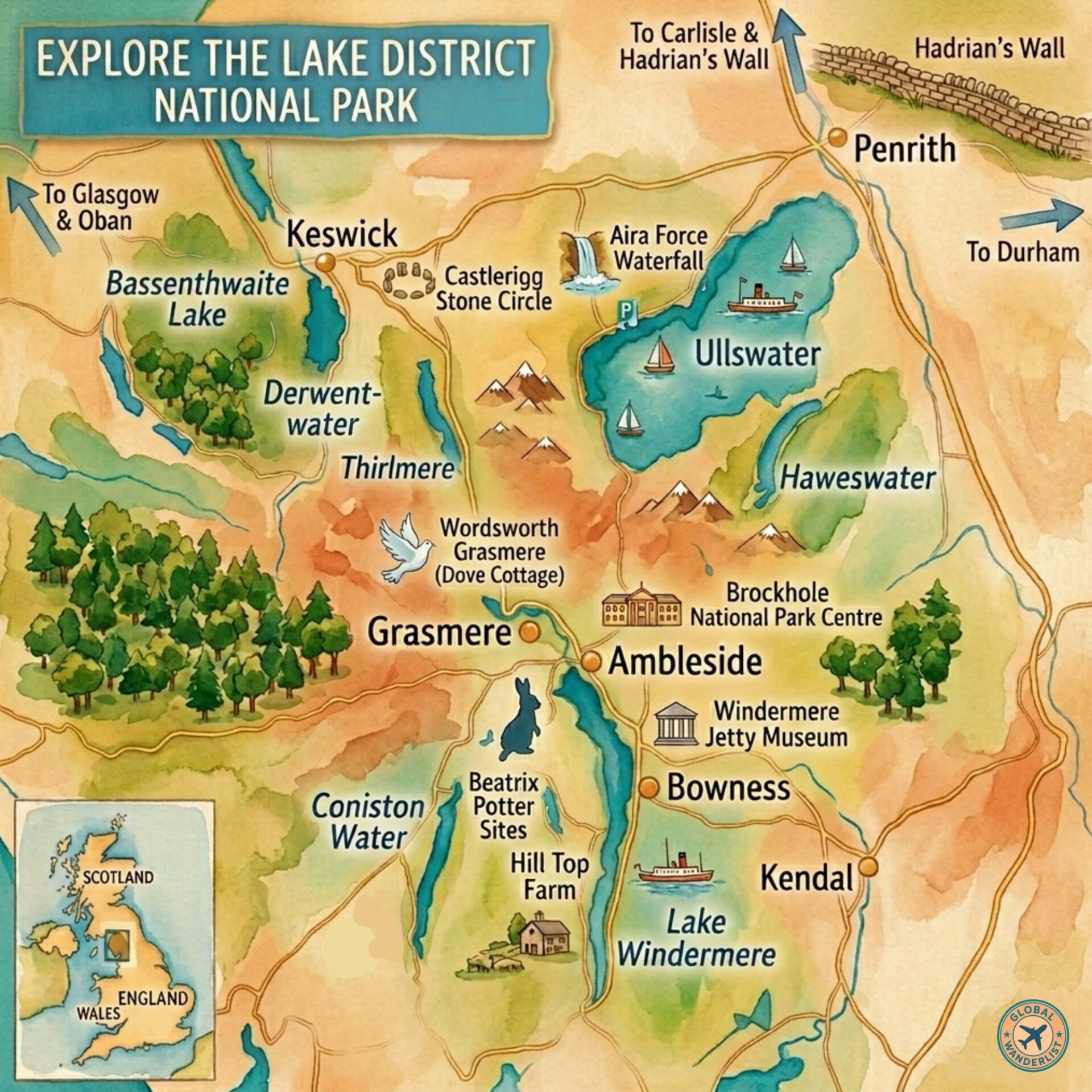
The Lake District rises from northern England like a landscape pulled straight from Romantic poetry, its glacial lakes ringed by rugged fells and quiet stone villages. William Wordsworth found his lifelong inspiration here, and Beatrix Potter later immortalized its farmland in her beloved children’s tales. Few national parks in Britain combine this much natural drama with such deep literary and cultural roots.
This guide covers the park’s essential lakes, market towns, and cultural landmarks. Below is a quick reference table, followed by detailed information on each destination.
| Place | Category | Best Known For | Recommended Visit Duration |
|---|---|---|---|
| Keswick and Derwentwater | Market town and lake | Boat trips, fell walking access | 1-2 days |
| Bassenthwaite Lake | Lake | Wildlife, quieter northern scenery | Half day |
| Castlerigg Stone Circle | Ancient monument | Neolithic stone circle, mountain views | 1 hour |
| Thirlmere | Reservoir lake | Forest walks, scenic drives | Half day |
| Ullswater and Aira Force Waterfall | Lake and waterfall | Steamer cruises, waterfall walks | 1 day |
| Haweswater | Reservoir lake | Remote scenery, golden eagle habitat | Half day |
| Grasmere and Dove Cottage | Village and literary site | Wordsworth’s home, gingerbread | Half day |
| Ambleside and Brockhole | Town and visitor center | Outdoor gear shops, park information | Half day to 1 day |
| Bowness and Lake Windermere | Lakeside town | England’s largest lake, steamer cruises | 1-2 days |
| Coniston Water and Beatrix Potter Country | Lake and countryside | Hill Top Farm, literary heritage | 1 day |
| Kendal | Market town | Historic streets, mint cake | Half day |
| Penrith and Hadrian’s Wall | Gateway town and Roman site | Historic center, Roman frontier wall | 1 day |
Keswick and Derwentwater
Keswick anchors the northern Lake District as a lively market town set beside the glassy waters of Derwentwater. Surrounded by dramatic fells, it has long served as a base for hikers and outdoor enthusiasts exploring the surrounding mountains. The town’s pencil museum reflects its industrial history, since Keswick was once a center of graphite mining and pencil manufacturing.
What to See in Keswick and Derwentwater
- Derwentwater offers scenic boat cruises stopping at several small islands and lakeside villages, a relaxed way to see the surrounding fells.
- Keswick’s outdoor market has operated since the 13th century, still drawing crowds on market days with local produce and crafts.
- The Keswick Pencil Museum traces the town’s unusual industrial history, a quirky stop for families and curious travelers alike.
- Catbells, a popular fell just across the lake, offers a relatively accessible climb with sweeping views over Derwentwater below.
- Friar’s Crag provides one of the most photographed viewpoints in the entire national park, just a short walk from Keswick’s town center.
Bassenthwaite Lake
Bassenthwaite Lake sits just northwest of Keswick, the only body of water in the national park officially designated a lake rather than a mere or water. Its shallower, reed-fringed shoreline supports rich birdlife, including ospreys that have returned to breed here in recent decades. This quieter corner of the park offers a peaceful contrast to the busier southern lakes.
What to See in Bassenthwaite Lake
- Osprey viewing points near the lake allow visitors to watch these impressive birds of prey during their spring and summer breeding season.
- The surrounding woodland trails offer gentle walking routes suited to families and those wanting a relaxed nature walk.
- Mirehouse, a historic house near the lake’s eastern shore, offers gardens and literary connections to poets including Tennyson.
- The lake’s quieter shoreline makes it a favorite for birdwatching and photography, away from the crowds of Windermere or Derwentwater.
Castlerigg Stone Circle
Castlerigg Stone Circle ranks among the oldest and most dramatically situated stone circles in Britain, dating back roughly 5,000 years to the Neolithic period. Positioned on a plateau surrounded by mountains on nearly every side, it offers one of the most atmospheric ancient sites in the country. Its accessibility, just a short drive from Keswick, makes it an easy addition to any northern Lake District itinerary.
What to See in Castlerigg Stone Circle
- The circle itself consists of 38 stones arranged nearly five thousand years ago, their original purpose still debated by archaeologists.
- Surrounding mountain views, including Blencathra and Skiddaw, frame the site dramatically in almost every direction.
- Sunrise or sunset visits offer the most atmospheric experience, with soft light casting long shadows across the ancient stones.
- The free, unrestricted access to the site allows visitors to explore at their own pace without ticketed entry requirements.
Thirlmere
Thirlmere sits between Keswick and Grasmere, a reservoir created in the 19th century to supply water to Manchester. Dense conifer forest surrounds much of its shoreline, offering a different character from the park’s more open, fell-lined lakes. Its forest trails and quiet setting make it a favorite for a peaceful walk away from busier tourist spots.
What to See in Thirlmere
- Forest trails circling the reservoir offer shaded walking routes, particularly welcome on warmer summer days.
- Helvellyn, one of the Lake District’s most popular mountains, rises above Thirlmere’s eastern shore and draws serious hikers.
- The reservoir’s dam and Victorian era waterworks reflect the engineering history behind this man-made lake.
- Scenic pull-offs along the road between Keswick and Grasmere offer easy photo opportunities without requiring a long walk.
Ullswater and Aira Force Waterfall
Ullswater stretches through the park’s northeastern section, often considered one of the most beautiful lakes in England for its combination of mountain backdrop and winding shoreline. Historic steamers have operated on the lake since Victorian times, connecting villages along its shores. Nearby Aira Force waterfall, a dramatic 65-foot cascade, sits within a wooded valley famous for inspiring Wordsworth’s daffodil poetry.
What to See in Ullswater and Aira Force Waterfall
- Ullswater Steamers offer scenic cruises connecting Glenridding, Pooley Bridge, and other points along the lake, a relaxing way to see the surrounding fells.
- Aira Force waterfall tumbles dramatically through a wooded gorge, reachable via an easy woodland walk from the nearby car park.
- The daffodil fields near Aira Force inspired Wordsworth’s famous poem, particularly vivid during their spring bloom in March and April.
- The Ullswater Way, a roughly 20-mile circular walking route, offers hikers a chance to fully circle the lake at their own pace.
- Helvellyn’s summit, accessible from trails near Ullswater, ranks among the most popular and dramatic mountain hikes in the entire park.
Haweswater
Haweswater sits in a remote valley on the park’s eastern edge, another reservoir created by damming a natural lake in the 1930s. Its isolated setting has made it an important habitat for England’s only golden eagle population in past decades, along with other rare wildlife. This quieter corner rewards hikers willing to venture further from the park’s busier central lakes.
What to See in Haweswater
- The remote valley setting offers some of the park’s most peaceful, undisturbed scenery, ideal for those seeking solitude.
- Wildlife spotting opportunities here include rare birds and, historically, golden eagles, making it a draw for dedicated birdwatchers.
- Hiking trails around the reservoir lead into dramatic, less crowded fell country compared to the park’s central lakes.
- The submerged village of Mardale Green occasionally reappears during periods of low water, a haunting reminder of the valley’s flooded history.
Grasmere and Dove Cottage
Grasmere holds a cherished place in English literary history as the longtime home of William Wordsworth, who lived at Dove Cottage for nearly a decade. The poet described the village and surrounding valley as the loveliest spot that man hath ever found, and it remains a pilgrimage site for literature lovers today. Its churchyard holds Wordsworth’s grave, while the village itself retains a charming, walkable center.
What to See in Grasmere and Dove Cottage
- Dove Cottage preserves Wordsworth’s former home much as it appeared during his residence, offering genuine insight into his daily life and inspiration.
- The Wordsworth Museum next door houses manuscripts, personal artifacts, and rotating exhibitions on the poet’s life and work.
- St. Oswald’s Church holds Wordsworth’s grave in its churchyard, a quiet, contemplative stop for visitors.
- Grasmere gingerbread, a unique local recipe sold from a historic shop near the church, remains a beloved regional specialty worth sampling.
- Surrounding fell walks, including the popular route up Helm Crag, offer relatively accessible hiking with rewarding valley views.
Ambleside and Brockhole
Ambleside sits near the northern tip of Lake Windermere, a bustling town packed with outdoor gear shops, cafes, and stone architecture. Its central location makes it a popular base for exploring the surrounding fells and lakes. Nearby Brockhole, the Lake District’s official national park visitor centre, offers extensive gardens and family activities right on the shores of Windermere.
What to See in Ambleside and Brockhole
- Ambleside’s compact center offers excellent outdoor gear shopping, useful for hikers stocking up before heading into the fells.
- Bridge House, a tiny 17th century structure built directly over Stock Beck, ranks among the most photographed buildings in the Lake District.
- Brockhole National Park Centre provides detailed information on trails, activities, and current conditions throughout the park.
- Brockhole’s gardens and lakeside grounds offer treetop trekking, zip lining, and other family-friendly activities alongside the informational displays.
- Stock Ghyll Force, a scenic waterfall just outside town, offers an easy walking route suitable for most fitness levels.
Bowness and Lake Windermere
Bowness-on-Windermere sits directly on England’s largest natural lake, a lively lakeside town packed with boat rentals, restaurants, and Victorian architecture. Windermere itself stretches for over ten miles, historically a favorite destination for Victorian tourists arriving by the newly built railway. The lake remains the park’s most visited body of water, offering everything from leisurely steamer cruises to serious sailing.
What to See in Bowness and Lake Windermere
- Windermere Lake Cruises offer scenic trips across the lake, connecting Bowness with Ambleside and Lakeside at the southern end.
- The Windermere Jetty Museum showcases historic boats and the lake’s maritime heritage, housed in a striking waterside building.
- Bowness’s compact town center offers plenty of shops, cafes, and ice cream stops, especially lively during summer months.
- Boat rentals along the waterfront let visitors explore the lake independently, from rowboats to motor launches.
- The World of Beatrix Potter attraction in Bowness brings her illustrated tales to life, a popular stop for families with young children.
Coniston Water and Beatrix Potter Country
Coniston Water stretches through the park’s southwestern section, historically famous as the site of Donald Campbell’s water speed record attempts and tragic 1967 accident. The surrounding countryside forms the heart of Beatrix Potter country, where she lived, farmed, and drew inspiration for her illustrated children’s books. Hill Top Farm, her former home, remains one of the region’s most visited literary sites.
What to See in Coniston Water and Beatrix Potter Country
- Hill Top Farm preserves Beatrix Potter’s former home exactly as she left it, filled with the furnishings and details that inspired her illustrations.
- Coniston Water offers scenic boat trips aboard the historic steam yacht Gondola, a beautifully restored Victorian vessel.
- The Beatrix Potter Gallery in nearby Hawkshead displays original artwork and manuscripts from her beloved children’s stories.
- Tarn Hows, a picturesque small lake near Coniston, ranks among the most photographed viewpoints in the entire national park.
- The Ruskin Museum in Coniston village tells the story of both John Ruskin and the water speed record attempts made on the lake.
Kendal
Kendal sits just outside the national park’s eastern boundary, a historic market town often called the gateway to the Lake District. Its limestone architecture and narrow yards reflect centuries of history as a wool trading center. The town also gave the world Kendal Mint Cake, a dense, sugary treat favored by mountaineers for its quick energy.
What to See in Kendal
- Kendal Castle ruins overlook the town from a hilltop, offering pleasant views and a glimpse into the area’s medieval history.
- The town’s historic yards and narrow alleys reveal centuries of commercial history, worth exploring on a slow walk through the center.
- Kendal Museum showcases local history and natural history exhibits, a good stop for context before heading into the national park.
- Kendal Mint Cake remains a beloved regional specialty, sold throughout town and famously carried by Edmund Hillary’s Everest expedition.
- The Abbot Hall Art Gallery displays a strong collection of British art within an elegant Georgian house near the River Kent.
Penrith and Hadrian’s Wall
Penrith serves as a practical gateway to the northern Lake District, sitting at a crossroads connecting the park to Carlisle, Hadrian’s Wall, and destinations further north. Its red sandstone buildings and ruined castle reflect a long history as a border town between England and Scotland. Hadrian’s Wall, the ancient Roman frontier fortification, lies within reach for those extending their trip beyond the national park itself.
What to See in Penrith and Hadrian’s Wall
- Penrith Castle ruins sit near the town center, offering a glimpse into the region’s turbulent border history.
- The town’s red sandstone architecture gives Penrith a distinctive character compared to the slate-heavy buildings found throughout the Lake District proper.
- Hadrian’s Wall, a short drive northeast, offers a chance to walk sections of this UNESCO World Heritage Roman frontier fortification.
- Penrith’s position at a major road junction makes it a convenient stop for those combining a Lake District visit with trips toward Carlisle or Durham.
Beyond the Postcard Views
The Lake District rewards travelers who venture beyond its most photographed lakeshores. Ancient stone circles, remote reservoirs, and literary cottages all sit within reach of the park’s famous mountain scenery. Few national parks in England offer this much layered history alongside such dramatic natural beauty.
Give yourself time to explore both the busier southern lakes around Windermere and the quieter northern fells near Keswick and Ullswater. Whether you come for Wordsworth’s Grasmere, a steamer cruise on Ullswater, or a hike up Catbells above Derwentwater, the Lake District leaves a lasting impression well beyond its postcard views.