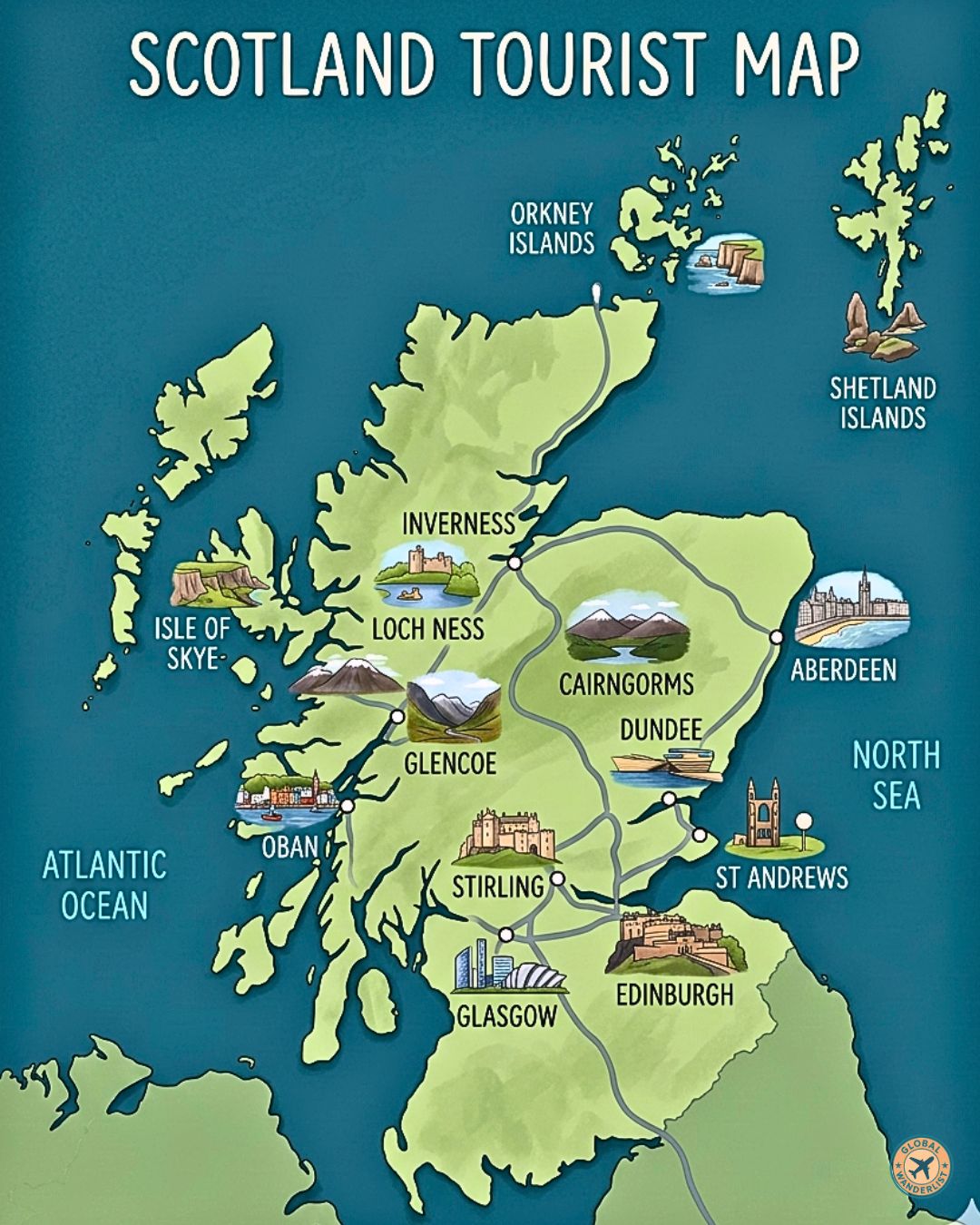
Scotland packs an extraordinary range of scenery into a compact, dramatic landscape. Medieval castles rise above cobblestone capitals, mist covered lochs stretch through the Highlands, and remote northern islands preserve some of Europe’s oldest archaeological sites. Few countries offer this much history and wild natural beauty within such an accessible distance.
This guide covers Scotland’s essential cities, Highland landscapes, and island destinations. Below is a quick reference table, followed by detailed information on each place.
| Place | Category | Best Known For | Recommended Visit Duration |
|---|---|---|---|
| Edinburgh | Capital city | Historic castle, Old Town architecture | 2-3 days |
| Glasgow | Major city | Victorian architecture, music and arts scene | 1-2 days |
| Stirling | Historic city | Medieval castle, Battle of Bannockburn history | 1 day |
| St Andrews | University town | Golf heritage, coastal ruins | 1 day |
| Dundee | Coastal city | Design museum, waterfront regeneration | 1 day |
| Aberdeen | Coastal city | Granite architecture, North Sea energy hub | 1 day |
| Cairngorms | National park | Mountain scenery, wildlife, outdoor activities | 1-3 days |
| Loch Ness | Loch and legend | Monster mythology, castle ruins | 1 day |
| Inverness | Highland city | Gateway to the Highlands, riverside charm | 1-2 days |
| Glencoe | Highland glen | Dramatic mountain scenery, historic massacre site | 1 day |
| Oban | Coastal town | Ferry gateway, seafood dining | 1 day |
| Isle of Skye | Island | Dramatic cliffs, otherworldly rock formations | 2-3 days |
| Orkney Islands | Island archipelago | Neolithic archaeology, dramatic coastline | 2-3 days |
| Shetland Islands | Island archipelago | Remote wildlife, Norse heritage | 2-3 days |
Edinburgh
Edinburgh anchors Scotland’s identity as its historic capital, a city where a medieval castle overlooks cobblestone streets and elegant Georgian squares. Edinburgh Castle has dominated the skyline for nearly a thousand years, while the Royal Mile connects it to the Palace of Holyroodhouse below. The city’s dual character, split between the Old Town’s winding closes and the New Town’s orderly grid, earned it UNESCO World Heritage status.
What to See in Edinburgh
- Edinburgh Castle sits atop an extinct volcanic plug, offering sweeping views and centuries of royal and military history within its walls.
- The Royal Mile connects the castle to Holyroodhouse Palace, lined with historic closes, shops, and street performers throughout summer.
- Arthur’s Seat, an ancient volcano within Holyrood Park, offers a rewarding hike with panoramic views over the entire city.
- The National Museum of Scotland houses an extensive collection spanning natural history, science, and Scottish heritage, free to enter.
- Calton Hill offers some of the city’s best sunset views, dotted with striking monuments including an unfinished Parthenon replica.
- The Edinburgh Festival Fringe transforms the city each August into the world’s largest arts festival, drawing performers from around the globe.
Glasgow
Glasgow built its reputation as a powerhouse of Victorian industry, and that legacy remains visible in its grand sandstone architecture and ornate former merchant buildings. Today the city thrives as Scotland’s cultural and musical capital, known for a lively arts scene and distinctly friendly character. Charles Rennie Mackintosh’s architectural legacy adds a distinctive artistic thread throughout the cityscape.
What to See in Glasgow
- Kelvingrove Art Gallery and Museum houses an outstanding collection spanning fine art, natural history, and Scottish culture, free of charge.
- The Glasgow Necropolis offers a dramatic Victorian cemetery on a hill overlooking the cathedral, worth a quiet, atmospheric walk.
- Charles Rennie Mackintosh’s architecture appears throughout the city, with the Mackintosh at the Willow tearoom offering an accessible introduction.
- The West End’s Ashton Lane and surrounding streets provide a lively hub of bars, restaurants, and independent shops.
- Glasgow’s live music scene ranks among the best in Britain, with venues ranging from intimate pubs to major arena shows.
- The Riverside Museum showcases transport history in a striking Zaha Hadid designed building along the River Clyde.
Stirling
Stirling holds outsized historical significance for a relatively small city, having witnessed pivotal battles that shaped Scottish independence. Stirling Castle rivals Edinburgh’s in grandeur, perched on another dramatic volcanic crag overlooking the surrounding countryside. The nearby site of the Battle of Bannockburn adds further weight to the city’s role in Scotland’s fight for sovereignty.
What to See in Stirling
- Stirling Castle offers beautifully restored royal apartments and sweeping views over the Forth Valley, rivaling Edinburgh’s fortress in historical importance.
- The National Wallace Monument commemorates William Wallace’s role in Scottish history, with a tower climb rewarding visitors with panoramic views.
- The Battle of Bannockburn site includes an interactive visitor center explaining Robert the Bruce’s decisive 1314 victory over English forces.
- Stirling’s compact Old Town retains medieval streets and historic churches, easily explored on foot in a few hours.
- The Church of the Holy Rude, where James VI was crowned king, offers a quieter historical stop near the castle.
St Andrews
St Andrews holds legendary status as the home of golf, its Old Course drawing players from around the world to the sport’s spiritual birthplace. Beyond golf, the town’s ancient university and dramatic cathedral ruins reflect centuries of ecclesiastical and academic history. Its position on the Fife coast adds scenic sea views to the historic streets.
What to See in St Andrews
- The Old Course at St Andrews remains the most storied golf course in the world, with public access available through a ballot system.
- St Andrews Cathedral ruins, once Scotland’s largest church, offer dramatic coastal views and a climbable tower.
- St Andrews Castle sits on a rocky headland above the sea, its ruins reflecting a turbulent history of sieges and imprisonment.
- The University of St Andrews, Scotland’s oldest university, lends the town a youthful, academic energy alongside its historic streets.
- West Sands Beach, made famous by the film Chariots of Fire, offers a scenic coastal walk just beyond the town center.
Dundee
Dundee has transformed dramatically in recent decades from an industrial waterfront into a hub of design and culture. The V&A Dundee, Scotland’s first design museum, anchors this regeneration with a striking building overlooking the River Tay. The city’s history as a center for jute, jam, and journalism gives it a distinctive character beyond its modern waterfront.
What to See in Dundee
- The V&A Dundee showcases Scottish design within a dramatic, ship-inspired building right on the waterfront.
- The RRS Discovery, Captain Scott’s Antarctic research ship, sits preserved beside the museum, open for tours of its historic decks.
- Dundee’s revitalized waterfront offers pleasant walking paths along the River Tay, connecting several of the city’s main attractions.
- The McManus Galleries display local history and art within a striking Gothic Revival building in the city center.
- Verdant Works, a former jute mill, tells the story of Dundee’s industrial past through an engaging, hands-on museum experience.
Aberdeen
Aberdeen earned its nickname, the Granite City, from the distinctive gray stone used throughout its architecture, which sparkles under sunlight after rain. Once a major fishing port, the city later became the center of Britain’s North Sea oil and gas industry. Its combination of historic university buildings and coastal scenery offers a different character from Scotland’s more touristed cities.
What to See in Aberdeen
- Old Aberdeen preserves cobblestone streets and historic university buildings, offering a quieter, more contemplative pace than the city center.
- Aberdeen Beach stretches for two miles along the North Sea, popular for walks despite the region’s cooler climate.
- Marischal College’s granite facade ranks among the most striking examples of the city’s distinctive architectural style.
- Aberdeen Maritime Museum traces the city’s fishing and oil industry heritage through detailed exhibits and ship models.
- Duthie Park’s Winter Gardens offer a warm, plant filled escape, particularly welcome during Aberdeen’s colder months.
Cairngorms
The Cairngorms National Park spreads across Scotland’s largest protected wilderness, a landscape of ancient pine forest, mountain plateaus, and glacial lochs. This is Britain’s premier destination for spotting wildlife including red deer, golden eagles, and the elusive Scottish wildcat. The park supports activities ranging from gentle loch walks to serious winter mountaineering.
What to See in Cairngorms
- The Cairngorm Mountain Railway carries visitors up toward the summit plateau, offering sweeping views without requiring a full mountain trek.
- Loch Morlich provides a scenic lake setting surrounded by pine forest, popular for watersports and relaxed walking.
- Rothiemurchus Forest showcases ancient Caledonian pine woodland, home to red squirrels and a rich variety of birdlife.
- Aviemore serves as the park’s main gateway town, offering outdoor gear shops and a convenient base for exploring the mountains.
- Winter visitors can access Scotland’s main skiing area within the park, one of the few reliable snow sports destinations in Britain.
Loch Ness
Loch Ness stretches for over 20 miles through the Great Glen, its deep, dark waters famous worldwide for legends of a mysterious resident monster. Beyond the folklore, the loch offers genuinely dramatic scenery, framed by the ruins of Urquhart Castle along its shore. Boat cruises and lochside walks let visitors experience the setting that inspired centuries of storytelling.
What to See in Loch Ness
- Urquhart Castle ruins sit dramatically on the loch’s shore, offering both historical intrigue and a classic photo opportunity.
- Loch Ness boat cruises use sonar equipment to search for signs of the legendary monster while showcasing the loch’s scenic depths.
- The Loch Ness Centre in Drumnadrochit explores both the science and folklore behind the enduring monster legend.
- Fort Augustus, at the loch’s southern end, offers a charming stop along the Caledonian Canal with a series of historic locks.
- The surrounding Great Glen offers excellent cycling and walking routes along a scenic, historic transport corridor.
Inverness
Inverness serves as the unofficial capital of the Highlands, a compact riverside city that makes an excellent base for exploring the surrounding wilderness. Its position along the River Ness gives the city center a pleasant, walkable charm, with a castle overlooking the water. Most Highland day trips, including Loch Ness and the Cairngorms, radiate out from this convenient hub.
What to See in Inverness
- Inverness Castle, a relatively recent 19th century structure, overlooks the river and offers a striking centerpiece to the city skyline.
- The riverside paths along the River Ness provide a pleasant walking route connecting several of the city’s parks and bridges.
- Inverness Museum and Art Gallery offers context on Highland history and culture before heading further into the countryside.
- Culloden Battlefield, a short drive from the city, marks the site of the pivotal 1746 battle that ended the Jacobite rising.
- Clava Cairns, a Bronze Age burial site near Culloden, offers an atmospheric, lesser-known archaeological stop.
Glencoe
Glencoe carries both dramatic natural beauty and a somber historical legacy, its steep mountain walls framing one of Scotland’s most photographed valleys. The glen is infamous as the site of the 1692 massacre of the MacDonald clan, a dark chapter still remembered by locals today. Its towering peaks have also made it a popular filming location, appearing in several major movies.
What to See in Glencoe
- The glen’s dramatic mountain scenery offers some of the most striking views in the Scottish Highlands, especially dramatic in changing weather.
- The Glencoe Visitor Centre provides context on both the massacre history and the area’s geology and wildlife.
- Hiking routes through the glen range from gentle valley walks to serious mountain climbs up peaks like Buachaille Etive Mòr.
- The village of Glencoe itself offers a small, peaceful base with a folk museum detailing local history and clan heritage.
- Photography opportunities abound throughout the glen, particularly at dawn when mist often settles across the valley floor.
Oban
Oban serves as the main gateway to Scotland’s western islands, a compact harbor town where ferries depart for Mull, Iona, and beyond. Its curved waterfront, backed by the unfinished McCaig’s Tower, gives the town a distinctive silhouette. Fresh seafood, particularly from the town’s harbor, has earned Oban a reputation as an excellent stop for food loving travelers.
What to See in Oban
- McCaig’s Tower, an unfinished Colosseum-style folly overlooking the town, offers sweeping views over the harbor and surrounding islands.
- Oban’s harbor bustles with ferry traffic and fishing boats, with waterside stalls selling freshly caught seafood.
- Oban Distillery, one of Scotland’s oldest whisky producers, offers tours explaining the traditional production process.
- Ferry connections from Oban provide access to the islands of Mull, Iona, and Coll, each offering their own distinct character.
- Dunollie Castle ruins sit just north of town, offering a quieter historical stop with views back over the harbor.
Isle of Skye
The Isle of Skye ranks among Scotland’s most dramatic landscapes, its jagged Cuillin mountains and otherworldly rock formations drawing photographers from around the world. Names like the Old Man of Storr and the Fairy Pools have become iconic symbols of Highland scenery. The island’s remote, weather-beaten beauty rewards travelers willing to venture beyond mainland Scotland.
What to See in Isle of Skye
- The Old Man of Storr, a distinctive rock pinnacle, offers one of Skye’s most iconic hikes with dramatic views over the surrounding landscape.
- The Fairy Pools provide a series of crystal clear waterfalls and swimming holes, though the water remains cold even in summer.
- Portree, the island’s main town, offers colorful harbor buildings and a good base for exploring the rest of Skye.
- The Quiraing, a dramatic landslip formation, offers challenging but rewarding hiking through otherworldly rock scenery.
- Dunvegan Castle, the ancestral seat of Clan MacLeod, ranks among the oldest continuously inhabited castles in Scotland.
- Talisker Distillery offers tours of Skye’s oldest whisky producer, set dramatically near the island’s western coast.
Orkney Islands
The Orkney Islands sit off Scotland’s northern tip, home to some of the best preserved Neolithic archaeology in all of Europe. The village of Skara Brae predates both Stonehenge and the Egyptian pyramids, offering an extraordinary window into prehistoric life. Beyond the ancient sites, dramatic sea cliffs and a strong Norse heritage add further depth to a visit.
What to See in Orkney Islands
- Skara Brae preserves a remarkably intact Neolithic village, offering one of the best prehistoric archaeological sites anywhere in Europe.
- The Ring of Brodgar, a large Neolithic stone circle, sits within a dramatic landscape between two lochs.
- St Magnus Cathedral in Kirkwall showcases striking red sandstone architecture dating back nearly 900 years.
- Scapa Flow, a large natural harbor, holds significant World War history and offers diving among sunken German warships.
- The Italian Chapel, built by prisoners of war from a Nissen hut, offers a moving and unexpected historical stop.
Shetland Islands
The Shetland Islands stretch further north than any other part of Britain, closer to Norway than to Edinburgh in both distance and cultural feel. Centuries of Norse rule have left a distinct linguistic and cultural imprint still visible today, from place names to the annual Up Helly Aa fire festival. Remote, windswept, and rich in wildlife, Shetland rewards travelers seeking Scotland’s wildest edges.
What to See in Shetland Islands
- Jarlshof archaeological site reveals thousands of years of continuous settlement, from Bronze Age structures through Viking longhouses.
- Sumburgh Head offers spectacular seabird colonies, including puffins, during the summer nesting season.
- Lerwick, Shetland’s main town, retains a distinctly Norse character in its architecture and place names.
- The Up Helly Aa fire festival, held each January, celebrates the islands’ Viking heritage with torch-lit processions and a burning longship.
- Shetland’s rugged coastline offers excellent opportunities for spotting seals, otters, and a wide variety of seabirds.
Beyond the Postcard Views
Scotland rewards travelers who venture beyond its most famous castles and cities. Ancient stone circles, remote northern islands, and dramatic Highland glens all sit within reach of a well connected transport network. Few countries offer this much history and wild beauty within such a manageable journey.
Give yourself time to explore both the historic cities in the south and the wilder Highland and island landscapes further north. Whether you come for the castle above Edinburgh, the mystery of Loch Ness, or the ancient stones of Orkney, Scotland leaves a lasting impression well beyond its postcard views.
