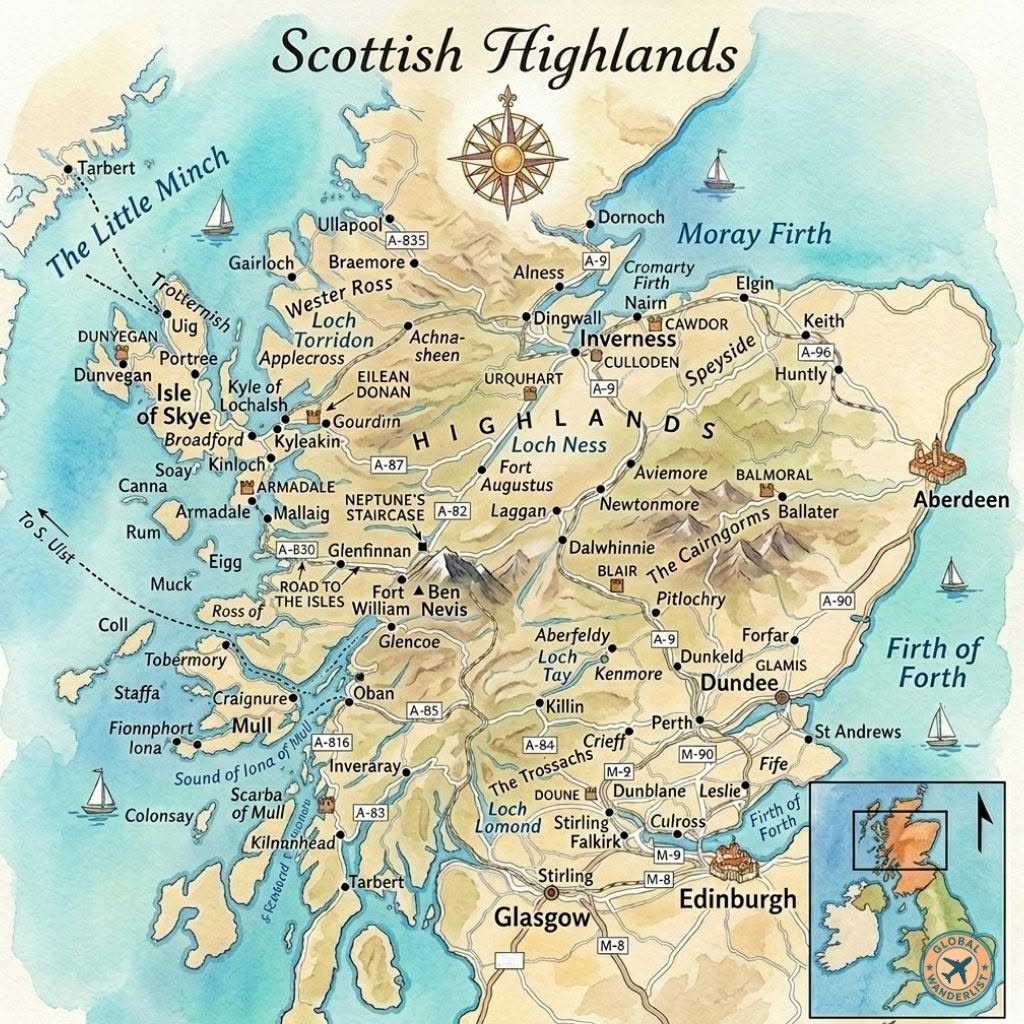
Scottish Highlands Tourist Map

The Scottish Highlands stretch across the northern half of the country in a landscape of jagged peaks, mirror still lochs, and windswept island coastlines. Ancient castles guard sea lochs, single track roads wind through glens steeped in clan history, and remote islands preserve a way of life shaped by centuries of isolation. Few regions in Europe offer this much dramatic scenery within such a well connected, if wonderfully wild, road network.

This guide covers the Highlands’ essential regions, from the Isle of Skye to the castles of royal Deeside. Below is a quick reference table, followed by detailed information on each area.

PlaceCategoryBest Known ForRecommended Visit Duration
Isle of Skye and the Little MinchIslandDramatic cliffs, otherworldly rock formations2-3 days
Wester Ross and the Northwest CoastCoastal regionRemote mountain scenery, sea lochs1-2 days
Eilean Donan and Kyle of LochalshCastle and gateway townIconic castle, island crossing pointHalf day to 1 day
Inverness, Loch Ness, and the Moray FirthCity and lochHighland capital, monster legend1-2 days
Speyside and the CairngormsWhisky region and national parkWhisky distilleries, mountain wilderness1-2 days
Fort William, Glencoe, and the Road to the IslesMountain town and glenBen Nevis, dramatic valley scenery1-2 days
The Inner HebridesIsland groupAncient abbey, dramatic sea caves2-3 days
Oban and ArgyllCoastal town and countrysideFerry gateway, seafood, castle grounds1 day
PerthshireCountryside regionLochs, distilleries, historic towns1-2 days
Stirling, Loch Lomond, and the TrossachsHistoric city and national parkMedieval castle, Scotland’s first national park1-2 days
Fife, Dundee, and the East CoastCoastal regionGolf heritage, design museum1-2 days
Aberdeen and the NortheastCity and royal countrysideGranite architecture, royal residence1-2 days

Isle of Skye and the Little Minch

The Isle of Skye ranks among Scotland’s most photographed landscapes, its jagged Cuillin mountains rising dramatically above sea lochs and crofting villages. Names like the Trotternish Ridge and Dunvegan Castle have become synonymous with Highland scenery at its wildest. The Little Minch, the stretch of water separating Skye from the Outer Hebrides, adds further drama to the island’s dramatic coastal setting.

What to See in Isle of Skye and the Little Minch

  • Portree, the island’s colorful harbor town, offers a good base with pastel buildings and easy access to Skye’s northern attractions.
  • Dunvegan Castle, ancestral seat of Clan MacLeod, ranks among the oldest continuously inhabited castles in Scotland, with gardens open to visitors.
  • The Trotternish Peninsula showcases dramatic rock formations, including landslip scenery that has drawn hikers and photographers for generations.
  • Uig serves as the ferry port connecting Skye to the Outer Hebrides across the Little Minch, a scenic crossing in its own right.
  • Broadford and Armadale offer quieter southern bases, with Armadale Castle gardens providing a peaceful historical stop.
  • Kyleakin, near the bridge connecting Skye to the mainland, offers easy access for those exploring both the island and Kyle of Lochalsh.

Wester Ross and the Northwest Coast

Wester Ross stretches along Scotland’s remote northwestern coastline, a region of towering mountains, sea lochs, and some of the country’s least populated landscapes. Loch Torridon and the Applecross peninsula rank among the most dramatic drives in Britain, with single track roads winding beneath ancient sandstone peaks. This corner of the Highlands rewards travelers seeking genuine wilderness over polished tourist infrastructure.

What to See in Wester Ross and the Northwest Coast

  • Loch Torridon offers some of Scotland’s most dramatic mountain scenery, with peaks rising directly from the water’s edge.
  • The Applecross Pass, known locally as Bealach na Bà, ranks among the highest and most thrilling mountain roads in Britain.
  • Ullapool serves as a charming fishing port and ferry gateway to the Outer Hebrides, with a lively harbor and good seafood.
  • Gairloch offers sandy beaches and whale watching opportunities along this rugged stretch of coastline.
  • Achnasheen provides a useful road and rail junction for those exploring the wider Wester Ross region.
  • Braemore Junction sits near the dramatic Corrieshalloch Gorge, a spectacular box canyon worth a short detour.

Eilean Donan and Kyle of Lochalsh

Eilean Donan Castle ranks among the most photographed castles in Scotland, its stone walls rising from a small tidal island where three sea lochs meet. Nearby Kyle of Lochalsh serves as the mainland gateway to the Isle of Skye, connected by a bridge that replaced the historic ferry crossing. This compact area offers some of the Highlands’ most iconic scenery within an easy stop along the main route to Skye.

What to See in Eilean Donan and Kyle of Lochalsh

  • Eilean Donan Castle offers guided tours through beautifully restored rooms, with the castle’s island setting creating one of Scotland’s most recognizable images.
  • Kyle of Lochalsh provides ferry and bridge access to Skye, along with pleasant harbor views over to the island.
  • Dornie village sits right beside Eilean Donan, offering a quiet base with excellent castle photography opportunities.
  • Kyleakin, just across the bridge on Skye, retains ruins of Castle Moil overlooking the narrow strait.
  • Plockton, a short drive from Kyle of Lochalsh, charms visitors with palm trees and a picture perfect harbor, an unusual sight this far north.

Inverness, Loch Ness, and the Moray Firth

Inverness anchors the Highlands as its unofficial capital, a compact riverside city that makes an ideal base for exploring Loch Ness and the surrounding countryside. The loch itself stretches for over 20 miles, its deep waters famous worldwide for monster legends, while Culloden Battlefield nearby marks a pivotal and somber chapter in Scottish history. The Moray Firth coastline adds dolphin watching and historic castles to the region’s appeal.

What to See in Inverness, Loch Ness, and the Moray Firth

  • Inverness Castle overlooks the River Ness, offering a scenic centerpiece to a walkable city center with pleasant riverside paths.
  • Urquhart Castle ruins sit dramatically on Loch Ness’s shore, one of the most visited historic sites in the Highlands.
  • Culloden Battlefield preserves the site of the 1746 battle that ended the Jacobite rising, with a detailed visitor center.
  • Cawdor Castle, with links to Shakespeare’s Macbeth, offers beautifully maintained gardens along with its historic rooms.
  • Fort Augustus, at the loch’s southern end, features a scenic set of locks along the Caledonian Canal.
  • The Cromarty Firth and Moray Firth coastline offer excellent chances to spot bottlenose dolphins from shore or boat tours.

Speyside and the Cairngorms

Speyside forms the heart of Scotland’s whisky country, home to more distilleries within a small area than anywhere else in the world. The Cairngorms National Park spreads across the region’s mountainous interior, Britain’s largest protected wilderness and home to ancient pine forest and rare wildlife. Together, this area offers both serious outdoor adventure and world class whisky tourism.

What to See in Speyside and the Cairngorms

  • Speyside’s whisky trail connects numerous working distilleries, offering tours and tastings through Scotland’s most concentrated whisky producing region.
  • Aviemore serves as the main gateway to the Cairngorms, with outdoor gear shops and access to skiing and hiking.
  • The Cairngorm Mountain Railway carries visitors toward the summit plateau, a dramatic Highland landscape without requiring a full trek.
  • Newtonmore and Dalwhinnie both offer smaller, quieter bases for exploring the southern Cairngorms.
  • Ballater and Balmoral showcase royal Deeside, with Balmoral Castle serving as the King’s private Highland residence.
  • Elgin, Keith, and Huntly round out the wider Speyside region, each offering historic architecture and easy whisky trail access.

Fort William, Glencoe, and the Road to the Isles

Fort William sits beneath Ben Nevis, Britain’s highest peak, making it the natural outdoor capital of the Highlands. Nearby Glencoe offers some of Scotland’s most dramatic and storied mountain scenery, framed by the memory of the 1692 massacre. The Road to the Isles continues west from here toward Glenfinnan and Mallaig, connecting to the ferry routes for Skye and the Small Isles.

What to See in Fort William, Glencoe, and the Road to the Isles

  • Ben Nevis offers Britain’s highest summit for serious hikers, along with gentler trails around its base for less demanding walks.
  • Glencoe’s steep mountain walls frame one of Scotland’s most photographed valleys, with hiking routes for every fitness level.
  • The Glenfinnan Viaduct, made famous by the Harry Potter films, carries the historic Jacobite steam train across a dramatic curved bridge.
  • Neptune’s Staircase, a series of locks on the Caledonian Canal near Fort William, offers an interesting stop for canal history.
  • Mallaig serves as the ferry port connecting the mainland to Skye and the Small Isles, with fresh seafood along its harbor.
  • The Road to the Isles route itself ranks among Scotland’s most scenic drives, connecting mountains, lochs, and coastline in a single journey.

The Inner Hebrides

The Inner Hebrides scatter across the sea west of the mainland, each island offering its own distinct character shaped by isolation and Gaelic heritage. Mull combines dramatic coastal scenery with the colorful harbor town of Tobermory, while nearby Iona holds deep spiritual significance as the birthplace of Scottish Christianity. Staffa’s basalt sea caves and the wilder islands of Coll, Colonsay, Rum, Eigg, Muck, and Canna add further variety to this island studded stretch of coast.

What to See in The Inner Hebrides

  • Tobermory’s brightly painted harbor buildings on Mull rank among the most photographed waterfronts in Scotland.
  • Iona Abbey marks one of the most important religious sites in Scottish history, founded by St. Columba in the 6th century.
  • Staffa’s Fingal’s Cave features dramatic hexagonal basalt columns, accessible by boat trips from Mull or Iona.
  • Craignure serves as Mull’s main ferry port, connecting the island to Oban on the mainland.
  • The smaller islands of Coll and Colonsay offer pristine beaches and a genuinely remote island experience away from the busier tourist routes.
  • Rum, Eigg, Muck, and Canna, collectively known as the Small Isles, reward travelers seeking wildlife and true island solitude.

Oban and Argyll

Oban serves as the gateway to the Inner and Outer Hebrides, a compact harbor town where ferries depart for Mull and beyond. Its curved waterfront and unfinished McCaig’s Tower give the town a distinctive silhouette recognizable throughout the region. Inland, Inveraray’s castle and the shores of Loch Lomond extend Argyll’s appeal into Scotland’s more accessible central Highlands.

What to See in Oban and Argyll

  • Oban’s harbor bustles with ferry traffic and fresh seafood stalls, making it an essential stop for island bound travelers.
  • McCaig’s Tower overlooks the town, offering sweeping views over the harbor and out toward Mull and Kerrera.
  • Inveraray Castle, seat of Clan Campbell, offers stately rooms and gardens along the shores of Loch Fyne.
  • Oban Distillery provides tours through one of Scotland’s oldest whisky producers, right in the town center.
  • Loch Lomond, Britain’s largest lake by surface area, anchors the southern edge of this region with excellent walking and boating.

Perthshire

Perthshire spreads across central Scotland’s countryside, often called Big Tree Country for its ancient forests and championship golf courses. Loch Tay and the surrounding glens offer some of the Highlands’ most accessible scenery, while towns like Pitlochry and Dunkeld combine historic charm with easy access to whisky and outdoor activities. This region works well for travelers wanting Highland scenery without venturing too far from central Scotland.

What to See in Perthshire

  • Loch Tay stretches beneath the Ben Lawers mountain range, with Kenmore village offering a scenic base at its eastern end.
  • Pitlochry combines a charming main street with nearby whisky distilleries and a salmon ladder worth watching in season.
  • Aberfeldy and Killin both offer smaller, quieter bases along this loch studded stretch of countryside.
  • Dunkeld’s cathedral ruins sit beautifully along the River Tay, a peaceful historic stop.
  • Blair Castle, ancestral home of the Dukes of Atholl, offers extensive gardens and Scotland’s only remaining private army.
  • Crieff and Dalwhinnie both provide access to well known whisky distilleries within the wider Perthshire whisky trail.

Stirling, Loch Lomond, and the Trossachs

Stirling holds outsized historical importance, its castle and nearby battlefields having shaped the course of Scottish independence. Just to the west, Loch Lomond and the Trossachs National Park offers accessible Highland scenery within easy reach of Glasgow and Edinburgh. This region works well as either a standalone destination or a scenic gateway before heading further north.

What to See in Stirling, Loch Lomond, and the Trossachs

  • Stirling Castle rivals Edinburgh’s in grandeur, perched on a volcanic crag with sweeping views over the Forth Valley.
  • The National Wallace Monument commemorates William Wallace, with a tower climb rewarding visitors with panoramic countryside views.
  • Loch Lomond offers boating, walking, and some of the most accessible Highland scenery in all of Scotland.
  • The Trossachs, sometimes called the Highlands in miniature, provide dramatic scenery within a compact, easily explored national park.
  • Doune Castle, a filming location for several major productions, offers an atmospheric medieval fortress open for tours.
  • Falkirk’s Kelpies, giant horse head sculptures, add a striking modern landmark to this historically rich region.

Fife, Dundee, and the East Coast

Fife and Dundee anchor Scotland’s east coast, offering a different character from the mountainous Highlands further west. St Andrews holds legendary status as the home of golf, while Dundee has transformed its industrial waterfront into a hub of design and culture. This coastal stretch pairs naturally with a Highlands trip for those extending their journey toward Edinburgh.

What to See in Fife, Dundee, and the East Coast

  • St Andrews Old Course remains the most storied golf course in the world, with dramatic cathedral ruins nearby along the coast.
  • The V&A Dundee showcases Scottish design within a striking waterfront building overlooking the River Tay.
  • Glamis Castle, childhood home of the late Queen Mother, offers stately rooms and extensive parkland near Forfar.
  • Perth’s compact center provides a pleasant stop along the River Tay, with easy access to both Highland and Lowland Scotland.
  • Culross preserves a remarkably well kept 17th century village, a favorite filming location for its authentic historic streets.

Aberdeen and the Northeast

Aberdeen anchors Scotland’s northeast coast, its distinctive granite architecture sparkling under sunlight after rain. Once a major fishing port, the city grew into the center of Britain’s North Sea oil industry while retaining a historic university quarter. The surrounding countryside, including royal Deeside near Balmoral, extends the region’s appeal into castle studded countryside.

What to See in Aberdeen and the Northeast

  • Old Aberdeen preserves cobblestone streets and historic university buildings, offering a quieter pace than the busier city center.
  • Aberdeen Beach stretches for two miles along the North Sea, a popular walking spot despite the region’s cooler climate.
  • Huntly and Keith both sit within easy reach of Speyside’s whisky trail, combining small town charm with distillery access.
  • Elgin’s cathedral ruins, once one of Scotland’s finest churches, offer an atmospheric historic stop in the northeast.
  • The wider Aberdeenshire countryside holds numerous castles, adding further depth for travelers extending their trip beyond the city itself.

Beyond the Postcard Views

The Scottish Highlands reward travelers who venture beyond their most photographed lochs and castles. Remote island coastlines, ancient whisky trails, and ancient abbeys all sit within reach of a well connected, if wonderfully winding, road network. Few regions in Europe offer this much dramatic scenery within such a manageable journey.

Give yourself time to explore both the well known routes around Loch Ness and Skye and the quieter corners of Wester Ross or the Small Isles. Whether you come for Eilean Donan’s iconic silhouette, a dram on the Speyside whisky trail, or the sea caves of Staffa, the Scottish Highlands leave a lasting impression well beyond their postcard views.