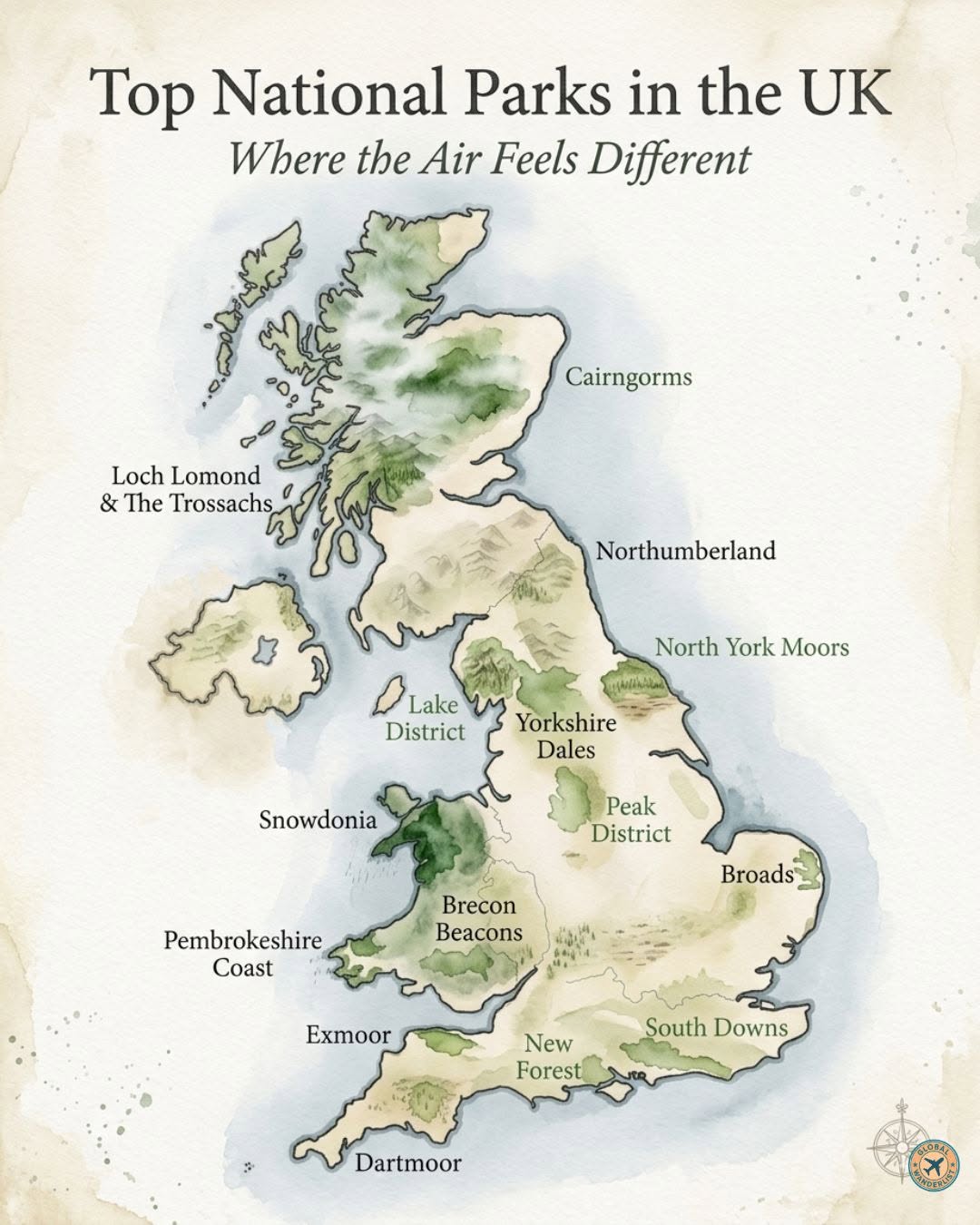
Top National Parks in the UK

The United Kingdom packs an extraordinary variety of landscapes into a compact island, protected across fifteen national parks spanning Scotland, England, and Wales. Jagged Highland peaks give way to chalk cliffs, ancient moorland, and gentle river valleys, each park offering its own distinct character. Few countries this size protect such a wide range of scenery within such an accessible network of trails and villages.

This guide covers all fifteen UK national parks, from the Scottish Highlands to the southern coast. Below is a quick reference table, followed by detailed information on each park.

PlaceCategoryBest Known ForRecommended Visit Duration
CairngormsMountain wildernessBritain’s largest park, wildlife, skiing2-3 days
Loch Lomond and The TrossachsLoch and mountain sceneryScotland’s first national park, accessible Highlands1-2 days
NorthumberlandMoorland and dark sky reserveHadrian’s Wall, stargazing1-2 days
North York MoorsHeather moorlandSteam railway, coastal villages1-2 days
Yorkshire DalesLimestone valleysWaterfalls, dry stone walls, caving1-2 days
Lake DistrictMountains and lakesWordsworth heritage, fell walking2-3 days
Peak DistrictMoorland and gritstone edgesBritain’s first national park, walking trails1-2 days
SnowdoniaWelsh mountainsHighest peak in Wales, slate heritage2-3 days
Brecon BeaconsWelsh mountains and waterfallsDark sky reserve, waterfall walks1-2 days
Pembrokeshire CoastCoastal cliffsCoastal path, beaches, wildlife2-3 days
BroadsWetland waterwaysBoating, wildlife, flat wetland scenery1-2 days
ExmoorMoorland and coastWild ponies, dark sky reserve1-2 days
New ForestAncient woodlandFree-roaming ponies, cycling trails1-2 days
South DownsChalk downlandRolling hills, coastal cliffs1-2 days
DartmoorGranite moorlandWild tors, ancient stone circles1-2 days

Cairngorms

The Cairngorms National Park spreads across Scotland’s largest protected wilderness, a landscape of ancient pine forest, mountain plateaus, and glacial lochs. This is Britain’s premier destination for spotting wildlife including red deer, golden eagles, and the elusive Scottish wildcat. The park supports everything from gentle loch walks to serious winter mountaineering.

What to See in Cairngorms

  • The Cairngorm Mountain Railway carries visitors up toward the summit plateau, offering sweeping views without a full mountain trek.
  • Loch Morlich provides a scenic lake setting surrounded by pine forest, popular for watersports and relaxed walking.
  • Rothiemurchus Forest showcases ancient Caledonian pine woodland, home to red squirrels and a rich variety of birdlife.
  • Aviemore serves as the park’s main gateway town, offering outdoor gear shops and a convenient hiking base.
  • Winter visitors can access Scotland’s main skiing area within the park, one of Britain’s few reliable snow sports destinations.

Loch Lomond and The Trossachs

Loch Lomond and The Trossachs became Scotland’s first national park in 2002, offering accessible Highland scenery within easy reach of Glasgow. Britain’s largest lake by surface area anchors the park’s western edge, while the Trossachs earn their nickname as the Highlands in miniature. This region works well as either a standalone destination or a scenic gateway before heading further north.

What to See in Loch Lomond and The Trossachs

  • Loch Lomond offers boating, swimming, and walking trails along one of Scotland’s most iconic bodies of water.
  • Ben Lomond, the park’s highest peak, rewards hikers with sweeping views over the loch and surrounding hills.
  • The Trossachs’ compact glens and lochs pack dramatic scenery into an easily explored, smaller scale landscape.
  • Loch Katrine offers steamship cruises aboard a historic Victorian vessel, a relaxed way to see the surrounding hills.
  • Aberfoyle serves as a convenient base for exploring the Trossachs, with good access to forest walking trails.

Northumberland

Northumberland National Park protects England’s northernmost wilderness, a landscape of open moorland stretching toward the Scottish border. Hadrian’s Wall cuts through the park’s southern edge, adding nearly two thousand years of Roman history to the wild scenery. The park also holds status as one of Europe’s largest Dark Sky Parks, drawing stargazers from across the country.

What to See in Northumberland

  • Hadrian’s Wall offers walkable sections of this UNESCO World Heritage Roman frontier, with forts and museums along its length.
  • The park’s Dark Sky status makes it one of the best stargazing locations in England, especially during new moon periods.
  • Kielder Water and Forest Park combines England’s largest man-made lake with extensive cycling and walking trails.
  • The Cheviot Hills offer remote, rolling moorland hikes near the Scottish border, popular with serious walkers.
  • Simonside Hills provide relatively accessible hiking with rewarding panoramic views over the surrounding valley.

North York Moors

The North York Moors combine heather covered moorland with a dramatic coastline along the North Sea. Steam trains still cross this landscape on a historic heritage railway, connecting the park to seaside towns like Whitby. Late summer transforms the moors into a sea of purple heather, one of England’s most striking seasonal displays.

What to See in North York Moors

  • The North Yorkshire Moors Railway offers a scenic steam train journey through the heart of the park, popular with families.
  • Whitby, on the park’s coastal edge, charms visitors with its abbey ruins and connections to Bram Stoker’s Dracula.
  • Late summer heather blooms transform the moors into vivid purple, especially striking from elevated viewpoints.
  • Rosedale offers quieter, less crowded moorland walking away from the park’s busier tourist routes.
  • The coastal path along Robin Hood’s Bay provides dramatic cliff scenery and access to a charming fishing village.

Yorkshire Dales

The Yorkshire Dales showcase a landscape shaped by limestone, with dramatic valleys, waterfalls, and dry stone walls crisscrossing the hillsides. This park has long attracted hikers to its network of well marked trails, including sections of the famous Pennine Way. Traditional market towns dot the valleys, offering a genuine taste of rural Yorkshire life.

What to See in Yorkshire Dales

  • Malham Cove’s dramatic limestone amphitheater ranks among the park’s most photographed natural features, with a rewarding clifftop walk.
  • Aysgarth Falls offers a series of picturesque waterfalls along the River Ure, an easy and popular walking destination.
  • The Settle-Carlisle railway crosses the dales via the iconic Ribblehead Viaduct, a scenic journey through dramatic countryside.
  • Gordale Scar provides a dramatic limestone gorge experience for more adventurous hikers willing to scramble.
  • Traditional market towns like Hawes offer a genuine taste of Dales life, along with locally made cheese.

Lake District

The Lake District rises from northern England in a landscape of glacial lakes ringed by rugged fells. William Wordsworth found his lifelong inspiration here, and the park remains deeply tied to Romantic era poetry and literature. Its combination of natural drama and cultural heritage earned UNESCO World Heritage status.

What to See in Lake District

  • Windermere, England’s largest lake, offers scenic steamer cruises and a lively lakeside town at Bowness.
  • Grasmere preserves Wordsworth’s former home at Dove Cottage, a pilgrimage site for literature lovers.
  • Derwentwater and the town of Keswick provide an excellent base for fell walking and boat trips.
  • Scafell Pike, England’s highest peak, challenges serious hikers with dramatic summit views.
  • Ullswater offers historic steamer cruises alongside the scenic Aira Force waterfall walk.

Peak District

The Peak District holds the distinction of being Britain’s first national park, designated in 1951 to protect its rolling moorland and dramatic gritstone edges. Its location within easy reach of Manchester and Sheffield makes it one of the most visited parks in the country. Limestone caverns, historic market towns, and stately homes add further depth beyond the open moorland.

What to See in Peak District

  • Kinder Scout, the park’s highest point, holds deep significance as the site of a pivotal 1932 mass trespass for public access rights.
  • Chatsworth House offers a grand stately home and gardens, one of England’s finest surviving country estates.
  • The Peak District’s limestone caverns near Castleton offer underground tours through dramatic cave systems.
  • Bakewell, famous for its pudding, provides a charming market town base for exploring the southern park.
  • Stanage Edge offers dramatic gritstone cliff scenery, popular with rock climbers and photographers alike.

Snowdonia

Snowdonia protects Wales’s most dramatic mountain landscape, home to Mount Snowdon, the highest peak in Wales and England combined. A historic mountain railway carries visitors toward the summit, while slate quarrying heritage reflects the region’s industrial past. The park’s rugged scenery has made it one of Britain’s premier destinations for hiking and climbing.

What to See in Snowdonia

  • Mount Snowdon offers several hiking routes to its summit, along with a historic railway for those preferring not to walk.
  • The Snowdon Mountain Railway carries visitors to the summit via Britain’s only public rack and pinion railway.
  • Llyn Idwal and the surrounding Ogwen Valley provide dramatic glacial scenery popular with hikers and photographers.
  • Portmeirion, a colorful Italianate village just outside the park, offers a quirky architectural contrast to the mountains.
  • The National Slate Museum in Llanberis explores the region’s industrial heritage within a former slate quarry.

Brecon Beacons

The Brecon Beacons, recently renamed Bannau Brycheiniog, protect a landscape of rounded peaks, waterfalls, and dark sky reserves in South Wales. Pen y Fan, the park’s highest peak, draws hikers seeking sweeping views over the surrounding countryside. A cluster of dramatic waterfalls near Ystradfellte has earned the area the nickname Waterfall Country.

What to See in Brecon Beacons

  • Pen y Fan offers the park’s most popular hike, with sweeping views rewarding those who reach its summit.
  • Waterfall Country near Ystradfellte features several dramatic cascades, including one walkable route behind the falling water.
  • The park’s Dark Sky Reserve status makes it an excellent stargazing destination, particularly on clear winter nights.
  • Brecon town provides a good base for exploring the park, with a historic cathedral and canal side walks.
  • Llangorse Lake offers watersports and a scenic contrast to the surrounding mountainous terrain.

Pembrokeshire Coast

Pembrokeshire Coast National Park protects one of Britain’s most dramatic coastlines, its cliffs, beaches, and offshore islands teeming with wildlife. The Wales Coast Path traces the park’s entire shoreline, offering some of the best coastal walking in the country. This is the UK’s only national park designated primarily for its coastline rather than inland scenery.

What to See in Pembrokeshire Coast

  • The Pembrokeshire Coast Path stretches for 186 miles, offering dramatic cliff walks with frequent access points for shorter sections.
  • Skomer Island hosts one of Britain’s largest puffin colonies, accessible by boat trip during the spring breeding season.
  • St Davids, Britain’s smallest city, features a stunning cathedral tucked into a valley near the coast.
  • Barafundle Bay ranks among the most beautiful beaches in Wales, reachable via a scenic coastal walk.
  • Tenby’s colorful harbor town offers a charming base with sandy beaches right in town.

Broads

The Broads spread across a unique wetland landscape in eastern England, a network of rivers and shallow lakes formed by medieval peat digging. This flat, watery national park offers boating rather than hiking as its signature activity, with hire boats a popular way to explore. Rich birdlife and rare wetland habitats make it an important conservation area alongside its recreational appeal.

What to See in Broads

  • Boat hire remains the essential Broads experience, letting visitors explore the network of rivers and lakes at a relaxed pace.
  • Wroxham, often called the capital of the Broads, offers boat rental and a good base for exploring the waterways.
  • How Hill provides nature trails and a historic thatched house overlooking the River Ant.
  • Hickling Broad, the largest of the Broads, offers excellent birdwatching including rare species like the marsh harrier.
  • Wherry sailing boats, traditional to the region, offer a scenic and historic way to experience the waterways.

Exmoor

Exmoor stretches across the border of Devon and Somerset, a landscape of high moorland meeting dramatic Atlantic coastline. Wild Exmoor ponies roam freely across the park, a breed with ancient roots in the region. Its Dark Sky Reserve status, the first in Europe, makes it an exceptional destination for stargazing.

What to See in Exmoor

  • Wild Exmoor ponies roam freely across the moor, an ancient breed that has grazed this landscape for centuries.
  • Dunkery Beacon, the park’s highest point, offers sweeping views across the moor toward the Bristol Channel.
  • The coastal village of Lynmouth combines dramatic cliff scenery with a historic water powered cliff railway.
  • Tarr Steps, an ancient clapper bridge, offers a scenic and historic river crossing popular with photographers.
  • Exmoor’s Dark Sky Reserve status makes it one of the best stargazing locations in England.

New Forest

The New Forest protects ancient woodland and heathland in southern England, established as a royal hunting ground nearly a thousand years ago by William the Conqueror. Free-roaming ponies wander through both the forest and its villages, a defining and beloved feature of the park. Extensive cycling trails make it one of the most accessible national parks for family visits.

What to See in New Forest

  • Free-roaming ponies wander throughout the park, a distinctive sight found in villages as much as open heathland.
  • Extensive cycling trails crisscross the forest, making it one of England’s best national parks for family biking.
  • Beaulieu offers a historic abbey and motor museum, adding cultural depth to a New Forest visit.
  • Lyndhurst, the park’s main town, provides a good base with shops, cafes, and a visitor center.
  • Rufus Stone marks the spot where King William II reportedly died in a hunting accident, an interesting historical curiosity.

South Downs

The South Downs stretch across rolling chalk downland in southern England, connecting historic market towns with dramatic coastal cliffs. Britain’s newest national park, designated in 2010, offers gentle walking trails through a landscape long shaped by agriculture. The white cliffs at Beachy Head mark one of the park’s most striking natural landmarks.

What to See in South Downs

  • Beachy Head offers dramatic white chalk cliffs and sweeping views along the English Channel coastline.
  • The South Downs Way provides a 100-mile walking and cycling route through the heart of the park’s rolling hills.
  • Arundel Castle, just within the park’s boundary, offers a stately medieval fortress with extensive gardens.
  • Winchester, near the park’s western edge, features a historic cathedral and charming riverside walks.
  • Devil’s Dyke provides one of the park’s most popular viewpoints, a dramatic valley carved by glacial meltwater.

Dartmoor

Dartmoor protects a wild, granite landscape in southwest England, dotted with distinctive rock formations called tors and ancient stone circles. This bleak, atmospheric moorland has inspired countless stories, including Arthur Conan Doyle’s Hound of the Baskervilles. Wild ponies and a strong sense of remoteness define much of the park’s character.

What to See in Dartmoor

  • Haytor Rocks offers one of Dartmoor’s most accessible and photographed granite tors, with sweeping moorland views.
  • Wistman’s Wood provides an atmospheric, ancient oak woodland unlike anywhere else on the moor.
  • Dartmoor’s numerous Bronze Age stone circles and ancient settlements reflect thousands of years of human history.
  • Wild Dartmoor ponies roam freely across the moor, a hardy breed adapted to the harsh conditions.
  • Princetown offers a good base for exploring the park, along with the historic Dartmoor Prison Museum.

Beyond the Postcard Views

The UK’s fifteen national parks reward travelers who venture beyond the country’s famous cities. Ancient moorland, dramatic coastlines, and glacial lakes all sit within reach of a well connected transport network. Few countries this compact protect such a wide range of landscapes within such an accessible distance.

Give yourself time to explore beyond each park’s most famous viewpoint, since quieter trails and villages often hold the most rewarding discoveries. Whether you come for the fells of the Lake District, the cliffs of Pembrokeshire, or the wild ponies of Dartmoor, these fifteen parks leave a lasting impression well beyond their postcard views.