
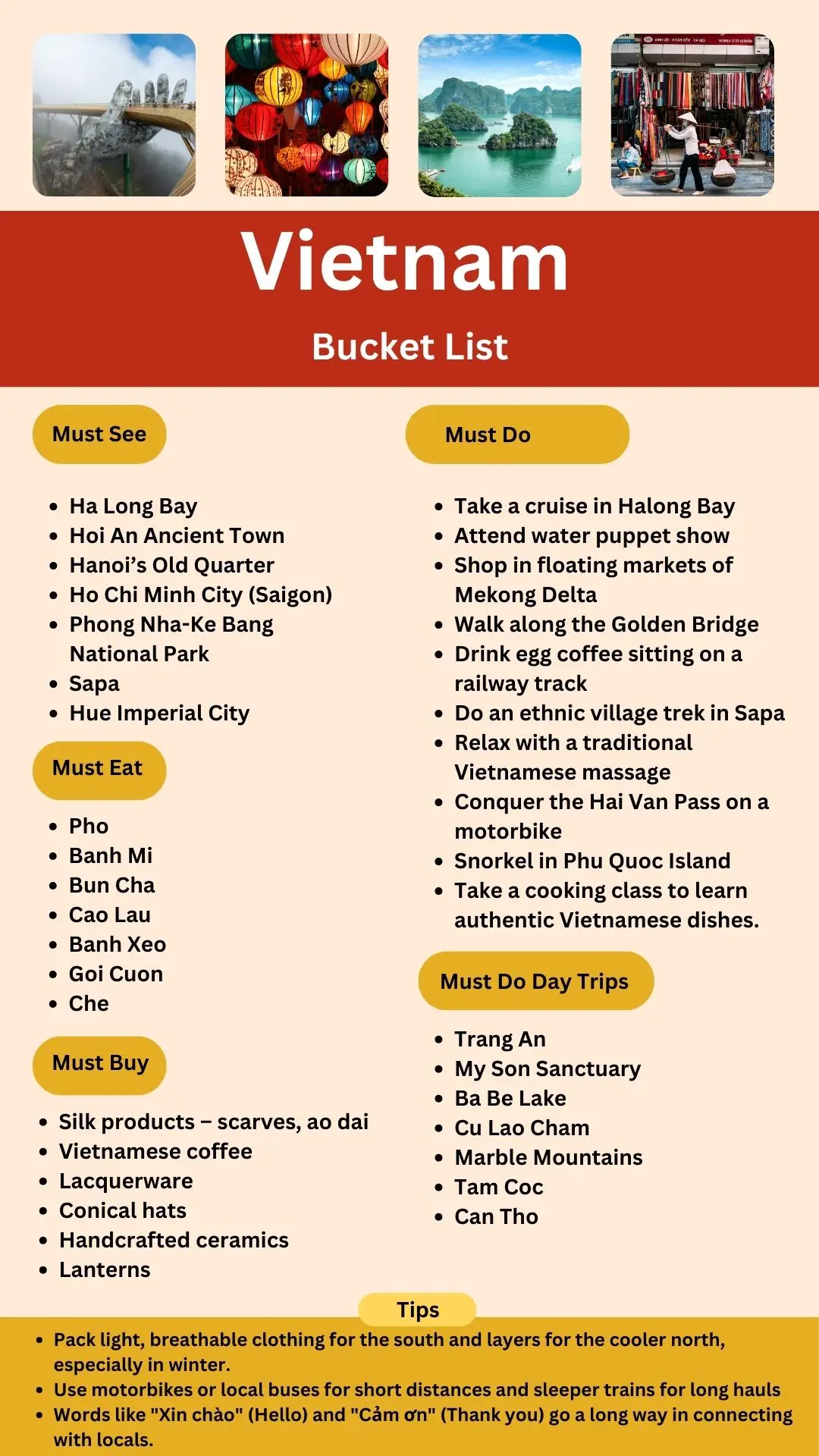
Vietnam stretches over 1,600 kilometers from north to south, and its bucket list reflects that geographic diversity. Limestone islands rise from emerald water in the north, while the Mekong Delta unfolds in a maze of rivers and floating markets in the south. Deciding where to focus can be genuinely difficult given how much the country offers.
This guide breaks Vietnam’s biggest draws into manageable categories, from landmarks to food to practical travel tips. Whether you have ten days or a full month, it should help shape a trip that captures the country’s range without feeling rushed.
Must-See Landmarks Across Vietnam
Vietnam’s landmarks span dramatic natural scenery and centuries of layered history. Ha Long Bay remains the country’s most iconic image, with thousands of limestone karsts rising from the Gulf of Tonkin. Hoi An Ancient Town offers a completely different kind of beauty, its lantern-lit streets preserved almost unchanged since the 15th century.
Hanoi’s Old Quarter and Ho Chi Minh City both showcase Vietnam’s urban energy, though each carries a distinct character shaped by the country’s north-south divide. Phong Nha-Ke Bang National Park, Sapa’s terraced hillsides, and Hue’s former Imperial City round out a list that moves from coast to mountains to royal history.
Planning Tips for Landmark Hopping
- Group northern landmarks like Ha Long Bay, Hanoi, and Sapa into one leg of your trip, since they sit relatively close together.
- Treat Hoi An and Hue as a central Vietnam pairing, easily connected by a short drive or train ride.
- Save Ho Chi Minh City and the Mekong Delta for a separate southern leg, given the distance from the northern and central regions.
Best Photo Spots
- Photograph Ha Long Bay from an early morning cruise, when the water is calmest and mist often clings to the karsts.
- Capture Hoi An’s lanterns at dusk along the riverside, just as they begin to glow against the fading daylight.
- Shoot Sapa’s rice terraces during the June planting season or the September harvest, when the fields shift to vivid green or gold.
Must-Do Experiences in Vietnam
Some Vietnam experiences are worth building an entire day, or even a detour, around. A Halong Bay cruise remains the essential way to see the bay’s limestone islands up close, often including overnight options aboard traditional junk boats. A traditional water puppet show in Hanoi offers a genuinely unique cultural experience, rooted in centuries-old rice paddy performance traditions.
Shopping the floating markets of the Mekong Delta, walking across Ba Na Hills’ Golden Bridge, and drinking egg coffee while sitting beside Hanoi’s famous train tracks each offer a distinctly Vietnamese moment. An ethnic village trek in Sapa, a traditional Vietnamese massage, riding the Hai Van Pass by motorbike, snorkeling off Phu Quoc Island, and a hands-on cooking class round out a strong list of hands-on experiences.
Booking These Experiences Ahead
- Reserve a Halong Bay overnight cruise several weeks in advance during peak season between October and April.
- Book Sapa trekking guides ahead if visiting during the busier September to November period, when demand is highest.
- Confirm cooking class schedules early in Hoi An or Ho Chi Minh City, since the most reputable classes often sell out days ahead.
Combining Multiple Experiences
- Pair a Halong Bay cruise with time in Hanoi, since the bay sits within a few hours’ drive of the capital.
- Combine the Hai Van Pass motorbike ride with stops in both Hue and Da Nang, since the pass connects the two cities directly.
- Add Phu Quoc Island snorkeling to a broader southern Vietnam itinerary, given its short flight connection from Ho Chi Minh City.
Food You Need to Try Across Vietnam
Vietnamese cuisine is built around fresh herbs, balanced broths, and a strong regional identity that shifts noticeably from north to south. Pho, the country’s most internationally recognized dish, varies considerably between Hanoi’s cleaner, simpler broth and the more herb-heavy versions found further south. Banh Mi, a French-influenced baguette sandwich, has become a genuine national obsession.
Bun Cha, grilled pork served with rice noodles and dipping sauce, remains a Hanoi specialty worth seeking out. Cao Lau, a noodle dish unique to Hoi An, and Banh Xeo, a crispy stuffed pancake, both showcase regional specialties. Goi Cuon, fresh spring rolls, and Che, a category of sweet dessert soups, round out a strong list for food-focused travelers.
Where Regional Specialties Taste Best
- Try Bun Cha in Hanoi, ideally at a small local restaurant rather than a tourist-oriented spot, for the most authentic version.
- Sample Cao Lau specifically in Hoi An, since the dish traditionally uses water drawn from a particular local well.
- Look for fresh Goi Cuon from street vendors throughout the south, where the dish is most commonly found.
Pairing Food with Regional Travel
- Combine a Pho tasting with time in both Hanoi and Ho Chi Minh City to compare the dish’s distinct northern and southern styles.
- Sample Banh Xeo alongside a Mekong Delta boat trip, since the dish’s crispy, stuffed style is especially popular in the south.
- Save Che for an afternoon break during Hoi An sightseeing, when the day’s heat makes a cold dessert soup especially welcome.
Souvenirs Worth Buying in Vietnam
Vietnam offers a strong range of souvenirs rooted in genuine local craft traditions. Silk products, including scarves and traditional ao dai garments, remain among the most popular purchases, particularly from Hoi An’s many tailoring shops. Vietnamese coffee, known for its strong, distinctive flavor, travels well and makes an easy gift.
Lacquerware, a craft with centuries of history in Vietnam, offers intricately finished bowls, trays, and decorative items. Conical hats, handcrafted ceramics, and colorful lanterns round out a shopping list that reflects the country’s strong artisan traditions.
Finding Authentic, Quality Souvenirs
- Buy silk products directly from Hoi An’s tailoring shops, where quality and craftsmanship are generally more reliable than mass-market alternatives.
- Look for genuine lacquerware with a smooth, deeply layered finish, since lower-quality imitations often have a duller, less consistent surface.
- Purchase Vietnamese coffee from a dedicated coffee shop or roastery rather than a tourist market stall for better quality assurance.
Budget-Friendly Shopping Tips
- Bargain respectfully at local markets, since haggling is an expected and normal part of shopping in Vietnam.
- Buy conical hats and ceramics in smaller regional towns rather than major tourist hubs, where prices tend to run higher.
- Purchase lanterns in Hoi An itself, since the town remains the primary source and offers the widest selection.
Must-Do Day Trips Across Vietnam
Vietnam’s compact geography makes several worthwhile day trips possible from its major hub cities. Trang An, a UNESCO-listed landscape of limestone karsts and cave systems, sits within easy reach of Ninh Binh, often called Ha Long Bay on land. My Son Sanctuary, a cluster of ancient Cham temple ruins, offers a quieter historical detour near Hoi An.
Ba Be Lake, the largest natural lake in Vietnam, and Cu Lao Cham, a marine protected island near Hoi An, both reward travelers willing to venture slightly off the main circuit. The Marble Mountains near Da Nang, the karst scenery of Tam Coc, and the riverside city of Can Tho round out a strong list of accessible day trips.
Choosing the Right Day Trip
- Pick Trang An or Tam Coc if you want karst scenery similar to Ha Long Bay without the longer boat journey.
- Choose My Son Sanctuary if ancient history and temple architecture appeal more than natural landscapes.
- Visit Can Tho if you want a genuine look at Mekong Delta life, including its famous floating markets.
Practical Tips for Day Trips
- Book Trang An boat tours early in the day to avoid both crowds and the stronger midday heat.
- Hire a local guide for My Son Sanctuary, since the site’s history is far richer with proper context.
- Arrange Can Tho floating market visits for early morning, since vendor activity dies down significantly by mid-morning.
Best Time to Visit and Practical Travel Tips
Vietnam’s long shape means weather varies significantly by region at any given time of year, making a single “best time to visit” difficult to pin down. Northern Vietnam experiences a cooler, sometimes chilly winter, while the south stays warm and humid year-round with a distinct wet and dry season. Central Vietnam sits somewhere between the two, with its own rainy season typically running from September through January.
Packing accordingly matters more in Vietnam than in many destinations, given how much the climate shifts between regions. Transportation choices also vary considerably depending on distance and budget.
Packing and Climate Tips
- Pack light, breathable clothing for southern and central Vietnam, since heat and humidity remain fairly constant.
- Bring warmer layers if traveling to northern Vietnam or Sapa during winter, when temperatures can drop significantly.
- Carry a light rain jacket regardless of season, since sudden downpours are common throughout much of the country.
Getting Around Vietnam
- Use motorbikes or local buses for short distances within cities or between nearby towns, since they offer flexibility and affordability.
- Book sleeper trains for longer overnight hauls, such as between Hanoi and Da Nang, a comfortable alternative to flying.
- Learn a few basic Vietnamese phrases like “Xin chào” for hello and “Cảm ơn” for thank you, since locals respond warmly to the effort.
Final Thoughts
Vietnam’s bucket list spans limestone bays, ancient towns, and a food culture that shifts dramatically from north to south. Whether your priority is landmark sightseeing, hands-on cultural experiences, or simply eating your way through the country, Vietnam rewards travelers who build in enough time to slow down. Pack for the region you are visiting, embrace the bargaining culture at local markets, and let a few Vietnamese phrases open doors with the people you meet along the way.