
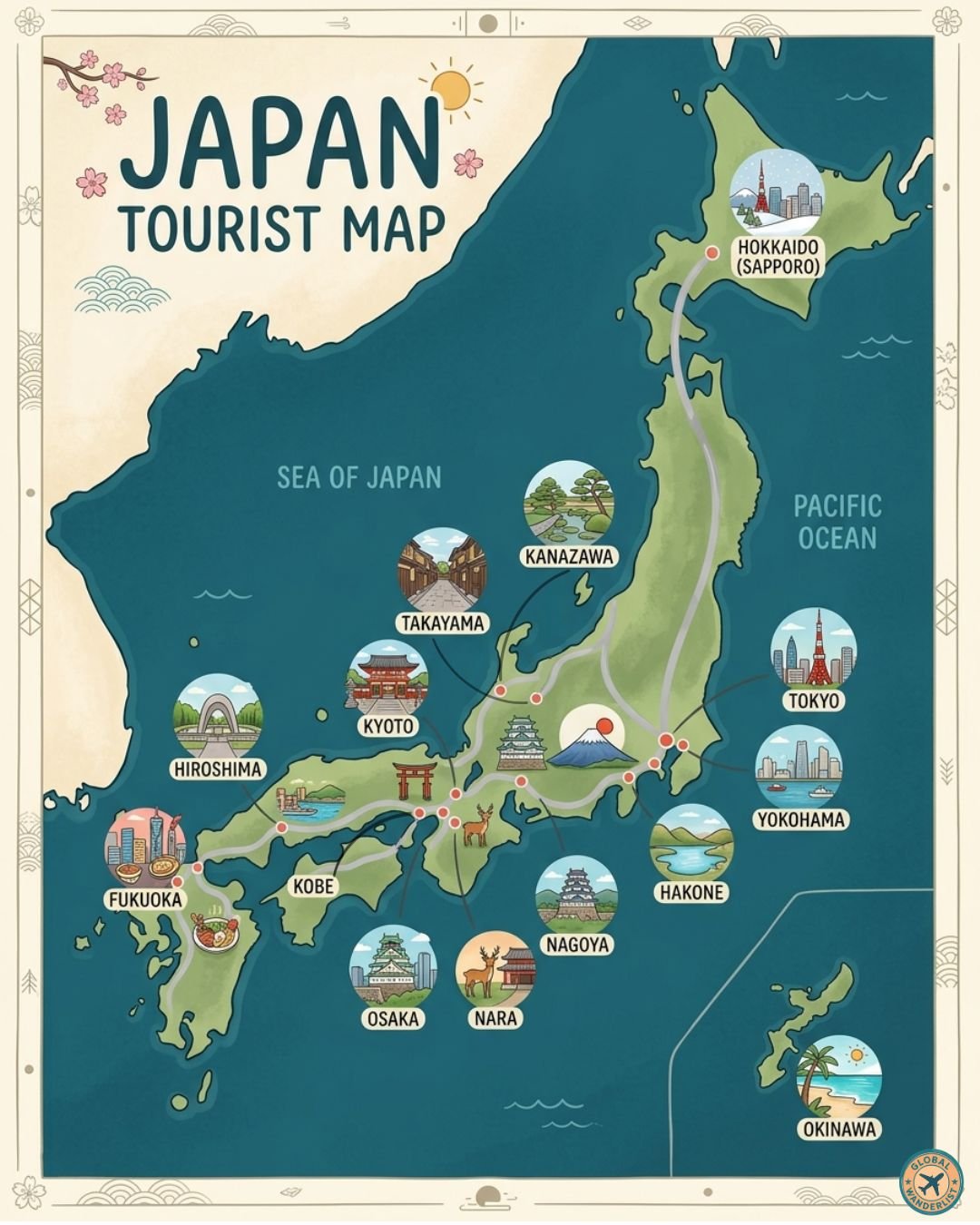
Japan stretches long and narrow, running from snowy Hokkaido in the north to tropical Okinawa in the south. That length means weather, food, and culture shift dramatically depending on where you land. Most visitors pick a handful of regions rather than trying to cover the whole country in one trip.
This guide walks through Japan’s major tourist regions, followitng the route most travelers use when planning. Below is a region by region breakdown, covering what to see and when to go.
Regions Overview
| Region | Key Cities | Best Known For |
| Kanto | Tokyo, Yokohama, Hakone | City life, hot springs, Mount Fuji views |
| Kansai | Kyoto, Osaka, Nara, Kobe | Temples, food, ancient capitals |
| Chubu | Nagoya, Takayama, Kanazawa | Castles, mountain villages, gardens |
| Chugoku | Hiroshima | Peace history, island shrines |
| Kyushu | Fukuoka | Ramen, hot springs, island food |
| Hokkaido | Sapporo | Snow, seafood, wide open space |
| Okinawa | Naha | Beaches, coral reefs, island culture |
Each region rewards a different kind of trip. Some suit a quick day visit, others need a week on their own.
Kanto: Tokyo, Yokohama, and Hakone
Tokyo sits at the center of this region, Japan’s largest city and most common entry point. Yokohama, just south, offers a calmer port city feel with its own waterfront charm. Hakone, further out in the mountains, gives travelers hot springs and Mount Fuji views without leaving the region.
Most first-time visitors base themselves in Tokyo and take day trips from there. The train network makes this easy, with Hakone reachable in under two hours.
What to See in Kanto
- Tokyo Tower and Skytree: These two towers give visitors sweeping city views from opposite sides of town.
- Yokohama Chinatown: This is one of the largest Chinatowns in the world, packed with food stalls and old gates.
- Hakone Open-Air Museum: Sculptures sit scattered across hillside grounds, with Fuji visible on clear days.
- Lake Ashi: Boats cross this lake in Hakone, giving riders a rare angle on Mount Fuji.
Best Time to Visit
- Visit late March through early April for cherry blossoms across Tokyo’s parks.
- Travel in autumn between October and November for cooler weather and fall colors in Hakone.
- Avoid the peak summer heat in August if you plan on walking a lot.
Getting Around This Region
- Use Tokyo’s subway and JR lines, both fast and easy once you get the hang of them.
- Take the Odakyu Romancecar train directly from Shinjuku to Hakone.
- Buy a Hakone Free Pass if you plan to use buses and cable cars there for more than a day.
Kansai: Kyoto, Osaka, Nara, and Kobe
Kyoto served as Japan’s capital for over a thousand years, and its temples still show that history everywhere. Osaka sits close by, louder and more food-focused, known for street eats and neon-lit nightlife. Nara, a short train ride from both, is famous for its deer that wander freely through the park. Kobe rounds out the region, known worldwide for its beef.
This cluster of cities works well together, since trains connect them all within an hour or less.
What to See in Kansai
- Fushimi Inari Shrine: Thousands of red gates climb a hillside just outside Kyoto.
- Dotonbori: Osaka’s famous canal-side strip glows with giant neon signs and street food stalls.
- Nara Park: Deer roam freely here, and many will bow for a snack.
- Kobe Harborland: This waterfront area mixes shopping with views of the city’s famous port.
Best Time to Visit
- Visit in early April for Kyoto’s cherry blossoms along the Philosopher’s Path.
- Travel in November for Kyoto’s fall foliage, considered some of the best in Japan.
- Avoid the rainy season in June if outdoor sightseeing matters to you.
Getting Around This Region
- Take the JR Kyoto Line between Kyoto and Osaka, running frequently and taking under 30 minutes.
- Use the Nara Line for an easy day trip from either Kyoto or Osaka.
- Walk Kyoto’s older districts on foot, since many temples sit close together.
Chubu: Nagoya, Takayama, and Kanazawa
Nagoya serves as the main gateway to central Japan, home to a rebuilt castle and a strong car industry history. Takayama sits deeper in the mountains, its old town preserved with wooden merchant houses. Kanazawa, further north, holds one of Japan’s most respected traditional gardens.
This region moves at a slower pace than Tokyo or Osaka, and many travelers find it a welcome change partway through a trip.
What to See in Chubu
- Nagoya Castle: This rebuilt castle sits at the heart of the city, surrounded by gardens.
- Takayama Old Town: Wooden buildings line these streets, many still run as shops and sake breweries.
- Kenrokuen Garden: Kanazawa’s garden ranks among the top three traditional gardens in Japan.
- Shirakawa-go: This nearby village has thatched-roof farmhouses, especially striking under snow.
Best Time to Visit
- Visit in winter for Shirakawa-go’s snow-covered rooftops, best seen from December through February.
- Travel in spring or autumn for comfortable walking weather in Takayama’s old streets.
- Check Kanazawa’s garden hours carefully, since seasonal illuminations run only on certain evenings.
Getting Around This Region
- Take the Shinkansen to Nagoya, then connect by local train or bus further into the mountains.
- Ride the highway bus from Takayama to Shirakawa-go, since no train line reaches the village.
- Use the Hokuriku Shinkansen for a direct, fast route to Kanazawa from Tokyo.
Chugoku: Hiroshima
Hiroshima carries a weight few other cities do, its Peace Memorial Park standing as a lasting reminder of 1945. Beyond that history, the city has rebuilt into a modern, walkable place with its own local food culture. A short ferry ride away, Miyajima Island holds one of Japan’s most photographed shrines.
Most visitors treat Hiroshima as a day trip from Kyoto or Osaka, though staying overnight lets you see Miyajima properly.
What to See in Hiroshima
- Peace Memorial Park: This park holds the Atomic Bomb Dome and a museum documenting the 1945 bombing.
- Miyajima Island: A floating torii gate here appears to rise straight out of the water at high tide.
- Hiroshima Castle: A rebuilt castle sits within walking distance of downtown.
- Okonomiyaki streets: Hiroshima’s version of this savory pancake dish gets its own dedicated food alleys.
Best Time to Visit
- Visit in spring or autumn for mild weather across both Hiroshima and Miyajima.
- Time your Miyajima visit around high tide, when the floating gate looks its best.
- Avoid peak summer humidity if you plan to spend the day walking outdoors.
Getting Around This Region
- Take the Shinkansen from Osaka or Kyoto, reaching Hiroshima in under two hours.
- Ride the local tram within the city, an easy and cheap way to get around.
- Catch the ferry from Miyajimaguchi Station for the short crossing to the island.
Kyushu: Fukuoka
Fukuoka sits on Japan’s southern main island, known nationwide for its ramen and street food stalls called yatai. The city feels more relaxed than Tokyo or Osaka, with a strong local food identity built around tonkotsu broth. Kyushu as a whole also holds some of Japan’s most active hot spring towns.
Fukuoka works well as either a standalone trip or a gateway into the rest of Kyushu’s countryside and hot springs.
What to See in Fukuoka
- Yatai food stalls: These open-air stalls line the riverside each evening, serving ramen and grilled skewers.
- Ohori Park: A large pond sits at the center of this park, ringed by a walking path.
- Dazaifu Tenmangu Shrine: This shrine draws students praying for exam success, set among plum trees.
- Canal City: This shopping complex mixes retail with a running canal through the middle of the building.
Best Time to Visit
- Visit in spring for plum blossoms at Dazaifu, usually peaking in February and March.
- Travel between October and November for cooler, more comfortable temperatures.
- Avoid the rainy season in June if you want to spend evenings at outdoor yatai stalls.
Getting Around This Region
- Fly into Fukuoka Airport, which sits unusually close to the city center.
- Take the subway for quick trips around downtown Fukuoka.
- Use JR trains to reach Dazaifu and other nearby towns within Kyushu.
Hokkaido: Sapporo
Sapporo anchors Japan’s northernmost island, a city built wide with open streets and heavy snowfall in winter. Its beer, seafood, and ramen have all earned strong reputations across the country. Hokkaido’s countryside beyond the city offers lavender fields in summer and ski resorts in winter.
This region asks for more travel time than the others, given its distance from Tokyo, but rewards visitors with a completely different pace of life.
What to See in Sapporo
- Sapporo Snow Festival: Massive ice and snow sculptures fill Odori Park each February.
- Sapporo Beer Museum: This museum traces the city’s brewing history, with tastings included.
- Nijo Market: Fresh seafood stalls here sell some of the best sushi-grade fish in Japan.
- Mount Moiwa: A ropeway carries visitors up for night views over the city.
Best Time to Visit
- Visit in February for the Sapporo Snow Festival, the region’s biggest annual event.
- Travel in summer between July and August for milder weather and lavender fields nearby.
- Avoid early spring, when melting snow makes for messy, unpredictable conditions.
Getting Around This Region
- Fly into New Chitose Airport, then take the train into central Sapporo.
- Use the city’s subway system for getting around downtown.
- Rent a car if you plan to explore Hokkaido’s countryside beyond the city.
Okinawa: Naha
Naha sits on a chain of subtropical islands far south of the Japanese mainland, closer in feel to Southeast Asia than Tokyo. Coral reefs, beaches, and a distinct local culture set Okinawa apart from the rest of Japan. Centuries of independent rule as the Ryukyu Kingdom still shape the island’s food, music, and architecture.
Most visitors add Okinawa as a separate leg of their trip rather than combining it with mainland cities, given the flight time involved.
What to See in Okinawa
- Shuri Castle: This former Ryukyu Kingdom palace shows a building style distinct from mainland castles.
- Kokusai Street: Naha’s main shopping strip runs through the city center, lined with local shops.
- Churaumi Aquarium: One of the largest aquariums in the world sits on Okinawa’s northern coast.
- Kerama Islands: These nearby islands offer some of the clearest snorkeling water in Japan.
Best Time to Visit
- Visit between April and June for warm weather without the peak summer humidity.
- Avoid September, since typhoon season regularly disrupts travel plans.
- Travel in October for still-warm water and thinner crowds than summer.
Getting Around This Region
- Fly directly into Naha Airport from Tokyo, Osaka, or Fukuoka.
- Rent a car if you plan to explore beyond central Naha, since public transport there stays limited.
- Take a ferry or short flight to reach the outer islands like Ishigaki or Miyako.
Planning a Multi-Region Trip
Japan’s regions connect well by train, making it realistic to combine two or three in a single trip.
Choosing Which Regions to Combine
- Pair Kanto and Kansai if this is your first visit, since the Shinkansen links them in under three hours.
- Add Chubu as a middle stop if you want mountain scenery between Tokyo and Kyoto.
- Save Hokkaido and Okinawa for dedicated trips, given their distance from the rest of the country.
Using the Japan Rail Pass
- Buy a Japan Rail Pass before you arrive, since prices run higher once you’re in the country.
- Calculate your planned train routes first, since the pass only pays off with enough long-distance travel.
- Reserve seats on busy Shinkansen routes in advance, even with a pass, during peak seasons like cherry blossom time.
Final Thoughts
Japan’s tourist map reflects a country where each region offers something genuinely different from the last. Tokyo’s energy, Kyoto’s temples, Hokkaido’s snow, and Okinawa’s beaches barely feel like the same country. Pick the regions that match your interests, plan your train routes early, and Japan’s length becomes an advantage rather than an obstacle.