
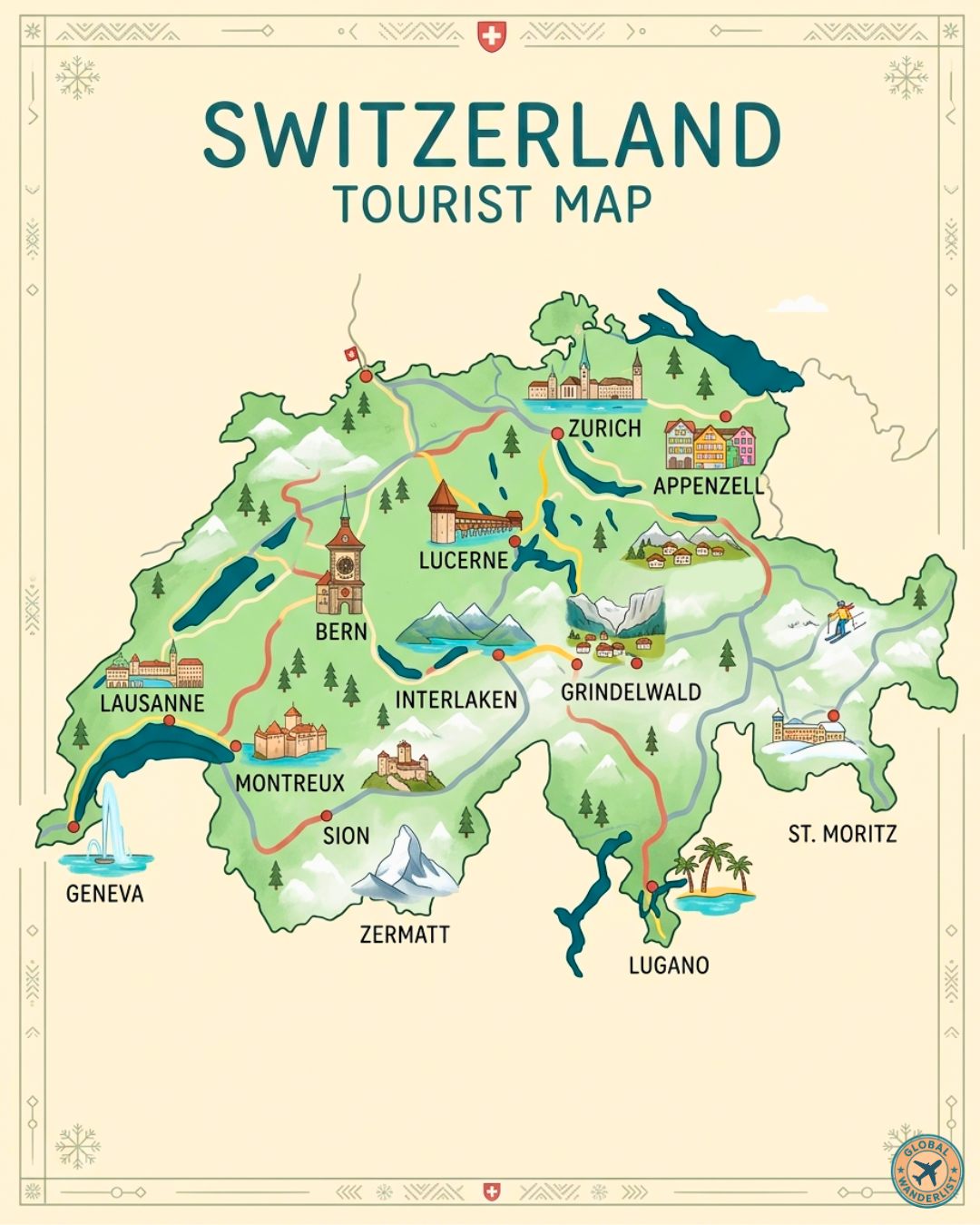
Switzerland packs remarkable variety into a small footprint, and this map lays out that variety clearly. Lakeside cities sit within an hour of alpine villages, and a country known mainly for mountains still holds palm trees along its southern lakes. Most visitors end up picking a handful of these regions rather than trying to cover the whole map in one trip.
This guide walks through Switzerland’s major tourist regions, following how the map naturally groups them together. Below is a region by region breakdown, covering what to see and when to go.
Region Overview
| Region | Key Towns | Best Known For |
|---|---|---|
| Zurich & Appenzell | Zurich, Appenzell | City life, painted villages, hiking |
| Central Switzerland | Lucerne, Interlaken, Grindelwald | Lakes, glacier trains, mountain views |
| Bern | Bern | Medieval old town, capital city |
| Lake Geneva Region | Geneva, Lausanne, Montreux | Vineyards, castles, French influence |
| Valais | Sion, Zermatt | Matterhorn, alpine villages |
| Ticino | Lugano | Italian culture, palm trees, lakes |
| Graubünden | St. Moritz | Winter sports, luxury resorts |
Each region asks for a different pace, from a single day trip to a full week on its own.
Zurich and Appenzell
Zurich anchors the northeast of Switzerland, the country’s largest city and most common entry point for international flights. Its old town sits compact and walkable, with churches, museums, and shopping streets all close together. Appenzell, a short drive further east, offers a complete change of pace, its painted farmhouses and traditional customs reflecting one of Switzerland’s most rural cantons.
Most travelers base themselves in Zurich for a day or two before heading into the mountains, though Appenzell rewards those who make the extra detour.
What to See in Zurich and Appenzell
- Zurich Old Town: Narrow streets wind past Grossmünster and Fraumünster, two churches with famous stained glass windows.
- Bahnhofstrasse: This shopping street ranks among the most expensive in the world, lined with watch and jewelry flagships.
- Appenzell villages: Painted farmhouses and decorated cow collars reflect one of Switzerland’s most traditional rural regions.
- Alpstein hiking trails: These wind through the hills above Appenzell, passing traditional dairy farms along the way.
Best Time to Visit
- Travel between May and September for the most reliable weather across both regions.
- Visit Appenzell in early September to catch the traditional cattle descent, when herders bring cows down from summer pastures.
- Avoid the coldest winter months if hiking in the Alpstein range is on your list.
Getting Around This Region
- Fly into Zurich Airport, which connects directly to the city center by train.
- Take a regional train from Zurich to Appenzell, a journey of just over an hour.
- Use Zurich’s tram network for getting around the city itself, since most sights sit close together.
Central Switzerland: Lucerne, Interlaken, and Grindelwald
This central cluster holds some of Switzerland’s most photographed scenery, built around Lucerne’s medieval bridges and the high peaks surrounding Interlaken and Grindelwald. Lucerne sits on its own lake, a short train ride from Zurich, while Interlaken serves as the launch point for excursions into the Jungfrau region. Grindelwald, tucked beneath the Eiger’s north face, adds another layer of alpine scenery just a short connection away.
This region rewards several days rather than a rushed day trip, given how much sits within easy reach of each base.
What to See in Central Switzerland
- Chapel Bridge: This covered wooden bridge in Lucerne dates back to 1333, one of the oldest of its kind in Europe.
- Mount Pilatus: A cogwheel railway, the steepest in the world, carries visitors up from Alpnachstad near Lucerne.
- Jungfraujoch: This high-altitude train station near Interlaken sits at over 3,400 meters, nicknamed the Top of Europe.
- Grindelwald’s Eiger views: The village sits directly beneath this famous mountain wall, with cable cars fanning out to nearby viewpoints.
Best Time to Visit
- Visit between June and September for full access to mountain excursions and hiking trails.
- Check Jungfraujoch weather forecasts before committing to a specific day, since clouds can obscure the views entirely.
- Consider a winter visit if skiing interests you more than summer hiking, since this region runs strong ski resorts too.
Getting Around This Region
- Take the train from Zurich to Lucerne, a journey of about 50 minutes.
- Connect from Lucerne to Interlaken by train, roughly two hours depending on the route.
- Use the short local train between Interlaken and Grindelwald, which takes well under an hour.
Bern
Bern sits roughly in the middle of the map, Switzerland’s political capital and one of its best-preserved medieval cities. Sandstone buildings line arcaded streets that stretch for kilometers, giving the old town a distinctive covered-walkway feel found in few other European capitals. Despite its political importance, Bern moves at a noticeably slower pace than Zurich or Geneva.
Many travelers treat Bern as a day trip between other stops, though its old town easily fills a full day on its own.
What to See in Bern
- Zytglogge: This medieval clock tower performs a small mechanical show each hour, drawing a crowd of visitors beforehand.
- Bear Park: Bears have a long association with the city, and this park along the river keeps that tradition alive.
- Bern Old Town arcades: These covered walkways run for kilometers, offering shelter while browsing shops and cafes.
- Federal Palace: Switzerland’s parliament building sits at the edge of the old town, with public tours available.
Best Time to Visit
- Travel between April and October for comfortable walking weather through the old town’s streets.
- Visit early morning to see the Zytglogge and main squares before crowds build.
- Check parliament tour availability ahead, since sessions occasionally limit public access.
Getting Around This Region
- Take the train directly from Zurich or Geneva, both well under two hours to Bern.
- Walk the old town entirely on foot, since nearly everything sits within the same compact area.
- Use Bern as a convenient stopover between Zurich and the Lake Geneva region, given its central position.
The Lake Geneva Region: Geneva, Lausanne, and Montreux
Lake Geneva stretches along Switzerland’s southwestern edge, its shores lined with vineyards, castles, and a string of towns each worth their own visit. Geneva anchors the western end, known internationally for its fountain and diplomatic history. Lausanne sits partway along the northern shore, while Montreux marks the eastern end, its mild microclimate supporting palm trees rarely seen elsewhere in the country.
This region carries a noticeably French character, both in language and in food, setting it apart from the German-speaking regions further north.
What to See in the Lake Geneva Region
- Jet d’Eau: Geneva’s giant fountain shoots water 140 meters into the air, visible from nearly anywhere along the lake.
- Lausanne Old Town: This hillside city holds a Gothic cathedral and a lively lakeside district below.
- Chillon Castle: Sitting right on the water near Montreux, this medieval castle ranks among the most photographed in Switzerland.
- Lavaux vineyards: These UNESCO-listed terraces run along the lake between Lausanne and Montreux, offering wine tasting with water views.
Best Time to Visit
- Visit between May and September for warm weather and full access to lake activities.
- Travel in late September or October if wine harvest season and the Lavaux vineyards interest you.
- Check the Montreux Jazz Festival dates in July if you want to catch the event, or avoid it if you prefer fewer crowds.
Getting Around This Region
- Fly into Geneva Airport, which connects directly to the city center by train.
- Take the train along the lake to reach Lausanne and Montreux, both well-connected stops.
- Use lake boats for a scenic alternative to trains between towns along the shore.
Valais: Sion and Zermatt
Valais stretches south from the Lake Geneva region toward the Italian border, home to some of Switzerland’s most dramatic mountain scenery. Sion, the cantonal capital, sits in the valley below two hilltop castles, while Zermatt climbs higher into the Alps, directly beneath the Matterhorn. This region shifts noticeably drier and sunnier than much of the rest of Switzerland, thanks to its position in a deep alpine valley.
Zermatt draws the bulk of international visitors here, though Sion offers a quieter, historically rich alternative worth its own stop.
What to See in Valais
- Zermatt and the Matterhorn: This car-free village sits directly beneath Switzerland’s most recognizable peak.
- Gornergrat Railway: This train climbs from Zermatt to a viewpoint facing the Matterhorn directly.
- Sion’s castles: Two hilltop fortresses, Valère and Tourbillon, overlook the town and surrounding vineyards.
- Glacier Paradise: A cable car from Zermatt reaches this high-altitude viewpoint above the surrounding glaciers.
Best Time to Visit
- Visit between June and September for the best hiking conditions and clearest Matterhorn views.
- Consider a winter trip if skiing matters more than hiking, since Zermatt runs a serious ski season.
- Check Matterhorn weather forecasts before booking the Gornergrat Railway, since cloud cover is common at higher elevations.
Getting Around This Region
- Take the train to Visp, then connect to the dedicated line running up to Zermatt.
- Park in Täsch and take the shuttle train into Zermatt, since the village bans private cars.
- Use regional trains to reach Sion directly from Geneva, Lausanne, or Zermatt.
Ticino: Lugano
Ticino sits in Switzerland’s southern corner, its Italian-speaking population and warmer climate giving the region a genuinely different feel from the rest of the country. Lugano anchors this area, a lakeside city with palm trees, pastel buildings, and an unmistakably Mediterranean atmosphere despite its Swiss address. Many visitors are surprised by how different Ticino feels compared to the alpine regions further north.
The drive or train ride here crosses through the Gotthard tunnel system, itself a notable feat of Swiss engineering.
What to See in Lugano
- Lugano’s lakefront promenade: Palm trees and pastel buildings line this walkway along Lake Lugano.
- Monte San Salvatore: A funicular carries visitors up this peak for panoramic views over the lake and surrounding hills.
- Lugano’s Old Town: Italian-influenced architecture and piazzas give this district a distinctly southern European feel.
- Lake Lugano boat tours: These cruises pass small lakeside villages tucked into the surrounding hills.
Best Time to Visit
- Visit between April and October for the warmest weather this region has to offer.
- Travel in summer if lake swimming and outdoor dining matter to your trip.
- Avoid peak August heat if you prefer more comfortable daytime walking temperatures.
Getting Around This Region
- Take the train through the Gotthard Base Tunnel, connecting Zurich to Lugano in around two hours.
- Fly into Lugano Airport for a more direct route if coming from elsewhere in Europe.
- Use lake boats to reach smaller villages around Lake Lugano without needing a car.
Graubünden: St. Moritz
Graubünden sits in Switzerland’s southeastern corner, home to St. Moritz, one of the country’s most storied winter destinations. The town has hosted the Winter Olympics twice, and it still carries that polished, high-altitude reputation today. Its lake freezes solid enough in winter to host events directly on the ice, while summer turns the same water a striking turquoise.
This region sits further from the main tourist circuit than Zurich or Lucerne, which keeps crowds noticeably thinner even during peak season.
What to See in St. Moritz
- Lake St. Moritz: This lake hosts winter events on its frozen surface and summer hiking trails around its shore.
- St. Moritz village: Designer boutiques and grand hotels reflect the town’s long history as a destination for wealthy travelers.
- Engadin valley trails: These hiking routes wind through one of the sunniest regions in the Swiss Alps.
- Glacier Express: This scenic train connects St. Moritz to Zermatt, crossing dramatic alpine terrain along the way.
Best Time to Visit
- Visit in winter between December and March for skiing and the region’s signature ice events.
- Travel between June and September if hiking and warmer weather suit your trip better.
- Book the Glacier Express well ahead during peak season, since panoramic seats sell out quickly.
Getting Around This Region
- Take the train from Zurich or Chur, both well-connected to St. Moritz by regional rail.
- Ride the Glacier Express if connecting to Zermatt, a scenic though lengthy journey across the Alps.
- Use local buses and funiculars for shorter trips within the Engadin valley itself.
Planning a Multi-Region Trip
Switzerland’s excellent rail network makes it realistic to combine several of these regions into a single trip without needing a car.
Choosing Which Regions to Combine
- Pair Zurich with Lucerne and Interlaken if this is your first visit, since these connect easily by short train rides.
- Add the Lake Geneva region if you want a mix of French culture alongside the German-speaking north.
- Save Ticino or Graubünden for a dedicated extension, given their distance from the main central cluster.
Using the Swiss Travel Pass
- Buy a Swiss Travel Pass before you arrive, since it covers trains, buses, and many boats across the country.
- Calculate your planned routes first, since the pass pays off best with several longer journeys.
- Reserve seats on scenic routes like the Glacier Express in advance, even with a valid pass.
Final Thoughts
Switzerland’s tourist map reflects a country where short train rides carry you between genuinely different worlds. Zurich’s polished streets, Zermatt’s alpine drama, and Lugano’s palm-lined lake barely feel like the same country, yet all sit within a few hours of each other. Pick the regions that match what you’re after, whether that’s mountains, lakes, or medieval history, and let Switzerland’s compact size and reliable trains do the rest.