
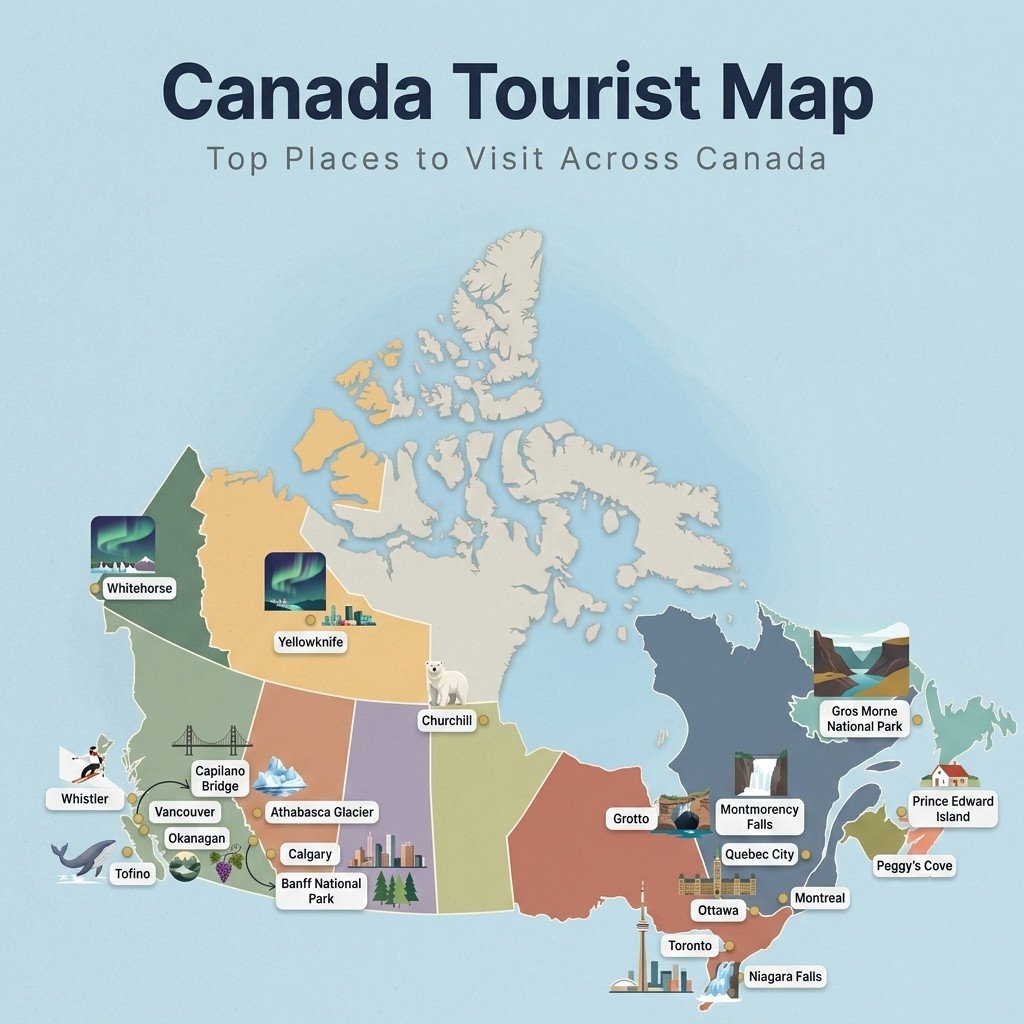
Canada is the world’s second-largest country, stretching from the Pacific Ocean to the Atlantic and reaching deep into the Arctic. Along the way, you’ll find snow-capped mountain ranges, turquoise glacial lakes, vibrant multicultural cities, rugged coastlines, ancient forests and charming fishing villages. Whether you’re planning your first visit or returning to explore a new region, Canada offers an incredible variety of landscapes and experiences.
The destinations featured on this Canada tourist map showcase some of the country’s most iconic places. From the towering peaks of Banff National Park and the surf beaches of Tofino to the cosmopolitan streets of Toronto and Montréal, each location represents a unique side of Canada. Nature lovers can explore glaciers, waterfalls and national parks, while city enthusiasts will discover world-class museums, diverse food scenes and historic neighbourhoods.
This guide follows the destinations highlighted on the tourist map, giving you an overview of what makes each place special, the top attractions to explore and why they’re worth adding to your Canadian itinerary.
1. Vancouver
Set between the Pacific Ocean and the Coast Mountains, Vancouver is one of Canada’s most beautiful cities and a common starting point for exploring Western Canada. Its mild climate, scenic waterfront and easy access to outdoor adventures make it a favourite among first-time visitors.
Begin your visit at Stanley Park, a 400-hectare urban park surrounded by a scenic seawall that’s perfect for walking or cycling. Continue to Gastown, Vancouver’s oldest neighbourhood, where cobbled streets, heritage buildings and the famous Steam Clock create a distinctly historic atmosphere. Granville Island is another must-visit destination, home to a bustling public market filled with fresh produce, artisan foods and local crafts.
Vancouver also offers excellent beaches, including English Bay and Kitsilano Beach, where locals gather during the summer months. Food lovers will appreciate the city’s outstanding seafood, Asian cuisine and café culture, while adventure seekers can easily take day trips into the surrounding mountains.
Plan to spend at least two or three days exploring Vancouver before continuing your journey through British Columbia.
2. Whistler
Just a two-hour drive north of Vancouver along the spectacular Sea-to-Sky Highway lies Whistler, one of North America’s premier mountain resorts. Although internationally recognised for skiing and snowboarding, Whistler has evolved into a year-round destination offering outdoor adventures in every season.
The Peak 2 Peak Gondola is one of Whistler’s signature attractions, connecting Whistler and Blackcomb Mountains while providing breathtaking panoramic views of alpine forests and rugged peaks. During summer, the mountains transform into a paradise for hikers and mountain bikers, with trails ranging from easy walks to challenging alpine routes.
Whistler Village is equally enjoyable, featuring pedestrian-only streets lined with boutique shops, cafés, restaurants and lively patios. Visitors can also enjoy ziplining, paddleboarding, golf and wildlife tours, making Whistler an excellent destination even outside the ski season.
Two days is generally enough to experience the highlights, although outdoor enthusiasts could easily spend much longer exploring the surrounding mountains.
3. Tofino
Located on the rugged west coast of Vancouver Island, Tofino is one of Canada’s most spectacular coastal destinations. Surrounded by ancient rainforests and the Pacific Ocean, it offers a completely different experience from the country’s mountain landscapes.
Long Beach, part of Pacific Rim National Park Reserve, stretches for kilometres and attracts surfers from around the world thanks to its consistent waves. Even if you don’t surf, walking along the expansive sandy beaches while watching the waves roll in is an unforgettable experience.
Wildlife encounters are another highlight. Whale watching tours operate throughout much of the year, while boat excursions also offer opportunities to spot sea lions, bald eagles and black bears feeding along the shoreline. Between autumn and winter, Tofino becomes famous for storm watching, as dramatic Pacific storms create spectacular coastal scenery.
The town itself has a relaxed atmosphere with excellent seafood restaurants, independent cafés and art galleries showcasing local Indigenous and coastal artists. Spending two or three days here allows enough time to experience both the beaches and nearby wilderness.
4. Okanagan Valley
The Okanagan Valley is Canada’s premier wine region, combining vineyards, orchards, lakes and sunny weather to create one of the country’s most relaxing holiday destinations. Located in the interior of British Columbia, it enjoys one of Canada’s warmest climates and attracts visitors throughout the summer.
Wine tasting is the region’s biggest draw, with hundreds of wineries producing award-winning Pinot Noir, Chardonnay, Merlot and Icewine. Many vineyards feature scenic terraces overlooking Okanagan Lake, making them ideal for leisurely afternoon visits.
Beyond its wineries, the valley offers sandy beaches, water sports, cycling routes and hiking trails through rolling hills. During summer, visitors can swim, kayak or paddleboard on Okanagan Lake, while local fruit stands sell fresh cherries, peaches, apples and other seasonal produce.
Kelowna serves as the region’s largest city and makes an excellent base for exploring nearby vineyards and lakeside attractions. Whether you’re interested in wine, outdoor recreation or simply enjoying the scenery, the Okanagan Valley offers a slower pace than many of Canada’s larger tourist destinations.
5. Capilano Suspension Bridge
One of Vancouver’s most famous attractions, the Capilano Suspension Bridge offers an exciting way to experience British Columbia’s temperate rainforest. Suspended 70 metres above the Capilano River, the bridge stretches 137 metres across the canyon, providing unforgettable views in every direction.
Beyond the suspension bridge itself, the park features several immersive experiences. Treetops Adventure allows visitors to walk along elevated suspension bridges connecting towering Douglas fir trees, while the Cliffwalk follows a series of narrow platforms attached directly to the canyon walls.
Interpretive displays throughout the park explain the rainforest ecosystem and Indigenous history of the area, making the attraction both educational and entertaining. During the festive season, thousands of lights transform the forest into a magical winter display.
Visiting early in the morning or later in the afternoon generally provides a quieter experience and better opportunities for photography.
6. Banff National Park
Banff National Park is Canada’s oldest national park and one of the country’s most iconic destinations. Located in the heart of the Canadian Rockies, it attracts millions of visitors each year with its dramatic mountain scenery, turquoise lakes and abundant wildlife.
The town of Banff serves as the park’s main hub, offering accommodation, restaurants, galleries and outdoor outfitters. From here, visitors can ride the Banff Gondola to the summit of Sulphur Mountain for panoramic views across the Bow Valley.
No visit is complete without exploring the park’s famous lakes. Lake Louise captivates visitors with its brilliant turquoise waters framed by towering peaks, while nearby Moraine Lake is equally spectacular and often regarded as one of Canada’s most photographed landscapes.
Hiking opportunities range from easy lakeside walks to challenging alpine trails, and wildlife sightings are common throughout the park. Elk, mountain goats, bighorn sheep and even black bears are occasionally spotted, particularly during the quieter hours of the day.
Whether you visit in summer for hiking and canoeing or in winter for skiing and snowboarding, Banff National Park offers some of the most memorable scenery in North America.
7. Athabasca Glacier
Travelling along the world-famous Icefields Parkway, the Athabasca Glacier is one of the most accessible glaciers in North America. As part of the Columbia Icefield, this ancient sheet of ice has existed for thousands of years and provides visitors with the rare opportunity to stand on a glacier without undertaking a challenging expedition.
The Columbia Icefield Adventure is the most popular experience, taking visitors onto the glacier aboard specially designed Ice Explorer vehicles. Nearby, the Glacier Skywalk extends over the Sunwapta Valley with a glass-floored observation platform offering spectacular views of the surrounding mountains and valleys.
Even the drive to the glacier is an attraction in itself. The Icefields Parkway is regularly ranked among the world’s most scenic roads, with countless waterfalls, turquoise lakes and mountain viewpoints along the route. Plan at least half a day for the glacier, although many travellers spend an entire day exploring the surrounding scenery.
8. Calgary
Often called the gateway to the Canadian Rockies, Calgary blends modern city life with Western heritage. While many visitors pass through on their way to Banff, the city is well worth exploring in its own right.
The Calgary Tower offers panoramic views across the skyline and, on clear days, all the way to the Rocky Mountains. Stephen Avenue is the city’s historic pedestrian street, lined with shops, restaurants and beautifully preserved heritage buildings. Families can spend hours at Heritage Park Historical Village, Canada’s largest living history museum, where vintage steam trains, paddlewheel boats and historic buildings recreate life in the early days of Western Canada.
If you’re visiting in July, don’t miss the Calgary Stampede. Known as “The Greatest Outdoor Show on Earth,” this world-famous event features rodeos, chuckwagon races, concerts and agricultural exhibitions that celebrate Alberta’s cowboy culture.
Calgary also makes an excellent base for day trips to Banff National Park, which is less than two hours away by road.
9. Churchill
Located on the shores of Hudson Bay in northern Manitoba, Churchill is one of Canada’s most extraordinary wildlife destinations. Despite its remote location, travellers from around the world visit this small town for unforgettable encounters with Arctic wildlife.
Churchill is best known as the Polar Bear Capital of the World. Every autumn, hundreds of polar bears gather near the town while waiting for Hudson Bay to freeze, creating one of the world’s most reliable opportunities to observe these magnificent animals in their natural habitat.
Summer brings an entirely different spectacle, as thousands of beluga whales migrate into the Churchill River estuary. Boat tours and kayaking excursions allow visitors to get remarkably close to these curious marine mammals.
During winter, Churchill also becomes one of Canada’s premier destinations for viewing the Northern Lights. With little light pollution and clear Arctic skies, colourful auroras frequently illuminate the landscape.
10. Yellowknife
Yellowknife, the capital of Canada’s Northwest Territories, has become one of the world’s most famous destinations for viewing the Aurora Borealis. Located beneath the Auroral Oval, the city enjoys clear skies and long winter nights that create ideal conditions for witnessing the Northern Lights.
From late August to early April, visitors arrive from across the globe hoping to watch vibrant green, purple and pink lights dance across the Arctic sky. Many tours combine aurora viewing with heated cabins, Indigenous storytelling and traditional northern cuisine.
During the day, visitors can explore Great Slave Lake, one of the deepest lakes in North America, or wander through Old Town, where colourful cabins and historic buildings overlook the water. Summer offers opportunities for fishing, boating and hiking, while winter transforms the region into a snowy playground for snowmobiling, dog sledding and ice fishing.
Although Yellowknife is famous for winter travel, its midnight sun and wilderness experiences make it rewarding throughout the year.
11. Whitehorse
Surrounded by mountains, rivers and vast wilderness, Whitehorse serves as the capital of the Yukon Territory and a gateway to some of Canada’s most remote landscapes. Despite its small size, the city offers plenty to see while maintaining a relaxed northern atmosphere.
The Yukon River flows through the heart of Whitehorse, providing scenic walking paths and opportunities for canoeing during the summer months. Visitors can also explore the SS Klondike National Historic Site, a restored sternwheeler that recalls the region’s important role during the Klondike Gold Rush.
Whitehorse is also an excellent base for exploring nearby natural attractions, including Kluane National Park, home to Canada’s highest mountain, Mount Logan. During winter, the area attracts visitors seeking Northern Lights, dog sledding and snowshoeing adventures.
Its combination of history, outdoor recreation and easy access to Yukon wilderness makes Whitehorse one of northern Canada’s most rewarding destinations.
12. Toronto
As Canada’s largest city, Toronto combines world-famous landmarks with diverse neighbourhoods, outstanding museums and one of the country’s best food scenes. It’s often the first stop for international visitors exploring Central Canada.
The CN Tower dominates the skyline and remains Toronto’s most recognisable attraction. Visitors can enjoy sweeping city views from the observation deck or experience the thrilling EdgeWalk around the tower’s exterior.
The Distillery Historic District offers beautifully restored Victorian buildings filled with galleries, cafés and boutique shops, while the waterfront provides scenic walking paths overlooking Lake Ontario. Other highlights include the Royal Ontario Museum, St. Lawrence Market and Kensington Market, each showcasing a different side of the city’s multicultural character.
Toronto’s excellent public transport system also makes it easy to explore nearby attractions, including Niagara Falls.
13. Niagara Falls
Located just 90 minutes from Toronto, Niagara Falls is one of the world’s greatest natural attractions. Every year, millions of visitors travel here to witness the immense power of the Horseshoe Falls, where millions of litres of water plunge over the cliff every second.
One of the most popular experiences is taking a boat cruise that carries visitors to the base of the falls, providing an unforgettable close-up view through the mist. Journey Behind the Falls offers another unique perspective, allowing visitors to stand in tunnels carved behind the cascading water.
The surrounding Niagara Parkway features beautiful gardens, scenic viewpoints and cycling paths, while nearby Niagara-on-the-Lake offers charming streets, wineries and historic buildings.
Although the falls can be visited in a single day, an overnight stay allows you to enjoy the spectacular evening illumination and seasonal fireworks displays.
14. Ottawa
Canada’s capital city combines impressive national landmarks with beautiful green spaces and fascinating museums. Situated on the Ottawa River, it offers a more relaxed atmosphere than Toronto while remaining rich in history and culture.
Parliament Hill is the city’s centrepiece, where visitors can admire Gothic Revival architecture and watch the ceremonial Changing of the Guard during summer. The Rideau Canal, a UNESCO World Heritage Site, transforms into the world’s largest naturally frozen skating rink each winter.
Other highlights include the Canadian Museum of History, the National Gallery of Canada and the lively ByWard Market, where cafés, restaurants and local artisans create one of the city’s most vibrant districts.
Ottawa is an ideal destination for travellers interested in Canadian history, politics and architecture.
15. Montréal
Montréal blends European charm with North American energy, creating one of Canada’s most distinctive cities. French heritage is evident throughout its historic streets, architecture and culinary traditions, giving visitors the feeling of stepping into another continent.
Old Montréal is the city’s highlight, featuring cobbled streets, heritage buildings and the magnificent Notre-Dame Basilica. Nearby, the Old Port offers waterfront promenades, seasonal festivals and river cruises along the St. Lawrence River.
For panoramic views across the city, head to Mount Royal Park, designed by the same landscape architect who created New York’s Central Park. Montréal is also celebrated for its food, with local favourites including bagels, smoked meat sandwiches and poutine.
The city’s lively festivals, arts scene and café culture make it one of Canada’s most exciting urban destinations.
16. Québec City
As one of North America’s oldest cities, Québec City offers an atmosphere unlike anywhere else in Canada. Its UNESCO-listed Old Québec district features fortified walls, narrow streets and beautifully preserved buildings that reflect more than 400 years of history.
The iconic Fairmont Le Château Frontenac dominates the skyline and is among the world’s most photographed hotels. Visitors can wander through Place Royale, explore the historic fortifications and browse charming boutiques and cafés throughout the old town.
During winter, Québec City becomes particularly magical, with snow-covered streets, festive decorations and the famous Québec Winter Carnival adding to its European charm.
Few cities in North America preserve their historic character as successfully as Québec City, making it an essential stop for anyone exploring Eastern Canada.
17. Montmorency Falls
Located just 15 minutes from Québec City, Montmorency Falls is one of the province’s most spectacular natural attractions. Standing at 83 metres, the falls are approximately 30 metres higher than Niagara Falls, creating an impressive display as the Montmorency River crashes into the St. Lawrence River below.
Visitors can admire the falls from several viewpoints, but the suspension bridge spanning the top offers one of the best perspectives. Walking across the bridge provides dramatic views of the rushing water beneath your feet, while the panoramic scenery stretches across the river and surrounding countryside.
For a different experience, take the cable car to the top or follow the staircase that winds alongside the falls. During winter, freezing spray forms an enormous cone of ice at the base known as the Sugarloaf, making the falls equally impressive in colder months.
Whether you’re visiting in summer or winter, Montmorency Falls makes an easy half-day excursion from Québec City and is well worth adding to your itinerary.
18. The Grotto
Hidden within Bruce Peninsula National Park in Ontario, the Grotto is one of Canada’s most photographed natural attractions. This sea cave, carved into the limestone cliffs by the crystal-clear waters of Georgian Bay, is famous for its striking turquoise water and dramatic rocky shoreline.
Reaching the Grotto requires a scenic hike through forests and along the Niagara Escarpment, with several viewpoints overlooking the bay along the way. Once you arrive, visitors can admire the cave from above or carefully descend to the shoreline for a closer look.
Swimming is popular during summer, although the water remains surprisingly cold throughout the year. Adventurous visitors often jump from the surrounding rocks into the clear water, while photographers come for the dramatic contrast between the white limestone cliffs and vivid blue bay.
Because of its popularity, especially during the summer months, advance parking reservations are often required. Visiting early in the morning or later in the afternoon usually offers a quieter experience.
19. Prince Edward Island
Canada’s smallest province is known for its red sandstone cliffs, rolling farmland, sandy beaches and relaxed coastal charm. Prince Edward Island offers a slower pace of travel, making it an ideal destination for visitors looking to unwind while exploring picturesque fishing villages and scenic coastal roads.
Many travellers come to visit Green Gables Heritage Place, the setting that inspired Lucy Maud Montgomery’s beloved Anne of Green Gables novels. Fans of the books can explore the historic farmhouse, walking trails and surrounding countryside that helped shape one of Canada’s most famous literary works.
The island’s coastline is equally appealing, with kilometres of sandy beaches found throughout Prince Edward Island National Park. Fresh seafood is another highlight, particularly lobster, mussels and oysters, which feature prominently on menus across the island.
Whether you’re cycling along quiet country roads or enjoying fresh seafood beside the harbour, Prince Edward Island offers one of Canada’s most relaxing holiday experiences.
20. Peggy’s Cove
Few places capture the spirit of Atlantic Canada quite like Peggy’s Cove. Located about an hour from Halifax, this small fishing village is famous for its iconic lighthouse perched on smooth granite rocks overlooking the Atlantic Ocean.
The Peggy’s Point Lighthouse has become one of Canada’s most photographed landmarks, attracting visitors throughout the year. The surrounding granite coastline creates spectacular scenery, particularly during sunrise and sunset when the light reflects across the ocean.
Despite its popularity, Peggy’s Cove remains an active fishing community where colourful boats, lobster traps and traditional wooden houses continue to define daily life. Small cafés, galleries and local craft shops add to the village’s charm, making it an enjoyable place to spend several hours.
Visitors should always respect warning signs and stay away from the dark, wet rocks near the ocean, as unexpected waves can be extremely dangerous.
21. Gros Morne National Park
Located on the west coast of Newfoundland, Gros Morne National Park is one of Canada’s greatest natural treasures and a UNESCO World Heritage Site. The park showcases extraordinary geological formations, dramatic fjords and rugged mountain landscapes that have been shaped over hundreds of millions of years.
One of its most remarkable features is the Tablelands, where ancient rocks from the Earth’s mantle are exposed at the surface, creating an unusual landscape unlike anywhere else in North America. Interpretive trails explain the park’s unique geology and why it has become internationally significant.
Another highlight is Western Brook Pond, a breathtaking freshwater fjord surrounded by towering cliffs and cascading waterfalls. Boat tours provide spectacular views of the landscape and are among the park’s most popular experiences.
With excellent hiking trails, abundant wildlife and some of the country’s most dramatic coastal scenery, Gros Morne rewards visitors willing to venture beyond Canada’s better-known destinations.
Planning Your Canada Trip
- Canada’s enormous size means careful planning is essential if you want to make the most of your visit. Rather than trying to see the entire country in one trip, most travellers focus on a specific region before returning to explore another part of Canada in the future.
- If you’re visiting for the first time, a two-week itinerary allows you to experience many of the country’s highlights. Western Canada is perfect for travellers who enjoy mountains, glaciers, national parks and outdoor adventures. A route through Vancouver, Whistler, Banff National Park, Athabasca Glacier and Calgary showcases some of Canada’s most spectacular scenery.
- Central Canada combines vibrant cities with world-famous natural attractions. Toronto, Niagara Falls and Ottawa can easily be explored in one itinerary, while Montréal and Québec City introduce visitors to Canada’s rich French heritage and historic architecture.
- Travellers seeking quieter landscapes and coastal charm should consider Eastern Canada, where Prince Edward Island, Peggy’s Cove and Gros Morne National Park offer scenic drives, picturesque fishing villages and unforgettable Atlantic Ocean views. For those looking for truly unique experiences, northern destinations such as Churchill, Yellowknife and Whitehorse provide opportunities to see the Northern Lights, encounter polar bears and explore vast wilderness areas unlike anywhere else on Earth.
- The best time to visit depends on your interests. Summer, from June to September, offers warm weather, long daylight hours and excellent conditions for hiking, sightseeing and road trips. Autumn brings colourful foliage across much of the country, while winter transforms destinations such as Banff, Whistler and Québec City into snowy wonderlands perfect for skiing and festive celebrations.