
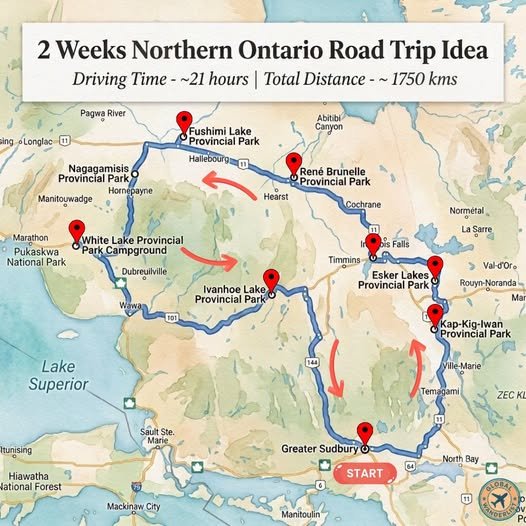
Northern Ontario offers a completely different Canadian road trip experience compared to its more famous southern counterparts. This route loops through the province’s northeastern wilderness, connecting a string of provincial parks across roughly 1,750 kilometers. Most travelers take about two weeks to complete it, spending several days at each park rather than rushing between stops.
This is a trip built around lakes, forests, and quiet campgrounds rather than towns and landmarks. Below is a full breakdown of the route, including where to eat and what to see at each major stop.
Route Overview
| Stop | Distance from Previous Stop | Best For |
|---|---|---|
| Greater Sudbury (Start) | – | City base, mining heritage |
| Kap-Kig-Iwan Provincial Park | 190 km | Waterfalls, river canyons |
| Esker Lakes Provincial Park | 60 km | Clear lakes, sandy beaches |
| René Brunelle Provincial Park | 180 km | Boreal forest, fishing |
| Fushimi Lake Provincial Park | 210 km | Remote lake camping |
| Nagagamisis Provincial Park | 190 km | Old-growth forest |
| White Lake Provincial Park | 170 km | Lake Superior views |
| Ivanhoe Lake Provincial Park | 300 km | Quiet backcountry lakes |
| Greater Sudbury (End) | 250 km | Return loop |
Total driving distance comes to roughly 1,750 kilometers, with an estimated 21 hours of total driving time. Spreading this across two weeks allows plenty of time at each park rather than treating it as a straight-through drive.
Greater Sudbury
Sudbury serves as both the starting and ending point for this loop, a city built on one of the world’s largest nickel mining operations. Its unusual landscape, shaped by an ancient meteorite impact, gives the surrounding area a distinct geological character. It is worth a day here both before and after the loop to resupply and rest.
Where to Eat in Sudbury
- Tuco’s Taco Lounge is a popular local favorite, known for its lively atmosphere and creative Mexican-inspired menu.
- 46 North Brewing Corp combines a strong craft beer selection with a relaxed food menu, a good spot to unwind before heading into the wilderness.
What to See in Sudbury
- Visit Science North, one of Canada’s largest science centers, built into the city’s unique rock formations.
- Explore the Big Nickel, a giant replica coin that has become an unofficial symbol of the city’s mining history.
- Walk the Bell Park Walkway along Lake Ramsey for a relaxed introduction to the region before departing.
Kap-Kig-Iwan Provincial Park
Kap-Kig-Iwan sits near Englehart, known for its dramatic river canyon and waterfalls along the Englehart River. The park’s compact size makes it an easy first stop after leaving Sudbury. Hiking trails wind along the canyon’s edge, offering some of the best short walks in the region.
Where to Eat Near Kap-Kig-Iwan
- Englehart’s small selection of diners and cafes provide simple, reliable meals before or after exploring the park.
- Most visitors pack a picnic for lunch within the park itself, given the limited dining options in the immediate area.
What to See in Kap-Kig-Iwan Provincial Park
- Walk along the canyon rim trail for views over the Englehart River’s waterfalls and rock formations.
- Visit in early autumn if possible, when the surrounding forest turns vivid shades of red and gold.
- Look for the park’s old-growth white pine stands, some of the oldest trees in the region.
Esker Lakes Provincial Park
Esker Lakes sits near Kirkland Lake, known for its exceptionally clear, spring-fed lakes formed by glacial esker ridges. The park offers some of the best swimming beaches in northeastern Ontario. Its network of small lakes makes it a popular canoeing destination as well.
Where to Eat Near Esker Lakes
- Kirkland Lake’s local restaurants and diners offer straightforward meals suited to a resupply stop before continuing the loop.
- Camping facilities within the park include basic supplies for those staying overnight.
What to See in Esker Lakes Provincial Park
- Swim at one of the park’s clear, sandy-bottomed lakes, known for being noticeably warmer than nearby Lake Superior.
- Paddle between the park’s interconnected lakes, an easy way to explore the glacial esker landscape.
- Hike the park’s short interpretive trails, which explain the unusual glacial formations found throughout the region.
René Brunelle Provincial Park
René Brunelle sits near Kapuskasing, a boreal forest park known for its fishing lakes and quiet, undeveloped character. This stretch marks the shift into deeper northern Ontario wilderness, with towns becoming noticeably more spread out. Remi Lake, the park’s main feature, is popular for both swimming and fishing.
Where to Eat Near René Brunelle
- Kapuskasing’s town center offers a modest range of diners and pizzerias, practical for restocking before continuing north.
- Fishing lodges near the park sometimes offer meals for guests, worth checking ahead if planning an extended stay.
What to See in René Brunelle Provincial Park
- Fish for walleye and pike in Remi Lake, one of the more productive fishing spots along this route.
- Walk the park’s boreal forest trails, offering a good introduction to the region’s dominant black spruce and jack pine ecosystem.
- Watch for moose along quieter forest roads near the park, particularly around dawn and dusk.
Fushimi Lake Provincial Park
Fushimi Lake sits close to Hearst, one of the most remote towns on this route. The park itself centers on a large, undeveloped lake surrounded by dense boreal forest. This stretch of the loop feels noticeably wilder than the earlier stops, with far fewer visitors.
Where to Eat Near Fushimi Lake
- Hearst’s small downtown offers a handful of diners and bakeries, a good final resupply point before the more remote stretches ahead.
- Most visitors cook at their campsite here, given the limited dining options this far north.
What to See in Fushimi Lake Provincial Park
- Canoe across Fushimi Lake, one of the larger and quieter lakes along this route.
- Watch for loons and other waterfowl, common sightings on the park’s undeveloped shoreline.
- Camp under exceptionally dark skies, since light pollution is minimal this far from major towns.
Nagagamisis Provincial Park
Nagagamisis Provincial Park protects a stretch of old-growth boreal forest along the shores of Nagagamisis Lake. It remains one of the least visited parks on this loop, offering genuine solitude for those seeking it. The park’s remote character makes careful trip planning essential.
Where to Eat Near Nagagamisis
- Hornepayne, the nearest town, offers a small selection of basic dining options suited to travelers passing through.
- Self-sufficiency is strongly advised through this stretch, since formal restaurants are scarce.
What to See in Nagagamisis Provincial Park
- Walk among the park’s old-growth white and red pine stands, some of the least disturbed forest in the region.
- Fish or paddle on Nagagamisis Lake, known for its clear water and quiet, undeveloped shoreline.
- Watch for black bears and moose, both common in this less-visited section of the park.
White Lake Provincial Park
White Lake sits close to Lake Superior’s northern shore, offering campers a taste of the Great Lakes’ scale without the crowds of more famous parks further south. Its beach and rocky shoreline give it a noticeably different character from the inland lakes earlier in the loop. This stretch also marks the westernmost point of the route.
Where to Eat Near White Lake
- Nearby Dubreuilville and Wawa offer small-town diners and casual restaurants, practical stops for resupplying.
- Most campers cook at their sites within the park, given the limited commercial dining nearby.
What to See in White Lake Provincial Park
- Walk the park’s sandy beach along White Lake, one of the more scenic swimming spots on this route.
- Visit nearby Wawa to see its famous giant Canada goose statue, an iconic Northern Ontario roadside landmark.
- Watch the sunset over the lake, particularly striking given the park’s open, west-facing shoreline.
Ivanhoe Lake Provincial Park
Ivanhoe Lake marks the final major stop before looping back toward Sudbury, known for its clear, deep lake and quiet backcountry character. The park sits near Foleyet, a small rail town along the route. This stretch offers a peaceful close to the loop before returning to the more developed south.
Where to Eat Near Ivanhoe Lake
- Foleyet’s limited services include a small general store and basic dining options for passing travelers.
- Most visitors rely on packed supplies through this final wilderness stretch before reaching larger towns further south.
What to See in Ivanhoe Lake Provincial Park
- Swim or paddle in Ivanhoe Lake’s exceptionally clear water, among the cleanest lakes on this route.
- Fish for lake trout, a signature species found in the park’s deep, cold waters.
- Camp along the quiet shoreline for one of the loop’s most peaceful final nights before returning to Sudbury.
Also read: Gaspé Peninsula Road Trip Idea
Final Thoughts
Northern Ontario’s provincial park loop offers a genuinely different kind of Canadian road trip, built around lakes, forests, and solitude rather than famous landmarks. Each stop shifts the scenery subtly, from canyon waterfalls to old-growth pine to the shores of Lake Superior. Plan carefully for the remote stretches, pack extra supplies, and let the quiet character of the north set the pace.