
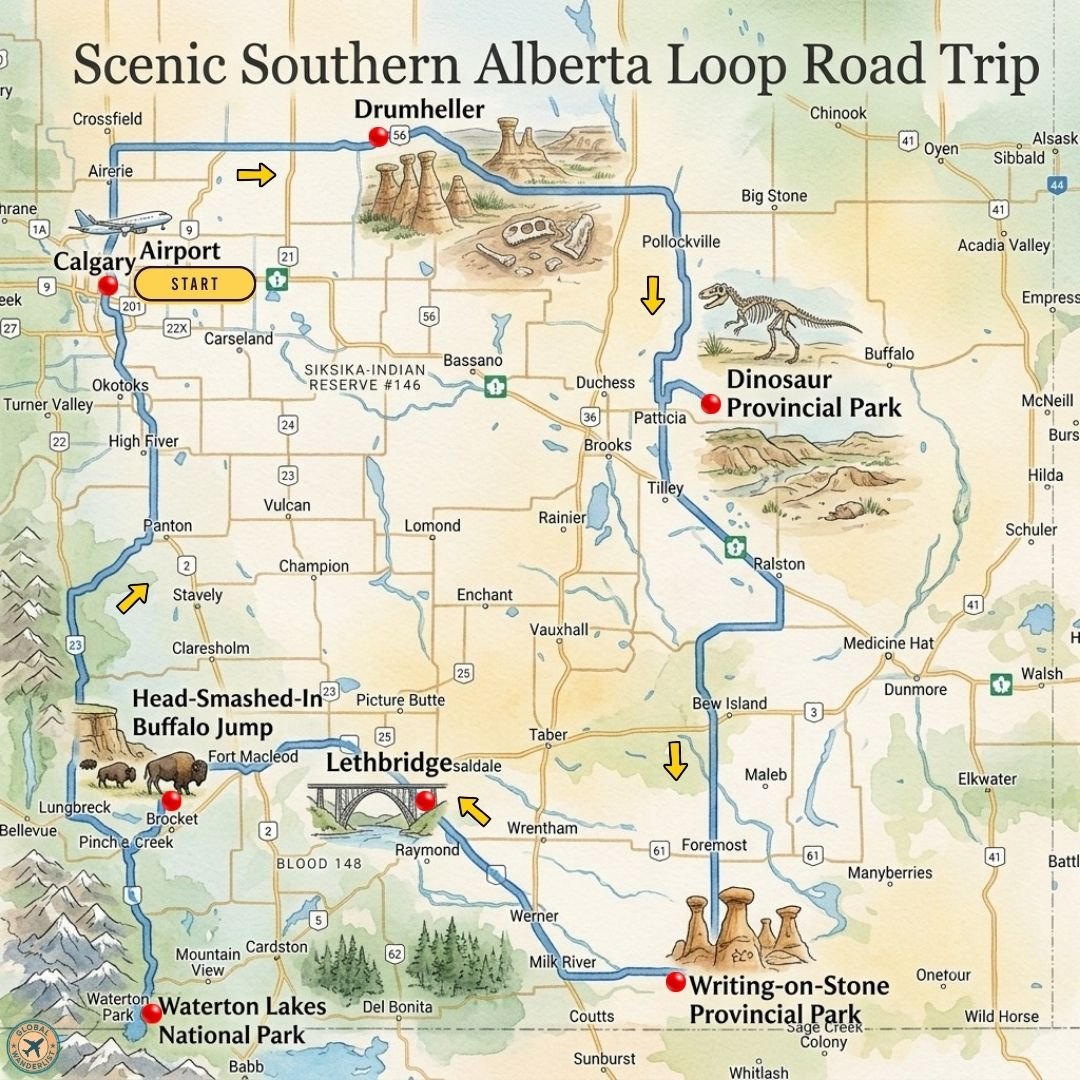
Southern Alberta offers a road trip experience quite different from the mountain scenery most associate with the province. This loop out of Calgary covers badlands, dinosaur fossil beds, Indigenous heritage sites, and glacier-fed mountain lakes, all within a manageable circuit. Most travelers complete it comfortably in five to seven days.
The route’s strength lies in its variety, moving from otherworldly rock formations to prairie grasslands to alpine scenery in a single loop. Below is a full breakdown of the journey, including where to eat and what to see at each major stop.
Route Overview
| Stop | Distance from Previous Stop | Best For |
|---|---|---|
| Calgary (Start) | – | City base, airport access |
| Drumheller | 140 km | Badlands, dinosaur fossils |
| Dinosaur Provincial Park | 100 km | UNESCO fossil site |
| Writing-on-Stone Provincial Park | 210 km | Indigenous rock art |
| Lethbridge | 100 km | Coulees, historic sites |
| Head-Smashed-In Buffalo Jump | 60 km | Indigenous heritage |
| Waterton Lakes National Park (End) | 130 km | Mountain lakes, hiking |
Total driving distance comes to roughly 740 kilometers for the full loop back to Calgary. Most travelers spend five to seven days completing it, allowing a full day at each major stop.
Calgary
Calgary serves as the natural starting point for this loop, a modern city set against the backdrop of the Rocky Mountains to the west. Before heading out, it is worth spending a day exploring the city’s downtown core and historic Stephen Avenue. The drive northeast toward Drumheller crosses open prairie before dropping into the badlands.
Where to Eat in Calgary
- River Cafe, set on an island in the Bow River, has long been considered one of Calgary’s finest dining destinations, focused on regional and seasonal ingredients.
- Model Milk in the Beltline neighborhood offers a lively, well-regarded menu blending Southern comfort food with modern technique.
What to See in Calgary
- Walk along Stephen Avenue, the historic heart of downtown Calgary, home to numerous heritage buildings and restaurants.
- Visit Prince’s Island Park for a relaxed green space along the Bow River.
- Explore the Calgary Tower for panoramic views over the city and the Rockies beyond.
Drumheller
Drumheller sits at the heart of Alberta’s badlands, a dramatic landscape of eroded hoodoos and exposed rock layers rich in dinosaur fossils. The Royal Tyrrell Museum, one of the world’s leading paleontology institutions, anchors the town’s tourism. It is one of the most family-friendly stops on this entire loop.
Where to Eat in Drumheller
- Yavis has built a strong local reputation, particularly praised for consistently good, freshly prepared meals.
- Sam’s Kitchen is a well-regarded local spot known for hearty diner-style meals suited to a family stop.
What to See in Drumheller
- Visit the Royal Tyrrell Museum, home to one of the largest dinosaur fossil collections in the world.
- Drive through Horseshoe Canyon for dramatic badlands scenery just outside town.
- Walk among the Hoodoos, distinctive eroded rock pillars scattered throughout the surrounding valley.
Also read: Northern Ontario Road Trip Idea
Dinosaur Provincial Park
Dinosaur Provincial Park protects one of the richest dinosaur fossil beds on Earth, a UNESCO World Heritage Site since 1979. The park’s badlands terrain looks strikingly similar to Drumheller’s, but on a larger, more remote scale. Guided tours here offer access to restricted areas where active fossil excavation continues.
Where to Eat Near Dinosaur Provincial Park
- The park’s visitor center offers a small selection of snacks and light meals, though most visitors pack their own food given the remote location.
- Nearby Brooks offers a wider range of dining options, worth the short detour for a proper meal.
What to See in Dinosaur Provincial Park
- Take a guided badlands bus tour to access restricted fossil areas not open to general visitors.
- Walk the park’s self-guided trails for views over the eroded badlands terrain and exposed fossil beds.
- Visit the park’s field station to see active paleontological work, depending on the season.
Writing-on-Stone Provincial Park
Writing-on-Stone Provincial Park protects the largest concentration of Indigenous rock art on the North American plains, carved and painted into sandstone hoodoos along the Milk River. The site holds deep spiritual significance for the Blackfoot people. It was designated a UNESCO World Heritage Site in 2019.
Where to Eat Near Writing-on-Stone
- The park’s small visitor facilities offer basic supplies, though most travelers bring food for a picnic among the hoodoos.
- Nearby Milk River township has a handful of casual diners suited to a stop before or after visiting the park.
What to See in Writing-on-Stone Provincial Park
- Take a guided tour to see the park’s most significant petroglyph and pictograph sites, some access-restricted to protect the artwork.
- Walk among the hoodoo formations along the Milk River, striking rock pillars carved by centuries of erosion.
- Learn about the site’s ongoing significance to the Blackfoot Nation through interpretive programs.
Lethbridge
Lethbridge is southern Alberta’s largest city, known for its dramatic river coulees and the historic High Level Bridge, one of the longest and highest railway trestle bridges in the world. The city offers a good mix of history, parks, and dining after the more remote stretches of the loop. It also serves as a practical resupply stop.
Where to Eat in Lethbridge
- The Keg Steakhouse has built a loyal following in Lethbridge, particularly praised for its prime rib.
- Mango Tree offers a well-regarded change of pace with its Asian-inspired menu, popular for repeat visits among locals.
What to See in Lethbridge
- View the High Level Bridge from Indian Battle Park, one of the most photographed landmarks in southern Alberta.
- Visit the Nikka Yuko Japanese Garden, a peaceful, formally landscaped garden within the river valley.
- Explore Fort Whoop-Up, a reconstructed historic trading post with exhibits on the region’s early settlement history.
Head-Smashed-In Buffalo Jump
Head-Smashed-In Buffalo Jump is one of the oldest and best-preserved buffalo jump sites in North America, used by Indigenous peoples for nearly 6,000 years. The UNESCO-listed site includes an interpretive center built directly into the sandstone cliff. It offers one of the most significant Indigenous heritage experiences in the country.
Where to Eat Near Head-Smashed-In Buffalo Jump
- The site’s interpretive center includes a small cafe serving light meals and snacks.
- Nearby Fort Macleod offers a wider range of small-town dining options, worth the short detour for a full meal.
What to See at Head-Smashed-In Buffalo Jump
- Tour the interpretive center to learn how Indigenous hunters used the cliff formation to harvest buffalo for thousands of years.
- Walk along the cliff top itself, taking in views over the surrounding plains where herds once ran.
- Visit during one of the site’s cultural demonstration days, when traditional practices are showcased for visitors.
Waterton Lakes National Park
Waterton Lakes National Park closes out this loop, where the prairies meet the Rocky Mountains in dramatic fashion. The park forms part of the Waterton-Glacier International Peace Park alongside its counterpart across the U.S. border. Its combination of mountains and lakes makes it one of the most scenic finales in the country.
Where to Eat in Waterton Lakes National Park
- Lakeside Chophouse at the Bayshore Inn is consistently recommended, known for its lakefront views and reliable menu.
- Red Rock Trattoria offers a well-regarded Italian menu, a good option for a relaxed final dinner in the park.
What to See in Waterton Lakes National Park
- Hike to Bertha Falls or Crypt Lake, both offering dramatic mountain and lake scenery within a manageable day hike.
- Walk along the Waterton Lake shoreline for classic views where the mountains drop directly into the water.
- Visit the historic Prince of Wales Hotel, perched on a hill overlooking the lake since 1927.
Also read: The Great Divide Trail of Canada
Final Thoughts
The Southern Alberta loop offers an unexpectedly varied road trip, moving from badlands fossil beds to Indigenous heritage sites to alpine lakes in a single circuit. Every stop adds a different layer to the region’s history and landscape. Plan for a full week if possible, and let the contrast between prairie, badlands, and mountains define the rhythm of your trip.