
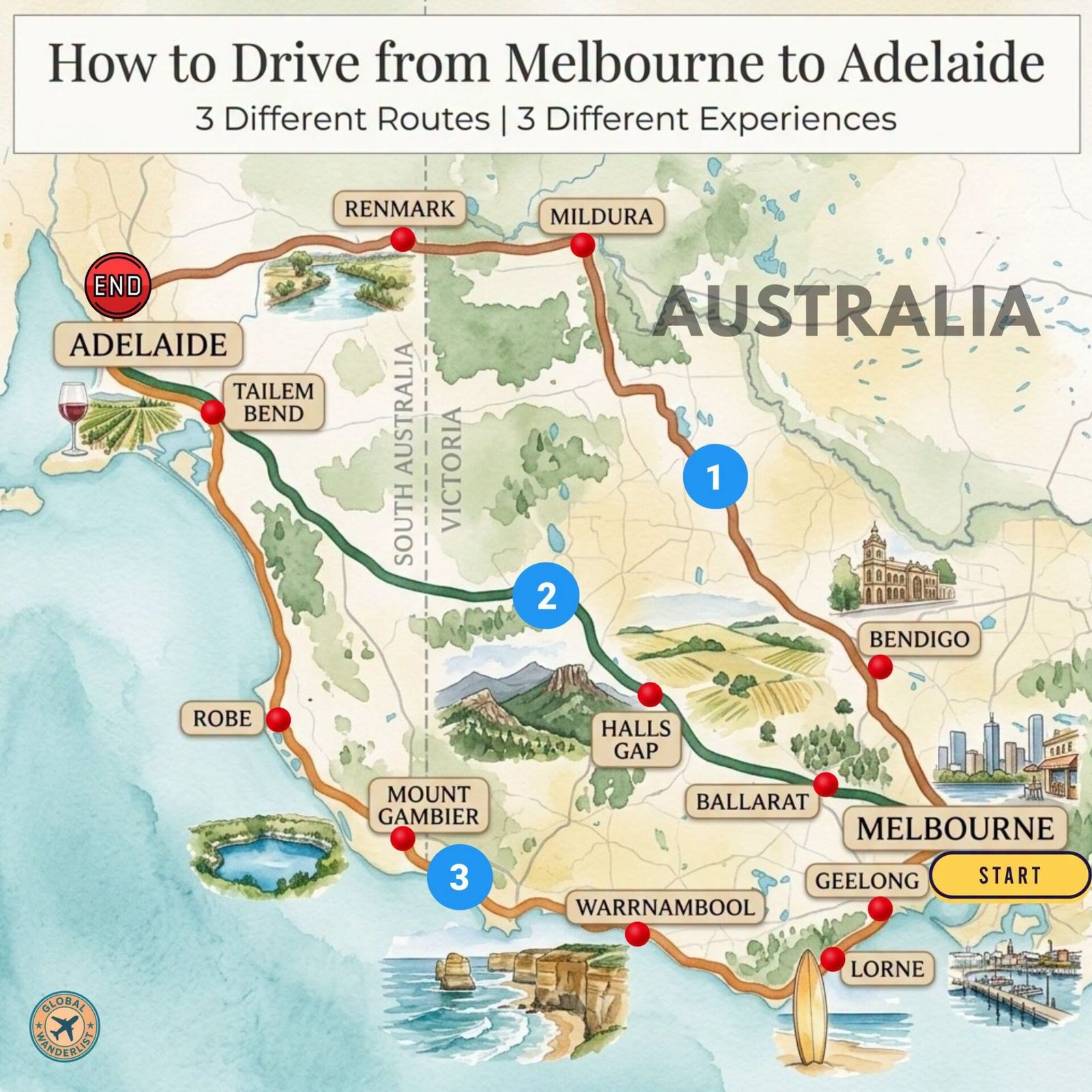
Melbourne and Adelaide sit roughly 730 kilometers apart, but the way you connect them can shape your entire trip. Three distinct routes link the two cities, each offering a completely different experience. One cuts inland through rural Victoria, another passes through the Grampians and South Australia’s Limestone Coast, and the third follows the Great Ocean Road along the southern coastline.
Choosing the right route depends on what you want out of the drive. Below is a full breakdown of all three options, including what each one offers and how to plan around it.
Route Comparison
| Route | Approx. Distance | Approx. Drive Time | Best For |
|---|---|---|---|
| Route 1: Inland via Bendigo & Mildura | 900 km | 10-11 hours | Fastest option, river towns |
| Route 2: Grampians & Limestone Coast | 800 km | 9-10 hours | Mountains, lakes, wine regions |
| Route 3: Great Ocean Road | 1,000+ km | 12-14 hours | Coastal scenery, iconic landmarks |
Each route can be driven in a single long day, but all three reward a slower pace with an overnight stop or two along the way.
Route 1: Inland via Bendigo and Mildura
This route heads north from Melbourne through Bendigo before turning west toward Mildura, then following the Murray River corridor into South Australia via Renmark. It is the most direct path between the two cities in terms of overall practicality, avoiding the winding coastal roads of the alternative routes. This makes it a strong choice for travelers who want to reach Adelaide efficiently while still passing through some worthwhile stops.
What to See Along Route 1
- Explore Bendigo’s gold rush architecture and the Central Deborah Gold Mine, a highlight of regional Victoria’s mining history.
- Visit Mildura, a Murray River town known for its citrus orchards and paddlesteamer cruises.
- Stop in Renmark, one of South Australia’s oldest irrigation settlements, known for its riverside parks and wineries.
Planning Tips for Route 1
- Break the drive with an overnight stop in Mildura, roughly the halfway point between Melbourne and Adelaide on this route.
- Watch for long, straight stretches of highway between Mildura and Renmark, where fatigue can set in on longer driving days.
- Fill up in larger towns along the way, since fuel stations become sparser on the more rural sections north of Bendigo.
Also read: Melbourne to Sydney Road Trip Idea: Inland Heritage Route
Route 2: Grampians and the Limestone Coast
This route heads west from Melbourne through Ballarat before reaching Halls Gap and the Grampians National Park. From there, it continues through Mount Gambier and along South Australia’s Limestone Coast, passing Robe before finishing in Adelaide. It offers a strong mix of mountain scenery, volcanic lakes, and quiet coastal towns.
What to See Along Route 2
- Hike to the Pinnacle lookout in Grampians National Park for sweeping views over Halls Gap and the surrounding ranges.
- Visit Mount Gambier’s Blue Lake, a volcanic crater lake famous for its striking seasonal color change.
- Explore Robe, a small coastal fishing town known for its relaxed atmosphere and fresh seafood.
Planning Tips for Route 2
- Allow extra time in the Grampians for a short hike, since the region’s lookouts are some of the best on this entire route.
- Visit the Blue Lake between November and March, when its color shifts to its most vivid deep blue.
- Book accommodation in Robe or Mount Gambier if you want to break the drive into two more relaxed days.
Route 3: The Great Ocean Road
This route follows Victoria’s southern coastline out of Melbourne, passing through Geelong, Lorne, and Warrnambool before turning inland toward Mount Gambier and on to Adelaide. It is significantly longer and slower than the other two options, given the Great Ocean Road’s winding coastal curves, but it delivers some of the most celebrated scenery in Australia.
What to See Along Route 3
- Drive past the Twelve Apostles near Warrnambool, one of Australia’s most photographed coastal landmarks.
- Stop in Lorne for beach views and a relaxed lunch, a popular resting point partway along the coastal stretch.
- Visit Mount Gambier’s Blue Lake before continuing inland toward Adelaide, linking back up with the Limestone Coast route.
Planning Tips for Route 3
- Allow at least two full days for this route if you want to properly stop at the major lookouts along the Great Ocean Road.
- Avoid driving this stretch after dark, since the road’s tight curves and cliffside sections are far easier to navigate in daylight.
- Book accommodation in Warrnambool or Port Fairy to split the coastal driving from the final inland stretch to Adelaide.
Choosing the Right Route for You
Each of these three routes suits a different kind of traveler. Route 1 works best if you simply need to get from Melbourne to Adelaide efficiently, with a few worthwhile stops along the way. Route 2 offers a good middle ground, combining mountain scenery with coastal towns in a moderate drive time.
Route 3 is the clear choice if the Great Ocean Road itself is the destination, rather than just a means of getting to Adelaide. It takes considerably longer, but the coastal scenery is hard to match anywhere else in the country. Many travelers choose to drive this route on the way out of Melbourne and return via one of the faster inland options.
Also read: Melbourne to Perth Coastal Road Trip Idea
Final Thoughts
The drive between Melbourne and Adelaide offers far more flexibility than the direct distance suggests. Whether you prioritize speed, mountain scenery, or coastal landmarks, one of these three routes will fit the trip you have in mind. Plan for an overnight stop regardless of which route you choose, and let the journey itself become part of the experience rather than just the drive between two cities.