
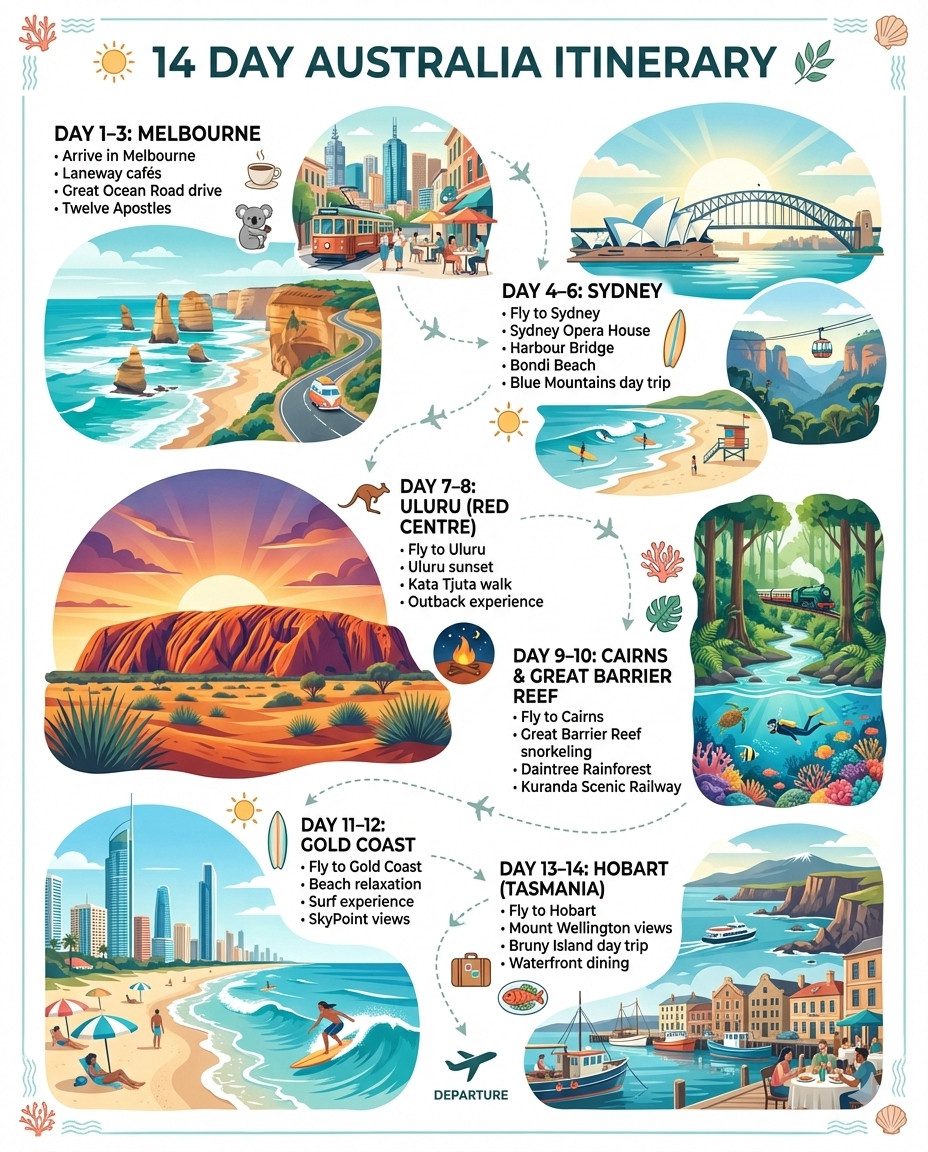
Australia is vast. That single fact trips up more first-time visitors than anything else. The distance between Perth and Cairns alone rivals flying from London to Moscow. Driving between major cities can eat up days you would rather spend exploring. The smartest way to see a real cross-section of the country is to fly between hubs. This beats attempting one epic road trip across the continent. You hop from a laneway-filled southern city to a tropical reef town. From there, you reach the red heart of the outback, all without losing days on the highway.
This 14-day itinerary strings together six destinations that showcase Australia at its most varied. You will visit a cosmopolitan food and culture capital and the country’s most recognizable harbor city. Then stand in the spiritual heart of the outback and snorkel a tropical reef gateway. You will relax on a beach and theme park playground. You will finish in an island state known for wild coastlines and world-class food. Each leg is built around a short domestic flight. That means you spend your time sightseeing rather than commuting.
Quick Comparison Table
| Days | City | Region | Signature Experience | Getting There |
|---|---|---|---|---|
| 1–3 | Melbourne | Victoria | Laneway culture and the Great Ocean Road | International or domestic arrival |
| 4–6 | Sydney | New South Wales | Opera House and Harbour Bridge | Flight from Melbourne (approx. 1.5 hrs) |
| 7–8 | Uluru | Northern Territory | Sunset and sunrise at Uluru | Flight from Sydney (approx. 3.5 hrs) |
| 9–10 | Cairns | Queensland | Great Barrier Reef snorkeling | Flight from Uluru (approx. 2.5 hrs, via hub) |
| 11–12 | Gold Coast | Queensland | Beaches and SkyPoint views | Flight from Cairns (approx. 2 hrs) |
| 13–14 | Hobart | Tasmania | Mount Wellington and Bruny Island | Flight from Gold Coast (approx. 3 hrs) |
Melbourne (Days 1 to 3)
Melbourne is the natural place to start this trip. The city’s airport connects well to the rest of the domestic network. Australia’s self-proclaimed culture capital rewards slow exploration more than any other city here. Its identity is built around hidden laneways and world-class coffee. Three days gives you time to settle into the city grid. You will still have time for one of the best coastal drives in the world.
What to Do in Melbourne
- Wander laneways like Hosier Lane and Degraves Street for street art and small bars
- Visit Federation Square and Flinders Street Station, the anchors of the downtown core
- Browse the Queen Victoria Market, Melbourne’s oldest and largest open-air market
- Spend an evening on a laneway crawl, sampling small plates and natural wine
Where to Stay in Melbourne
- The Central Business District, the most practical base for a short stay
- Southbank, a quieter alternative directly across the Yarra River with skyline views
- Docklands, a modern option for those wanting waterfront apartments and easy transit
- Fitzroy, a good pick if you want bars, street art, and a livelier scene
Sydney (Days 4 to 6)
A short flight from Melbourne brings you to Sydney. This is the city most people picture when they think of Australia. Sydney Harbour is framed by the Opera House on one side and the Harbour Bridge on the other. It ranks among the most photographed urban landscapes in the world. Three days is enough to cover the harborside icons and get some beach time in.
What to Do in Sydney
- Start at Circular Quay, where the Opera House and Harbour Bridge sit close together
- Take a guided tour inside the Opera House, or simply admire it from the promenade
- Walk across the Harbour Bridge for skyline views back toward the city
- Wander the Royal Botanic Garden toward Mrs Macquarie’s Chair, a popular lookout
- Spend an afternoon at Bondi Beach and walk part of the coastal path to Coogee
Where to Stay in Sydney
- The Rocks and Circular Quay, the top pick for first-time visitors
- Budget-friendly hostel-style options in the same historic neighborhood, some with harbor views
- The wider Sydney CBD, a short walk inland with typically lower prices
Uluru, the Red Centre (Days 7 to 8)
From Sydney’s harbor views, the itinerary shifts to the red desert of the Northern Territory. Uluru is the enormous sandstone monolith sacred to the Anangu people. It sits at the heart of Uluru-Kata Tjuta National Park. Two days here is enough to experience its most iconic moments. This stretch trades city energy for total stillness and wide-open horizons.
What to Do at Uluru
- Watch sunset on your first evening, when the rock’s color shifts dramatically
- Pair sunset with a dinner-under-the-stars experience, since light pollution here is minimal
- Try Mala Walk or Kuniya Walk.
- Visit the Uluru Cultural Centre to learn about the site’s Anangu significance
- Head to Kata Tjuta and walk into Walpa Gorge, one of the park’s best short hikes
Where to Stay at Uluru
- Yulara, the only township servicing the national park, about 15 minutes from Uluru
- Sails in the Desert, the resort’s five-star option with full facilities
- The Lost Camel Hotel, a more affordable air-conditioned option with a pool
- Ayers Rock Campground, the only campground, with powered sites and shared kitchens
Cairns and the Great Barrier Reef (Days 9 to 10)
From the desert, the itinerary heads to the tropics. Cairns is the main gateway to the Great Barrier Reef. It also connects to the ancient Daintree Rainforest nearby. Few places let you snorkel a World Heritage reef and walk a World Heritage rainforest in one day.
What to Do in Cairns
- Ride the Skyrail Rainforest Cableway above the canopy to the village of Kuranda
- Return by the heritage Kuranda Scenic Railway, which winds through tunnels and past waterfalls
- Relax at the Cairns Esplanade, home to a free public swimming lagoon
Where to Stay in Cairns
- The Cairns Esplanade area, close to restaurants and the reef tour jetties
- Palm Cove, about 25 minutes north, for a quieter, more upscale base
Gold Coast (Days 11 to 12)
The next flight brings a shift from rainforest to coastline. The Gold Coast is Australia’s classic beach and entertainment destination. It stretches roughly 40 kilometers along the Queensland coast. Surfers Paradise sits at its high-rise, high-energy center.
What to Do on the Gold Coast
- Wander the boutiques and cafes along Cavill Avenue
- Ride the elevator to the SkyPoint Observation Deck on the 77th floor of Q1
- Add the SkyPoint Climb for an external walk around the building’s rooftop edge
- Explore Broadbeach for laid-back dining, or Burleigh Heads for a village feel.
Where to Stay on the Gold Coast
- Surfers Paradise, the obvious base, right on the beach and near SkyPoint
- Broadbeach, a quieter option just south with a strong dining scene
Hobart, Tasmania (Days 13 to 14)
The final leg takes you south to Tasmania, Australia’s island state. Hobart, the state capital, combines colonial architecture with a renowned food and wine scene. It offers easy access to wild coastal scenery nearby. This makes it a fitting, contrasting close to the trip.
What to Do in Hobart
- Visit Salamanca Market on Saturday morning, held along the historic waterfront
- Wander through Battery Point, one of Hobart’s oldest and most charming suburbs
- Ride up kunanyi/Mount Wellington for sweeping views across the city and river
- Round out your stay with a proper waterfront seafood dinner in Hobart
Where to Stay in Hobart
- Battery Point, within walking distance of the waterfront and Salamanca Market
- The adjoining Sullivan’s Cove precinct, close to the city’s best restaurants
Final Thoughts
Fourteen days and six flights is an ambitious pace. It is also the most efficient way to see how different one part of Australia can be from another. You will go from Melbourne’s laneways to Sydney’s harbor in a matter of days. Then trade the red desert silence of Uluru for the color of the Great Barrier Reef. You will end with the Gold Coast’s beach energy and Tasmania’s wild, cool-climate charm. Book your domestic flights early, and pace yourself between destinations. This itinerary shows why one visit to Australia is rarely enough.