
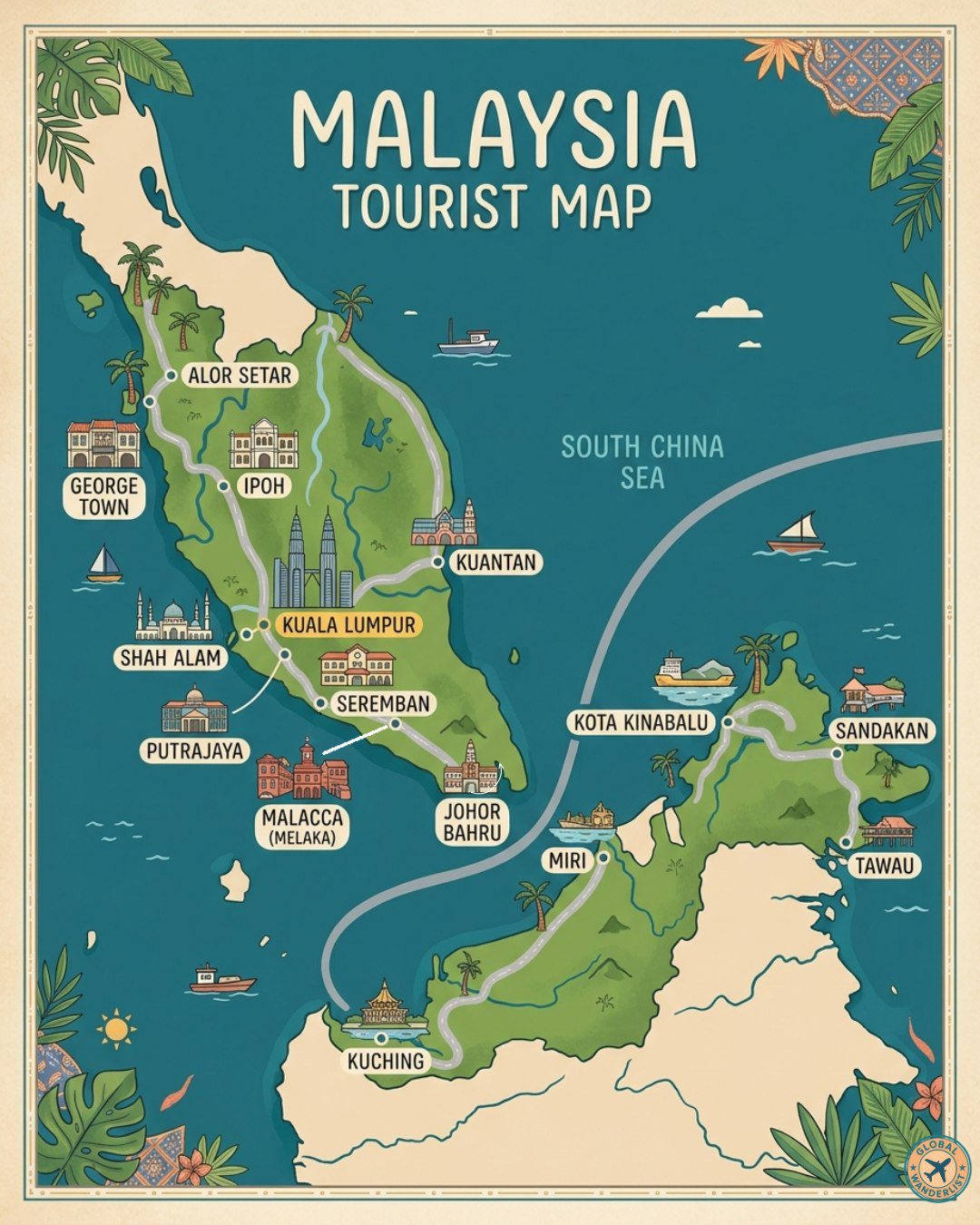
Malaysia splits cleanly into two halves separated by the South China Sea, and that split shapes almost every trip planned here. Peninsular Malaysia holds the cities, colonial towns, and hill stations most visitors picture first. Borneo, across the water, holds rainforest, orangutans, and a completely different pace of travel. This guide walks through both halves region by region, following how the map itself naturally groups these places together.
Regions Overview
| Region | Key Towns | Best Known For |
| Northern Peninsula | George Town, Ipoh, Alor Setar | Colonial architecture, food, limestone caves |
| Central West Coast | Kuala Lumpur, Shah Alam, Putrajaya, Seremban | Capital city sights, mosques, government architecture |
| Southern Peninsula | Malacca, Johor Bahru | Colonial history, border crossing to Singapore |
| East Coast Peninsula | Kuantan | Beaches, quieter pace |
| Sabah (Borneo) | Kota Kinabalu, Sandakan, Tawau | Mount Kinabalu, wildlife, diving |
| Sarawak (Borneo) | Kuching, Miri | Rainforest, Indigenous culture |
Each region asks for a different kind of trip. Some suit a quick weekend, others need a full week to do properly.
The Northern Peninsula
George Town anchors this stretch of the map, its old streets holding one of the best food scenes in the country. Ipoh sits inland, built on old tin-mining money and now known for cave temples and white coffee. Alor Setar rounds out the north as a quieter gateway toward Langkawi and the Thai border.
This part of Malaysia moves slower than Kuala Lumpur, and most visitors spend more time here than they originally planned.
What to See in the Northern Peninsula
- George Town street art: Painted murals cover old shophouse walls throughout the historic core, turning a simple walk into something closer to a treasure hunt.
- Ipoh cave temples: Limestone hills outside town hide temples carved directly into the rock, some centuries old.
- Kek Lok Si Temple: This sits just outside George Town and ranks among the largest Buddhist temples in Southeast Asia.
- Alor Setar’s old quarter: Traditional Kedah architecture survives here, largely untouched by the development found further south.
Best Time to Visit
- Travel between December and February, when rainfall drops and the north stays relatively dry.
- Avoid the monsoon stretch from September through November if you want reliable sightseeing weather.
- Book George Town accommodation early during Chinese New Year, since the city gets genuinely packed.
Getting Around This Region
- Fly directly into Penang International Airport rather than routing through Kuala Lumpur first.
- Take the train between Ipoh and George Town, a comfortable and scenic couple of hours.
- Rent a car if Alor Setar is on your list, since public transport there thins out fast.
The Central West Coast
Kuala Lumpur dominates this stretch, but three smaller cities nearby round out the picture in ways many visitors skip. Shah Alam holds one of the country’s most striking mosques. Putrajaya, Malaysia’s built-from-scratch administrative capital, feels almost surreal in its planned symmetry. Seremban sits a short drive south, less visited but worth a stop for its own colonial-era buildings.
Together these towns show a side of Malaysia that isn’t just skyscrapers, even though they sit practically next door to them.
What to See in the Central West Coast
- Petronas Twin Towers: Kuala Lumpur’s defining landmark still dominates the skyline decades after completion.
- Blue Mosque, Shah Alam: Officially the Sultan Salahuddin Abdul Aziz Mosque, its striking blue dome ranks among the largest in the world.
- Putra Mosque: Set beside an artificial lake in Putrajaya, its pink dome reflects beautifully at sunset.
- Seremban’s old town: Colonial-era shophouses and a well-preserved state museum give this town its own quiet character.
Best Time to Visit
- Visit between May and July for a slightly drier window in this central stretch of the peninsula.
- Expect heat and humidity regardless of season, since this region sits close to the equator year-round.
- Time mosque visits for late afternoon, when the light works best for photos and crowds thin out.
Getting Around This Region
- Use Kuala Lumpur’s MRT and LRT network as your base, then branch out by car or Grab.
- Drive to Shah Alam and Putrajaya, both under an hour from central KL.
- Take a short train ride to Seremban if you’d rather skip the drive.
The Southern Peninsula
Malacca and Johor Bahru anchor Malaysia’s southern tip, each shaped by very different histories. Malacca carries centuries of Portuguese, Dutch, and British rule layered into one small riverside city. Johor Bahru sits right across the causeway from Singapore, functioning as both a border town and a destination worth its own time.
Visitors heading south often treat this region as a stepping stone toward Singapore, but Malacca alone deserves more than a passing glance.
What to See in the Southern Peninsula
- Malacca River: Old shophouses line both banks, especially striking once the lights come on after dark.
- Jonker Street: This transforms into a packed night market every weekend, full of food stalls and antique shops.
- A Famosa: Ruins of this Portuguese fortress mark Malacca’s earliest colonial chapter.
- Johor Bahru’s Arch: This monument commemorates the old Sultanate and remains a popular photo stop.
Best Time to Visit
- Visit Malacca on a weekday if crowds bother you, since Jonker Street gets seriously busy on weekends.
- Travel between March and September for generally drier conditions across the south.
- Cross into Johor Bahru early morning if combining it with a Singapore trip, since the causeway backs up fast.
Getting Around This Region
- Drive or take a bus from Kuala Lumpur, both roughly two hours to Malacca.
- Use the train connection from KL to Johor Bahru if you’d rather avoid driving.
- Walk Malacca’s old town entirely on foot, since most sights sit within a compact radius.
The East Coast Peninsula
Kuantan represents the east coast on this map, a noticeably quieter stretch compared to the busier west. Beaches here draw a more local crowd than the tourist-heavy islands elsewhere in the country. It also serves as a natural stopover for travelers heading further up the coast toward the Perhentian or Redang islands.
This side of the peninsula moves at its own pace, shaped by monsoon seasons that differ from the west coast’s weather patterns.
What to See on the East Coast
- Teluk Cempedak Beach: This sits right on Kuantan’s edge, an easy stretch of sand without the crowds found elsewhere.
- Kuantan River: A river cruise here often turns up fireflies after dark, similar to the more famous Kuala Selangor tours.
- Local seafood markets: These give a genuine sense of the coastal fishing communities that define much of this region.
Best Time to Visit
- Travel between March and September, since the east coast’s monsoon season runs opposite to the west’s.
- Avoid November through February here specifically, when heavy rain and rough seas disrupt travel.
- Check ferry schedules carefully if continuing north toward the Perhentian Islands from this coast.
Getting Around This Region
- Fly into Kuantan directly rather than driving across the peninsula from Kuala Lumpur.
- Rent a car locally if you plan to explore beaches and villages beyond the main town.
- Use Kuantan as a jumping-off point for the east coast islands further north.
Sabah (Borneo)
Kota Kinabalu functions as Sabah’s main gateway, sitting on the coast with Mount Kinabalu visible on clear days. Sandakan and Tawau sit further along, both serving as bases for wildlife-focused trips into Borneo’s rainforest and coastal waters. This region asks for more planning than the peninsula, but rewards it heavily.
Sabah draws a different kind of traveler, one chasing orangutans, diving, and mountain treks rather than city sightseeing.
What to See in Sabah
- Mount Kinabalu: Southeast Asia’s highest peak outside the Himalayas draws serious trekkers for its two-day summit climb.
- Tanjung Aru Beach: Sunsets here regularly rank among the best in Southeast Asia.
- Sepilok Orangutan Rehabilitation Centre: Near Sandakan, this offers a genuine chance to see orangutans up close.
- Sipadan Island: Off the coast near Tawau, this ranks among the best diving destinations on Earth.
Best Time to Visit
- Visit between March and October, avoiding Sabah’s wetter months between November and February.
- Book Mount Kinabalu permits months ahead, since daily climber numbers stay strictly limited.
- Plan diving trips to Sipadan for April through December, when visibility tends to peak.
Getting Around This Region
- Fly into Kota Kinabalu as your main entry point, with onward flights to Sandakan and Tawau.
- Hire a guide for any Mount Kinabalu trek, since independent climbing isn’t permitted.
- Book Sipadan diving trips through a licensed operator based in Semporna, near Tawau.
Sarawak (Borneo)
Kuching leads Sarawak on this map, a slower-paced capital built along a scenic waterfront. Miri sits further north, serving as a base for national parks and cave systems deeper in the state’s interior. Sarawak carries its own distinct food culture and Indigenous history, separate from both the peninsula and Sabah.
Fewer visitors make it to Sarawak compared to Sabah, which tends to work in favor of anyone who does.
What to See in Sarawak
- Kuching Waterfront: Evening walks here mix colonial buildings with modern riverside development.
- Sarawak laksa: This regional dish differs enough from peninsula laksa to be worth seeking out specifically.
- Semenggoh Wildlife Centre: Near Kuching, this offers another strong chance to see orangutans in a semi-wild setting.
- Mulu Caves: Accessible from Miri, these rank among the largest cave systems in the world.
Best Time to Visit
- Travel between April and September for the driest stretch across Sarawak.
- Avoid December through February, when heavy rain affects both Kuching and Miri.
- Book Mulu Caves tours well ahead, since access requires coordination with park rangers.
Getting Around This Region
- Fly into Kuching directly from Kuala Lumpur or Kota Kinabalu.
- Take a short domestic flight from Kuching to Miri rather than attempting the long overland route.
- Arrange guided transport to Semenggoh and Mulu, since both sit outside easy independent access.
Planning a Trip Across Both Halves
Combining Peninsular Malaysia and Borneo into one trip takes real planning, given the distance and different rhythms of each region.
Choosing What to Combine
- Pair Kuala Lumpur with Malacca or George Town if your trip runs shorter than ten days.
- Add Kota Kinabalu as a second leg if wildlife and mountains interest you more than city sightseeing.
- Save Sarawak for a separate trip if time is tight, since it sits furthest from the peninsula’s main hubs.
Domestic Transport Between Regions
- Book flights between the peninsula and Borneo well ahead, since this longer route benefits most from early pricing.
- Budget extra buffer days around Borneo legs, since weather delays happen more often here than on the peninsula.
- Consider AirAsia or Malaysia Airlines for these longer domestic hops, both running frequent connections.
Final Thoughts
Malaysia’s tourist map reflects a country split into genuinely different halves, each asking for its own pace and planning. The peninsula rewards travelers moving between cities and colonial towns at a relaxed clip. Borneo asks for more advance booking but delivers rainforest and wildlife the peninsula simply can’t match. Pick your regions based on what you actually want from the trip, and Malaysia’s split geography stops feeling like a complication and starts feeling like the whole point.