
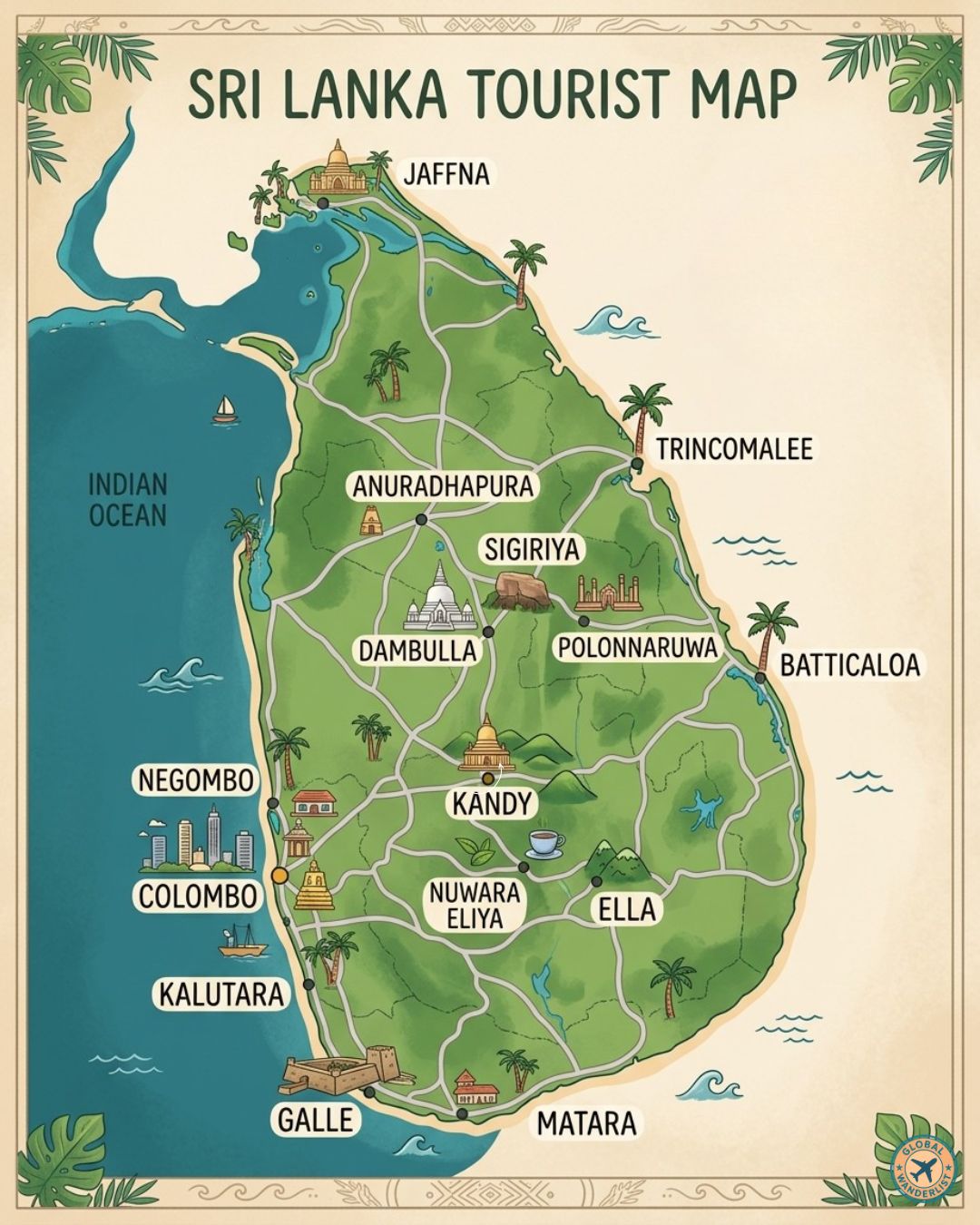
Sri Lanka is a surprisingly varied country to explore. The distances between major destinations are manageable, yet the character of the landscape changes quickly as you move around the island. A trip can include busy streets, quiet beaches, ancient ruins, tea-covered hills, old forts, and fishing towns without requiring huge amounts of time on the road. The places on this map cover many of the country’s best-known destinations, along with a few that tend to get less attention. Together, they give you a good sense of Sri Lanka’s history, culture, scenery, and everyday life.
Colombo
Colombo is Sri Lanka’s largest city and its main commercial center. It is busy, noisy, modern, and full of contrasts. High-rise buildings stand close to colonial-era architecture, while busy markets sit not far from quiet temples and the Indian Ocean. The city has a strong food culture, and areas such as Pettah are particularly interesting if you want to see everyday Colombo rather than just its tourist attractions. Galle Face Green is another popular spot, especially toward evening. Colombo is often treated as a gateway to the rest of Sri Lanka, but it deserves some time of its own.
Why You Should Visit Colombo
- Colombo gives you a good first look at modern Sri Lankan life before you head into the smaller towns and countryside.
- Pettah Market is a great place to see the city’s busy commercial side and browse everything from spices to clothing.
- Galle Face Green becomes particularly lively in the evening when locals gather along the waterfront.
- The city has an interesting collection of Buddhist temples, Hindu temples, churches, and colonial buildings.
- Colombo also has some of the country’s best choices for trying Sri Lankan food in one place.
Negombo
Negombo sits on the western coast, just north of Colombo, and has a strong connection with the sea. Fishing is still an important part of life here, and the coastline is lined with boats, seafood restaurants, and stretches of sandy beach. The city also has several churches and buildings that reflect its Portuguese and Dutch colonial past. Its network of canals adds another layer to the landscape. Negombo is particularly convenient for travelers arriving or departing through the nearby international airport, but it is more than an airport stop. A day here gives you a relaxed introduction to Sri Lanka’s coastal life before you continue inland.
Why You Should Visit Negombo
- Negombo lets you start your Sri Lankan trip beside the ocean without having to travel far from the airport.
- The city’s fishing industry gives you a chance to see an important part of local life that you may miss in larger tourist destinations.
- You can explore the old canals and learn more about the European influences that shaped the town.
- The long beach is an easy place to spend a quiet afternoon after a flight.
- Fresh seafood is one of the highlights here, particularly if you enjoy trying local dishes.
Kalutara
Kalutara is a coastal town south of Colombo, where the Kalu Ganga River reaches the sea. It is quieter than many of the better-known beach destinations farther south, which makes it appealing if you prefer a slower pace. The town is closely associated with the coconut trade and has a few interesting landmarks, including Gangatilaka Vihara, a distinctive Buddhist temple. Its location also makes it an easy stop on a western coastal road trip. Kalutara does not require a packed sightseeing schedule. A visit is more about enjoying the coast, seeing local life, and taking a break before continuing toward the southern beaches.
Why You Should Visit Kalutara
- Kalutara gives you a quieter coastal experience without taking you too far from Colombo.
- Gangatilaka Vihara is an unusual temple and one of the most recognizable landmarks in the town.
- The meeting point of the river and ocean creates a pleasant setting for a relaxed afternoon.
- You can get a better sense of everyday life in a smaller Sri Lankan coastal town.
- Kalutara makes a convenient stop if you are driving south toward Galle.
Galle
Galle has a completely different feel from Colombo and the beach towns along the western coast. Its main attraction is Galle Fort, a historic walled district overlooking the Indian Ocean. The Portuguese began the fortification, and the Dutch later expanded it into the structure you see today. Inside the walls, old buildings have been turned into cafes, shops, galleries, hotels, and restaurants, so the area still feels lived in rather than preserved as a museum. The fort is easy to explore on foot, and its walls provide excellent views of the sea. Galle is one of Sri Lanka’s most interesting places for history and architecture.
Why You Should Visit Galle
- Galle Fort lets you walk through a historic neighborhood where old architecture still forms part of everyday life.
- The fort walls are a great place to watch the Indian Ocean, particularly around sunset.
- Small shops, galleries, and cafes make wandering through the old streets more enjoyable than simply visiting individual monuments.
- The buildings show how Portuguese, Dutch, and Sri Lankan influences came together over several centuries.
- Galle also gives you easy access to some of the most popular beaches along the southern coast.
Matara
Matara sits on Sri Lanka’s southern coast and is a useful stop for exploring the less polished side of the region. The city has a long history, with Portuguese and Dutch influences visible in its historic buildings and fortifications. Star Fort is one of the best-known landmarks, while Matara Fort sits closer to the sea. The city also acts as a gateway to several beaches and smaller coastal communities farther east. Matara itself is not as focused on tourism as Galle, which can actually be part of its appeal. You get a busier local town, traditional markets, coastal scenery, and historic sites in one place.
Why You Should Visit Matara
- Matara gives you a glimpse of a working Sri Lankan coastal city rather than a destination built mainly around tourism.
- Star Fort is an unusual piece of colonial military architecture and is easy to include during a short visit.
- The city is surrounded by beaches, making it useful as a base for exploring the southern coastline.
- You can combine historic sights with local markets and everyday city life during the same day.
- Matara is well placed for continuing toward destinations such as Dikwella and the beaches farther east.
Ella
Ella is one of Sri Lanka’s best-known hill-country destinations, and the scenery explains much of its popularity. The town is surrounded by steep green hills, tea plantations, valleys, and waterfalls. Hiking is a major reason people come here, with Little Adam’s Peak and Ella Rock providing two very different walks. The Nine Arch Bridge is another favorite, particularly when a train passes through the valley below. Ella itself is fairly small, so you do not need to spend all your time in town. The surrounding countryside is the real attraction, and it is easy to fill several days exploring it.
Why You Should Visit Ella
- Ella gives you some of the best mountain scenery in Sri Lanka without requiring difficult access to remote areas.
- Little Adam’s Peak is an approachable hike with wide views across the surrounding hills.
- Nine Arch Bridge is one of the most recognizable sights in the Sri Lankan highlands.
- Tea plantations and waterfalls provide plenty of places to explore outside the town itself.
- The train journey through the hill country is an experience worth making time for during your stay.
Nuwara Eliya
Nuwara Eliya feels noticeably different from Sri Lanka’s tropical coastal towns. It sits high in the central mountains, where the cooler climate is ideal for growing tea. The surrounding hills are covered with tea plantations, and the town itself has plenty of reminders of the British colonial period. This is the heart of Sri Lanka’s tea country, so visiting a plantation or factory is one of the most worthwhile things to do here. The area is also known for its gardens, waterfalls, and mountain roads. Nuwara Eliya makes a good stop between Kandy and Ella, especially if you want to slow down and enjoy the scenery.
Why You Should Visit Nuwara Eliya
- You can drive through some of Sri Lanka’s most scenic tea-growing landscapes around Nuwara Eliya.
- A visit to a tea factory shows how the leaves are processed before they become the Ceylon tea sold around the world.
- The cooler weather makes a welcome change after spending time along the coast.
- The town’s colonial buildings and gardens give it a character that is quite different from the rest of Sri Lanka.
- Nearby waterfalls, lakes, and mountain viewpoints make the surrounding area worth exploring by car.
Kandy
Kandy was the last royal capital of Sri Lanka before British rule and remains one of the country’s most important cultural centers. The city sits among green hills around Kandy Lake, with the Temple of the Sacred Tooth Relic at its heart. The temple is one of the most important Buddhist sites in Sri Lanka and attracts pilgrims throughout the year. Kandy also has a lively market area, traditional performances, and the Royal Botanical Gardens at Peradeniya. It is a fairly busy city, but the hills around it give the place a softer feel. Kandy is an important stop for understanding Sri Lanka’s history and religious traditions.
Why You Should Visit Kandy
- The Temple of the Sacred Tooth Relic gives you an opportunity to see one of Sri Lanka’s most important religious sites.
- Kandy’s location among the hills makes the city particularly attractive when viewed from above.
- Kandy Lake provides a pleasant place to walk when you want a break from sightseeing.
- The Royal Botanical Gardens at Peradeniya are an easy addition to a day in the area.
- Traditional music and dance performances provide a closer look at the cultural traditions associated with the old royal capital.
Dambulla
Dambulla is best known for its cave temple complex, where Buddhist statues and paintings fill a series of caves beneath a rocky outcrop. The site has been an important religious center for centuries and is one of the major cultural attractions in central Sri Lanka. Dambulla also sits in a useful location for exploring the wider Cultural Triangle, with Sigiriya, Polonnaruwa, and other historic sites within reach. The town itself is fairly straightforward, but the cave temple is the reason most visitors stop here. It is a place where the artwork, religious significance, and setting all come together in a memorable way.
Why You Should Visit Dambulla
- The cave temples contain an impressive collection of Buddha statues and painted surfaces that have accumulated over many centuries.
- The setting inside the caves makes the visit feel very different from visiting a conventional temple.
- Dambulla is close enough to Sigiriya that both sites can easily be included in the same part of a trip.
- The area gives you a chance to learn more about the role Buddhism has played in Sri Lankan history.
- Dambulla is a practical base if you want to spend several days exploring the Cultural Triangle.
Sigiriya
Sigiriya is dominated by a huge rock that rises above the surrounding forest, making it one of the easiest Sri Lankan landmarks to recognize. The ruins at the top were once part of a fortified royal complex, and reaching them means climbing a long series of steps cut into the rock. Along the way, you pass ancient gardens, frescoes, and the famous Lion’s Paws. The views become increasingly impressive as you climb higher. Sigiriya is also close to Pidurangala Rock, which offers a different perspective of the fortress. The site combines history with a physical challenge, so it tends to be one of the most memorable stops on a Sri Lankan trip.
Why You Should Visit Sigiriya
- Climbing the rock gives you a chance to explore one of Sri Lanka’s most important archaeological sites firsthand.
- The view from the top stretches across forests and plains and makes the climb worthwhile.
- The ancient gardens at the base show how carefully the area around the fortress was designed.
- Pidurangala provides a popular viewpoint where you can see Sigiriya rising above the surrounding landscape.
- Sigiriya brings together archaeology, history, scenery, and a little adventure in one stop.
Anuradhapura
Anuradhapura was one of Sri Lanka’s ancient capitals and remained a major center of political and religious life for centuries. Today, the old city covers a huge area filled with stupas, monasteries, reservoirs, ruins, and sacred sites. The scale is difficult to appreciate from photographs. You can spend hours moving between enormous monuments, often with trees and open spaces separating one site from another. Sri Maha Bodhi is especially important to Buddhist pilgrims and is one of the city’s best-known sacred sites. Anuradhapura is worth taking your time with because it feels less like a single attraction and more like an entire ancient city spread across the landscape.
Why You Should Visit Anuradhapura
- The enormous stupas and ancient structures give you a sense of the scale of Sri Lanka’s early kingdoms.
- Sri Maha Bodhi is an important pilgrimage site with deep religious significance.
- The archaeological area contains enough sites to keep you occupied for most of a day.
- Exploring the ruins by bicycle is a good way to cover the large area without rushing between attractions.
- Anuradhapura provides useful context for understanding the history behind many of Sri Lanka’s later religious and cultural traditions.
Polonnaruwa
Polonnaruwa became the medieval capital of Sri Lanka after Anuradhapura and is now known for its well-preserved ruins. The archaeological area contains royal buildings, temples, stupas, statues, and remains of an advanced irrigation system. Gal Vihara is one of the major highlights, with several Buddha figures carved directly into a granite rock face. The site is spread across a large area, but many of the major monuments can be explored in a day. Polonnaruwa is especially interesting when paired with Anuradhapura because the two sites show different periods in the development of Sri Lanka’s ancient kingdoms.
Why You Should Visit Polonnaruwa
- Gal Vihara contains some of the most impressive ancient stone carvings you will see in Sri Lanka.
- The ruins provide a clear picture of how large and sophisticated the medieval capital once was.
- Cycling between the archaeological sites makes it easier to explore the area at your own pace.
- Ancient temples, royal buildings, and irrigation works show how closely religion, government, and engineering were connected.
- Polonnaruwa adds another chapter to the story that begins at the ancient city of Anuradhapura.
Trincomalee
Trincomalee sits on the northeast coast and is known for its natural harbor, beaches, and Hindu heritage. The city has a long history and has been influenced by several different cultures over the centuries. Koneswaram Temple is one of its best-known landmarks, standing dramatically above the ocean. The nearby beaches at Nilaveli and Uppuveli are another reason people make the journey here. Trincomalee feels different from the western and southern coast, partly because of its location and partly because of its strong Tamil cultural influence. It is a good choice for travelers who want to spend time on Sri Lanka’s less explored eastern side.
Why You Should Visit Trincomalee
- Koneswaram Temple has an extraordinary position overlooking the ocean and is one of the city’s defining landmarks.
- The beaches around Trincomalee have clear water and a much quieter feel than some of Sri Lanka’s busier coastal areas.
- The city gives you an opportunity to experience the Tamil cultural traditions that are particularly prominent in the east.
- The natural harbor is one of the most striking geographical features in this part of Sri Lanka.
- Trincomalee works well for travelers who want to add a different coastal experience to a trip focused mainly on the south and west.
Batticaloa
Batticaloa sits along Sri Lanka’s eastern coast and is surrounded by a network of lagoons and waterways. The city has a distinct cultural identity shaped by Tamil, Muslim, and Christian communities, and its pace is noticeably slower than Colombo or the major tourist centers. Batticaloa Fort is an important reminder of the area’s colonial history, while the lagoon remains central to the landscape and local life. The city also has beaches nearby, although sightseeing here is less about ticking off major attractions and more about experiencing a different part of the country. Batticaloa is particularly appealing if you have enough time to travel beyond Sri Lanka’s classic tourist circuit.
Why You Should Visit Batticaloa
- Batticaloa gives you a chance to experience a quieter part of Sri Lanka that sees fewer international visitors.
- The lagoon creates a distinctive landscape that is best appreciated slowly, rather than rushing through the city.
- Batticaloa Fort provides an interesting glimpse into the region’s colonial history.
- The city’s mix of communities makes its food, religious traditions, and everyday culture particularly interesting.
- Nearby beaches give you an easy way to combine cultural sightseeing with time beside the ocean.
Jaffna
Jaffna occupies the northern tip of Sri Lanka and has a character that is quite different from the rest of the island. Tamil culture is deeply woven into everyday life here, and it can be seen in the temples, food, language, architecture, and festivals. Nallur Kandaswamy Kovil is one of the region’s most important Hindu temples, while Jaffna Fort reflects the area’s long colonial history. The peninsula also has small islands, quiet beaches, lagoons, and rural roads that make exploring beyond the city worthwhile. Jaffna takes more effort to reach than most destinations on this map, but that distance is part of what makes it interesting.
Why You Should Visit Jaffna
- Jaffna gives you a chance to experience the distinctive Tamil culture of northern Sri Lanka.
- Nallur Kandaswamy Kovil is an impressive temple and an important part of the region’s religious life.
- Jaffna Fort provides a look at the strategic and colonial history of the northern peninsula.
- The surrounding islands and coastal areas have a quieter atmosphere than Sri Lanka’s main beach destinations.
- The food in Jaffna has its own character, making the region particularly interesting for travelers who enjoy trying local cuisine.