
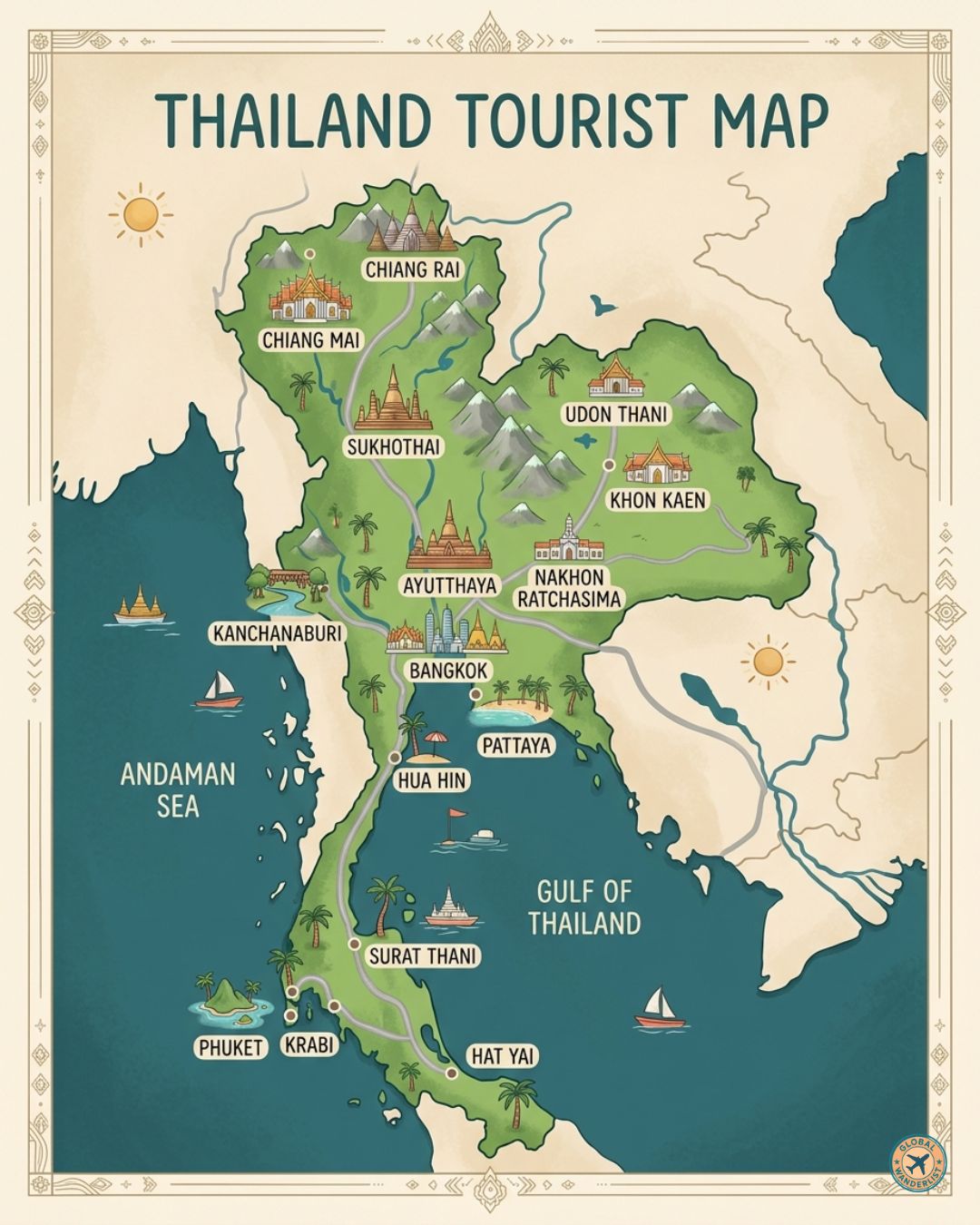
Thailand’s shape roughly resembles an elephant’s head, and that geography shapes how most trips get planned. The northern mountains, central plains, and southern peninsula each offer a genuinely different kind of Thailand, meaning most visitors end up choosing regions rather than trying to cover the entire country in one trip. Understanding what each area actually offers makes that decision far easier.
This guide walks through Thailand’s major tourist regions, following the natural flow most travelers use when planning a route. Below is a region-by-region breakdown, including what to see, how to get around, and practical tips for timing your visit to each part of the country.
Regions Overview
| Region | Key Cities | Best Known For |
| Bangkok & Central Plains | Bangkok, Ayutthaya, Kanchanaburi | Temples, history, river life |
| Northern Thailand | Chiang Mai, Chiang Rai, Sukhothai | Mountains, hill tribe culture |
| Isaan | Udon Thani, Khon Kaen, Nakhon Ratchasima | Rural culture, temples |
| Eastern Gulf Coast | Pattaya, Hua Hin | Beaches, nightlife |
| Southern Gulf & Andaman | Surat Thani, Phuket, Krabi, Hat Yai | Islands, diving, cliffs |
Each of these regions could easily fill a standalone trip. Below is a closer look at what makes each one worth visiting, along with practical guidance on getting there and getting around once you arrive.
Bangkok and the Central Plains
Bangkok anchors most Thailand itineraries, a dense, chaotic capital built along the Chao Phraya River. Ayutthaya, a former royal capital just north of the city, offers some of the country’s most significant historical ruins. Kanchanaburi, further west, carries a more somber history tied to the Second World War’s Death Railway.
This central region functions as the natural hub for the rest of the country, with Bangkok’s two international airports connecting to nearly every other region on this list. Most travelers spend at least a few days here before heading further afield, and the central plains reward those willing to venture beyond the capital itself.
What to See in Bangkok and the Central Plains
- Visit the Grand Palace and Wat Pho in Bangkok, both anchoring the city’s most concentrated cluster of temples.
- Explore Ayutthaya Historical Park, home to crumbling temple ruins and tree-wrapped Buddha statues.
- Visit the Bridge on the River Kwai in Kanchanaburi, a significant and moving World War II historical site.
- Take a boat trip through Bangkok’s khlongs, the network of canals that once served as the city’s primary transport routes.
- Explore Damnoen Saduak floating market, a short drive from Bangkok, for a glimpse of Thailand’s traditional waterway commerce.
Best Time to Visit
- Travel between November and February for the most comfortable temperatures in this central region.
- Avoid the hottest months between March and May, when Bangkok’s heat and humidity peak.
- Visit Ayutthaya early in the morning to avoid both crowds and the stronger midday sun.
Getting Around This Region
- Use the BTS Skytrain and MRT subway within Bangkok to avoid the city’s notoriously heavy traffic.
- Take a train or minivan to Ayutthaya, both offering a straightforward day trip option from Bangkok.
- Book a private car or organized tour for Kanchanaburi, since public transport connections require more planning.
Northern Thailand
Northern Thailand shifts the pace considerably compared to Bangkok, built around mountains, hill tribe villages, and slower-moving cities. Chiang Mai serves as the region’s cultural hub, while Chiang Rai offers striking modern temple architecture further north. Sukhothai, Thailand’s first capital, rounds out the region with well-preserved historical ruins.
The north’s cooler climate and mountainous terrain give it a distinctly different feel from the rest of the country, and many travelers find it offers the clearest window into rural Thai and hill tribe culture. The region also produces much of Thailand’s coffee, a growing draw for food and drink enthusiasts.
What to See in Northern Thailand
- Explore Chiang Mai’s Old City temples, walking between them within the historic moated square.
- Visit Wat Rong Khun in Chiang Rai, a striking white temple built by contemporary artist Chalermchai Kositpipat.
- Walk through Sukhothai Historical Park, Thailand’s first capital and a UNESCO World Heritage Site.
- Visit a hill tribe village near Chiang Rai or Chiang Mai, offering insight into the region’s diverse ethnic communities.
- Drive or join a tour along the Mae Hong Son Loop for some of northern Thailand’s most dramatic mountain scenery.
Best Time to Visit
- Visit between November and February for the coolest, most comfortable mountain temperatures.
- Avoid the burning season between February and April, when agricultural smoke can affect air quality significantly.
- Book Chiang Mai accommodation ahead during Loi Krathong in November, one of the region’s most popular festival periods.
Getting Around This Region
- Fly directly into Chiang Mai International Airport, the region’s main transport hub with frequent domestic connections.
- Take a bus or minivan between Chiang Rai and Chiang Mai, since no direct flight connects the two cities.
- Rent a scooter or hire a driver for Sukhothai Historical Park, since the ruins are spread across a wide area better covered with wheels than on foot.
Isaan
Isaan, Thailand’s northeastern region, remains one of the least visited by international tourists despite covering roughly a third of the country. Udon Thani and Khon Kaen serve as the region’s main urban centers, while Nakhon Ratchasima offers access to nearby national parks and ancient Khmer temple ruins. This region rewards travelers seeking a more authentic, less touristed side of Thailand.
Isaan’s relative lack of international tourism means prices stay lower and interactions with locals often feel more genuine than in more heavily visited regions. The area’s proximity to Cambodia and Laos also gives it a distinct cultural blend not found elsewhere in Thailand.
What to See in Isaan
- Visit Phanom Rung Historical Park near Nakhon Ratchasima, an impressive Khmer temple complex predating Angkor Wat.
- Explore Udon Thani’s Ban Chiang archaeological site, a UNESCO World Heritage Site with significant prehistoric artifacts.
- Sample Isaan’s distinct regional cuisine, including Som Tam and grilled meats, considered some of the most flavorful in the country.
- Visit Khao Yai National Park near Nakhon Ratchasima, one of Thailand’s most significant protected wilderness areas.
- Explore local markets in Khon Kaen for a genuine taste of everyday Isaan life away from tourist infrastructure.
Best Time to Visit
- Travel between November and February for the most comfortable temperatures across this inland region.
- Avoid the hottest months between March and May, when Isaan’s heat can become genuinely uncomfortable.
- Plan around regional festivals if possible, since Isaan hosts several distinct cultural celebrations throughout the year.
Getting Around This Region
- Fly into Udon Thani or Khon Kaen for the most direct access to this region, both served by regular domestic flights from Bangkok.
- Consider an overnight train from Bangkok if you prefer a scenic, budget-friendly alternative to flying.
- Rent a car or hire a driver for exploring Phanom Rung and other rural sites, since public transport options are limited outside the main cities.
The Eastern Gulf Coast
Pattaya and Hua Hin anchor Thailand’s eastern Gulf coast, both offering an easy beach escape within a few hours of Bangkok. Pattaya has built a reputation around nightlife and beach resorts, while Hua Hin offers a calmer, more low-key alternative popular with Thai royalty historically. Both serve as accessible introductions to Thailand’s beach culture without needing a domestic flight.
This region’s proximity to Bangkok makes it especially popular for shorter trips or weekend getaways, and it remains a strong option for travelers who want beach time without committing significant travel days to reach the southern islands.
What to See on the Eastern Gulf Coast
- Relax at Hua Hin’s beaches for a quieter, more traditional Thai beach town atmosphere.
- Explore Pattaya’s nightlife and beachfront strip if a livelier atmosphere suits your trip better.
- Visit Sanctuary of Truth near Pattaya, an enormous wooden temple structure built without a single nail.
- Explore Hua Hin’s night market, known for a strong mix of street food and local crafts.
- Take a day trip to Khao Sam Roi Yot National Park near Hua Hin, known for its limestone caves and coastal wetlands.
Best Time to Visit
- Visit between November and April for the driest, most reliable beach weather along this coastline.
- Avoid the wetter months between May and October if beach time is your priority.
- Choose Hua Hin over Pattaya if you prefer a calmer, family-friendly atmosphere.
Getting Around This Region
- Drive or take a minivan directly from Bangkok, since both Pattaya and Hua Hin sit within a two to three hour journey.
- Use local songthaews, shared pickup trucks, for short trips within either town.
- Book private transfers if traveling with significant luggage or in a larger group, generally more convenient than public options.
The Southern Gulf and Andaman Coast
Southern Thailand splits into two coastlines, the Gulf of Thailand to the east and the Andaman Sea to the west, both dotted with some of the country’s most famous islands. Phuket and Krabi anchor the Andaman side, known for dramatic limestone cliffs and diving. Surat Thani serves as the main gateway to Gulf islands like Koh Samui, while Hat Yai offers a practical southern transit hub.
This region draws the largest share of Thailand’s international beach tourism, and for good reason. The contrast between the Gulf’s calmer waters and the Andaman’s dramatic limestone scenery means travelers can genuinely experience two distinct coastlines within a single southern leg of their trip.
What to See on the Southern Coast
- Explore Krabi’s Railay Beach, accessible only by boat and known for its dramatic limestone cliffs and rock climbing.
- Dive or snorkel around Phuket’s surrounding islands, among the most popular diving destinations in the country.
- Take a boat trip from Surat Thani to Koh Samui or the Ang Thong Marine Park, known for their limestone island scenery.
- Visit the Phi Phi Islands, accessible from both Phuket and Krabi, for some of Thailand’s most photographed coastal scenery.
- Explore Phuket Old Town for a change of pace from the beaches, known for its well-preserved Sino-Portuguese architecture.
Best Time to Visit
- Visit between November and April for the driest, calmest conditions on the Andaman coast.
- Avoid the Andaman coast’s monsoon season between May and October, when rough seas can disrupt boat travel.
- Check regional weather separately for the Gulf and Andaman coasts, since their wet seasons do not always align.
Getting Around This Region
- Fly into Phuket International Airport for the most direct access to the Andaman coast, with frequent connections from Bangkok and other regions.
- Take a ferry between Surat Thani and the Gulf islands, a straightforward and scenic way to reach Koh Samui or Koh Phangan.
- Use longtail boats for short island-hopping trips around Krabi and Phuket, widely available and relatively inexpensive.
Planning a Multi-Region Thailand Trip
Given how differently each of these regions functions, planning a trip that spans more than one requires some strategic thinking about routing and timing.
Choosing Which Regions to Combine
- Pair Bangkok with the Central Plains if your trip is shorter, since these regions sit close together and require minimal additional travel time.
- Combine Northern Thailand with a southern island stop if you want the widest possible contrast between mountains and beaches.
- Consider Isaan as an add-on for a second or third visit to Thailand, since its lesser-known attractions reward travelers who have already covered the more famous regions.
Domestic Transport Between Regions
- Book domestic flights well in advance for routes between the north and south, since these longer legs benefit most from advance pricing.
- Consider overnight trains for shorter regional hops, particularly between Bangkok and destinations in the north or northeast.
- Budget extra buffer time between regions during peak season, since flight delays and cancellations become more common during the busiest travel months.
Final Thoughts
Thailand’s tourist map reflects a country where geography shapes the itinerary as much as personal interest does. From Bangkok’s temples to the northern mountains to the southern islands, each region offers something distinct enough to justify its own dedicated time. Match your route to the season and pace that suits you, plan your inter-regional transport ahead of time, and Thailand’s varied geography becomes an asset rather than an obstacle.