
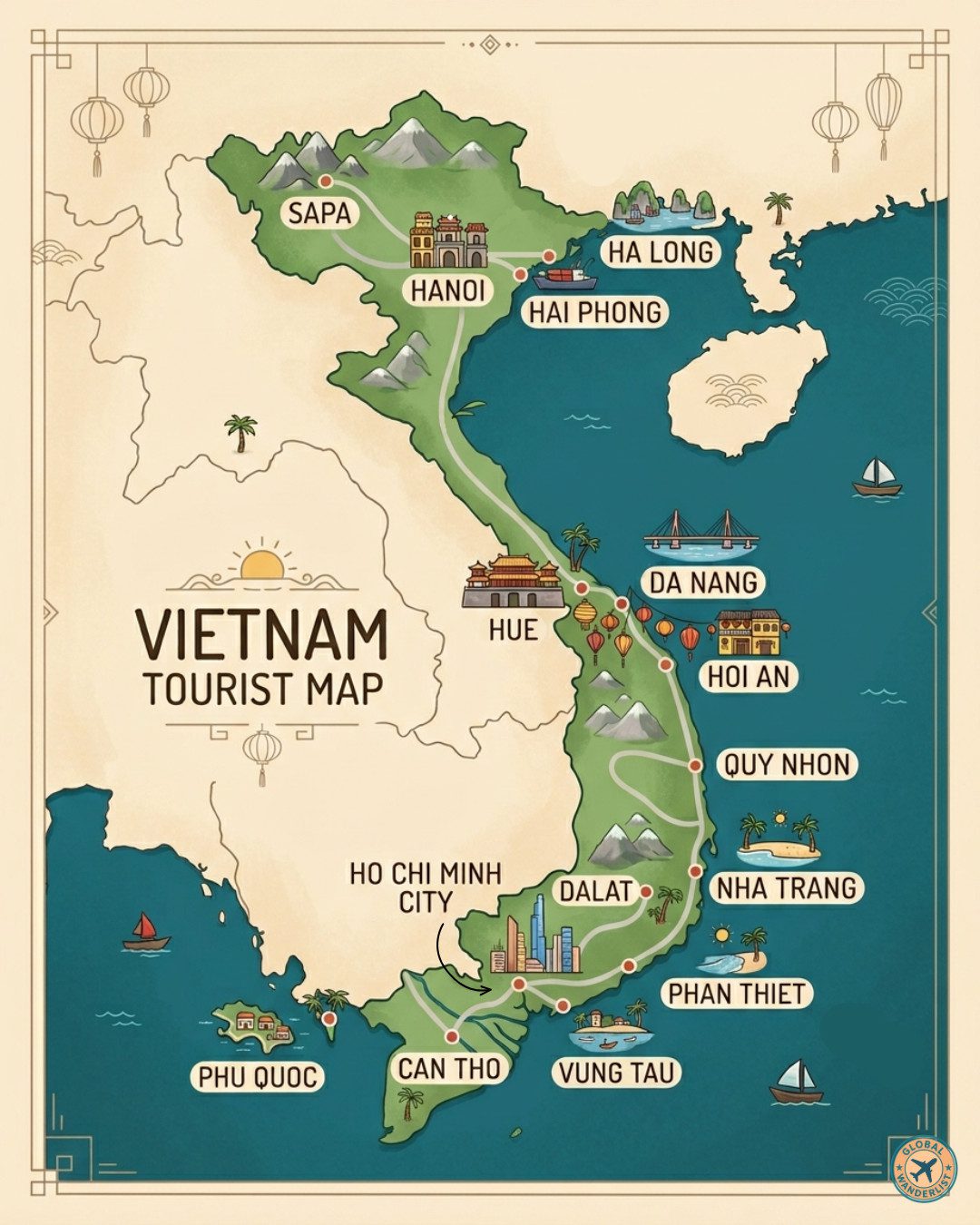
Vietnam’s shape alone tells you something about the trip ahead. The country stretches over 1,600 kilometers along a narrow S-curve, meaning even a well-planned itinerary usually means picking regions rather than trying to cover everything. Understanding what each area actually offers makes that decision far easier.
This guide walks through Vietnam’s major tourist regions from north to south, following the natural flow most travelers use when planning a route. Below is a region-by-region breakdown, including what to see and practical tips for timing your visit.
Regions Overview
| Region | Key Cities | Best Known For |
|---|---|---|
| Northern Highlands | Sapa | Rice terraces, ethnic minority culture |
| Hanoi & Ha Long Bay | Hanoi, Hai Phong, Ha Long | Old Quarter, limestone karsts |
| Central Coast | Hue, Da Nang, Hoi An, Quy Nhon | Imperial history, lantern-lit streets |
| South Central Coast | Nha Trang, Phan Thiet | Beaches, diving, sand dunes |
| Central Highlands | Da Lat | Cool climate, waterfalls |
| Ho Chi Minh City & South | Ho Chi Minh City, Vung Tau | Urban energy, war history |
| Mekong Delta & Islands | Can Tho, Phu Quoc | Floating markets, tropical islands |
Each of these regions could fill a standalone trip. Below is a closer look at what makes each one worth visiting.
Sapa and the Northern Highlands
Sapa sits high in Vietnam’s northern mountains, known for its dramatic terraced rice fields and strong ethnic minority culture. Hmong and Dao communities live throughout the surrounding valleys, many welcoming visitors on guided treks. The region’s cooler climate offers a welcome break from the heat found throughout much of the rest of the country.
What to See in Sapa
- Trek through the terraced rice fields surrounding Sapa town, particularly striking during the June planting or September harvest seasons.
- Visit a Hmong or Dao village on a guided homestay trek, offering genuine insight into the region’s ethnic minority cultures.
- Take the cable car to Fansipan, the tallest peak in Indochina, for sweeping views over the surrounding mountains.
Best Time to Visit
- Visit between March and May or September and November for the most comfortable trekking temperatures.
- Avoid the coldest winter months between December and February if you dislike chilly, sometimes foggy mountain weather.
- Book trekking guides in advance during the September to November harvest season, when demand peaks.
Hanoi and Ha Long Bay
Hanoi, Vietnam’s capital, blends French colonial architecture with a chaotic, motorbike-filled Old Quarter. A short drive or cruise away, Ha Long Bay’s limestone karsts rise dramatically from the Gulf of Tonkin, making it the country’s most photographed natural landmark. Hai Phong serves as a practical port city connecting the two.
What to See in Hanoi and Ha Long Bay
- Walk through Hanoi’s Old Quarter, exploring its narrow streets and centuries-old shophouses.
- Take an overnight cruise through Ha Long Bay, passing thousands of limestone islands along the way.
- Visit Hoan Kiem Lake in central Hanoi, home to the small but symbolically important Turtle Tower.
Best Time to Visit
- Travel between October and April for the most comfortable weather and clearer skies over Ha Long Bay.
- Avoid the hottest, most humid months between May and August if possible, particularly for city walking in Hanoi.
- Book Ha Long Bay cruises well ahead during peak season, since the most reputable boats fill quickly.
The Central Coast
Vietnam’s central coast holds much of the country’s imperial and colonial history. Hue served as the seat of the Nguyen Dynasty, while Hoi An’s lantern-lit Ancient Town remains remarkably preserved. Da Nang bridges the two with modern beaches and dramatic mountain pagodas, while Quy Nhon offers a quieter, less touristed coastal alternative.
What to See on the Central Coast
- Explore Hue’s Imperial City, the former seat of Vietnam’s last royal dynasty.
- Wander Hoi An’s Ancient Town at dusk, when lanterns illuminate the riverside streets.
- Ride the cable car to Ba Na Hills near Da Nang to see the famous Golden Bridge.
Best Time to Visit
- Visit between February and May for the most reliable dry weather across this stretch of coastline.
- Avoid the central coast’s rainy season, typically running from September through January.
- Book Hoi An accommodation ahead during the Lantern Festival, held monthly on the full moon.
Nha Trang and Phan Thiet
South of the central coast, Nha Trang and Phan Thiet shift the focus toward beaches and outdoor adventure. Nha Trang is known for its diving and snorkeling, with several nearby islands offering clear water and coral reefs. Phan Thiet, home to the town of Mui Ne, is famous for its striking red and white sand dunes.
What to See in Nha Trang and Phan Thiet
- Dive or snorkel around Nha Trang’s offshore islands, among the best diving spots in mainland Vietnam.
- Visit the Po Nagar Cham Towers in Nha Trang, an ancient Hindu temple complex overlooking the coast.
- Explore Mui Ne’s red and white sand dunes, particularly striking at sunrise or sunset.
Best Time to Visit
- Travel between January and August for the driest, most reliable beach weather in this region.
- Avoid Nha Trang and Phan Thiet during the wetter months between September and December.
- Visit Mui Ne’s sand dunes early morning to avoid both crowds and the strongest midday heat.
Da Lat and the Central Highlands
Da Lat sits at a noticeably higher elevation than most of Vietnam, giving it a cooler, spring-like climate year-round. French colonists once used the town as a mountain retreat, and its architecture still reflects that history. Waterfalls, flower farms, and pine forests surround the town on nearly every side.
What to See in Da Lat
- Visit Datanla Falls or Elephant Falls, both offering dramatic waterfall scenery just outside town.
- Explore Da Lat’s flower farms and greenhouses, which supply much of Vietnam with fresh produce and flowers.
- Walk through the town’s French colonial architecture, including the distinctive Da Lat Railway Station.
Best Time to Visit
- Visit between December and March for the driest weather and clearest mountain views.
- Pack layers regardless of season, since Da Lat’s elevation keeps temperatures cooler than most of the country.
- Avoid the wettest months between June and September if outdoor sightseeing is your priority.
Ho Chi Minh City and the South
Ho Chi Minh City, still commonly called Saigon, is Vietnam’s largest and most economically dynamic city. Its energy contrasts sharply with Hanoi’s more traditional character, reflected in its skyline, nightlife, and traffic. Vung Tau, a beach city a short drive away, offers an easy coastal escape from the urban core.
What to See in Ho Chi Minh City and the South
- Visit the War Remnants Museum for a sobering look at the Vietnam War from a Vietnamese perspective.
- Explore the Cu Chi Tunnels on a day trip, an extensive underground network used during the war.
- Walk through Ben Thanh Market for a concentrated taste of the city’s food and shopping culture.
Best Time to Visit
- Travel between December and April for the driest season in southern Vietnam.
- Avoid the peak wet season between June and October, when afternoon downpours are common.
- Book Cu Chi Tunnels tours in the morning to avoid both crowds and the hottest part of the day.
The Mekong Delta and Phu Quoc Island
The Mekong Delta unfolds in a maze of rivers and canals south of Ho Chi Minh City, with Can Tho serving as its main hub. Floating markets remain a defining feature of daily life here, though they have grown quieter in recent years. Phu Quoc Island, off the southwestern coast, offers a tropical alternative with clear water and a growing resort scene.
What to See in the Mekong Delta and Phu Quoc
- Visit Cai Rang floating market near Can Tho, one of the largest and most active in the delta.
- Take a boat tour through the delta’s smaller canals, passing fruit orchards and riverside villages.
- Snorkel or relax on Phu Quoc’s beaches, known for some of the clearest water in Vietnam.
Best Time to Visit
- Visit the Mekong Delta between December and April for the driest, most comfortable touring conditions.
- Time your Cai Rang floating market visit for early morning, since vendor activity dies down by mid-morning.
- Book Phu Quoc accommodation ahead during peak season between November and March, when the island is busiest.
Final Thoughts
Vietnam’s tourist map reflects a country where geography drives the itinerary. From Sapa’s mountain terraces to Phu Quoc’s beaches, each region offers something distinct enough to justify its own dedicated time. Match your route to the season and pace that suits you, and Vietnam’s long shape becomes an asset rather than an obstacle.