
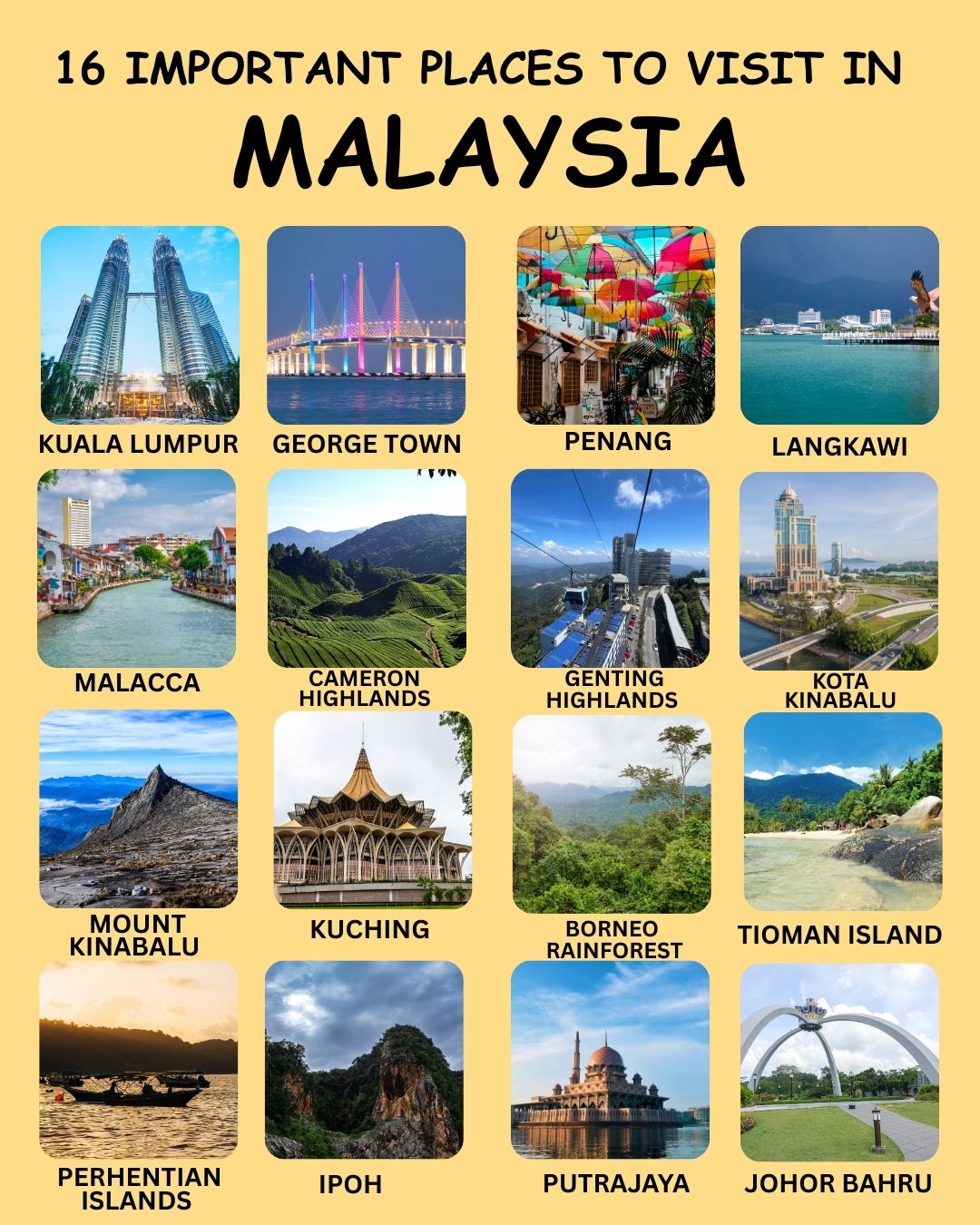
Malaysia manages something few countries pull off: skyscrapers, rainforest, tea country, and island beaches all within a manageable travel radius. Split roughly between Peninsular Malaysia and Borneo, the country offers wildly different experiences depending on which corner you’re standing in. This guide walks through sixteen destinations worth building a trip around, whether you’ve got ten days or a full month to work with.
1) Kuala Lumpur
Malaysia’s capital sets the tone for most first trips, a city where glass towers rise directly beside centuries-old temples. The Petronas Towers alone justify a stop, but the surrounding food scene and neighborhoods keep visitors here far longer than planned.
What To Do?
- Walk across the skybridge connecting the Petronas Towers, once the tallest building pairing in the world.
- Eat your way through Jalan Alor after dark, when the street fills with grills and stir-fry pans.
- Book skybridge tickets first thing in the morning online, since same-day passes disappear fast.
2) George Town
Penang’s capital earned its UNESCO status through a genuine mix of Chinese, Malay, British, and Indian influence, all visible on a single walk through its old streets. Street art turned this into an Instagram destination, but the food scene keeps it a serious one.
What To Do?
- Hunt down George Town’s famous murals, tucked into alleys and painted directly onto old shophouse walls.
- Order char kway teow from a street stall, since Penang claims the definitive version of this dish.
- Rent a bicycle rather than walk, since the street art trail covers more ground than it first appears.
3) Penang
Beyond George Town’s old town, the wider island of Penang stretches into beaches, hill stations, and one of the country’s most colorful covered markets. Little India adds another layer entirely, with its own food and rhythm.
What To Do?
- Walk beneath the colorful umbrella installations scattered through Penang’s covered market streets.
- Ride the funicular up Penang Hill for cooler air and views back over Georgetown.
- Visit Little India in the late afternoon, when the spice shops and sari stores are busiest.
4) Langkawi
This archipelago off Malaysia’s northwest coast trades city energy for beach time entirely. The Sky Bridge draws day-trippers, but most visitors come simply to slow down for a few days.
What To Do?
- Ride the cable car up to the Langkawi Sky Bridge, suspended dramatically above the rainforest canopy.
- Spend an afternoon island-hopping by boat, stopping at smaller, quieter beaches nearby.
- Take the cable car early, before afternoon clouds roll in and block the summit views.
5) Malacca
Malacca packs more colonial layering into one small city than almost anywhere else in Southeast Asia. Dutch, Portuguese, and British rule each left their mark, and the riverside old town still shows all three.
What To Do?
- Walk along the Malacca River at night, when the old shophouses and bridges light up.
- Explore Jonker Street’s night market, a weekend tradition packed with food stalls and antiques.
- Visit Malacca on a weekday if crowds bother you, since Jonker Street gets genuinely packed on weekends.
6) Cameron Highlands
Malaysia’s most famous hill station sits at an elevation cool enough to grow tea, a sharp contrast to the heat found almost everywhere else in the country. Rolling plantations and mossy forest trails give it a completely different feel.
What To Do?
- Walk through a working tea plantation, ideally early morning when mist still hangs over the hills.
- Hike a stretch of mossy forest trail, a strange, quiet ecosystem found only at this elevation.
- Pack a jacket regardless of season, since evenings here get genuinely cold.
7) Genting Highlands
Genting takes a different approach to mountain escape, building a full resort complex complete with casinos, theme parks, and a cable car ride up from the valley floor. It’s less about nature and more about entertainment at altitude.
What To Do?
- Ride the Genting Skyway cable car, one of the fastest and longest in Southeast Asia.
- Spend an evening at the resort’s casino or theme park, a strange but popular mountain-top combination.
- Book cable car tickets ahead on weekends, since queues stretch long during peak hours.
8) Kota Kinabalu
Sabah’s capital serves as the gateway to Borneo’s biggest draws, sitting right on the coast with Mount Kinabalu visible on clear days. It’s less a destination in itself and more a launching point, though its sunsets alone are worth the stop.
What To Do?
- Watch sunset from Tanjung Aru Beach, regularly ranked among the best in Southeast Asia.
- Use the city as a base for day trips into Borneo’s rainforest and wildlife reserves.
- Book Mount Kinabalu treks weeks ahead, since daily climber permits are limited.
9) Mount Kinabalu
Southeast Asia’s highest peak outside the Himalayas draws serious trekkers for its two-day summit climb. It’s a genuine physical challenge, but one that doesn’t require technical climbing skill, just stamina and proper acclimatization.
What To Do?
- Trek the two-day route to the summit, typically overnighting partway up before a pre-dawn final push.
- Watch sunrise from near the summit, one of the more rewarding views in the country.
- Book your permit and guide months in advance, since Sabah Parks limits daily climber numbers strictly.
10) Kuching
Sarawak’s capital moves at a slower pace than the peninsula’s bigger cities, built along a scenic waterfront and known for its own distinct food culture. It also serves as a base for exploring Borneo’s more remote rainforest regions.
What To Do?
- Walk along the Kuching waterfront in the evening, taking in the city’s mix of colonial and modern buildings.
- Sample Sarawak laksa, a regional specialty distinct from the laksa found on the peninsula.
- Use Kuching as a base for day trips to nearby orangutan sanctuaries rather than staying in the city the whole time.
11) Borneo Rainforest
Borneo’s interior holds some of the oldest rainforest on Earth, home to orangutans, proboscis monkeys, and wildlife found nowhere else. It requires more planning than the peninsula’s cities, but rewards travelers who make the effort.
What To Do?
- Spot wild orangutans on a guided rainforest trek, one of the last places on Earth to see them in the wild.
- Cruise a river at dusk, when proboscis monkeys and hornbills tend to appear along the banks.
- Book a licensed eco-lodge or guide rather than exploring independently, since much of this terrain is genuinely remote.
12) Tioman Island
Tioman sits off the east coast of the peninsula, a quieter, less developed island than Langkawi. Thick jungle covers most of its interior, dropping straight down to clear water and coral reefs.
What To Do?
- Snorkel directly off the beach, since coral reefs sit close enough to shore for easy access.
- Hike across the island’s jungle interior, connecting beaches on opposite sides.
- Visit outside monsoon season between November and February, when ferry services can be disrupted.
13) Perhentian Islands
These twin islands off the northeast coast remain some of Malaysia’s least developed, drawing backpackers and divers rather than resort crowds. No cars, no roads, just jungle paths connecting beach to beach.
What To Do?
- Snorkel or dive around the surrounding reefs, known for clear water and healthy coral.
- Walk the jungle trail connecting the islands’ main beaches, since no roads exist here.
- Bring cash, since ATMs are scarce and many operators here don’t take cards.
14) Ipoh
Ipoh built its reputation on food and limestone caves, a former tin-mining town that’s become a genuine culinary destination in its own right. Its cave temples add a striking, unexpected layer to the visit.
What To Do?
- Explore one of Ipoh’s cave temples, built directly into the surrounding limestone hills.
- Try Ipoh white coffee, a local specialty roasted with margarine for a smoother finish.
- Visit the old town in the morning, when the heritage shophouses and street art are easiest to photograph.
15) Putrajaya
Malaysia’s purpose-built administrative capital feels like nothing else in the country, all wide boulevards, artificial lakes, and striking modern mosques. It’s a planned city in the truest sense, built from scratch starting in the 1990s.
What To Do?
- Visit Putra Mosque, known for its distinctive pink dome reflected in the lake beside it.
- Walk or cycle along Putrajaya’s lakeside paths, taking in the city’s deliberately grand architecture.
- Visit Putrajaya in late afternoon, when the heat softens and the mosque’s dome catches better light.
16) Johor Bahru
Sitting right across the causeway from Singapore, Johor Bahru has grown into its own destination rather than just a border crossing. Theme parks and shopping malls draw day-trippers, while the older parts of the city hold real history.
What To Do?
- Visit the arch monument marking the city’s Sultanate history, a popular photo stop.
- Explore Johor Bahru’s theme parks, a major draw for visitors combining Malaysia and Singapore in one trip.
- Cross early from Singapore if visiting for the day, since the causeway gets heavily congested by mid-morning.
Final Thoughts
Sixteen destinations, and Malaysia still holds plenty back for a second or third trip. Cities, mountains, rainforest, and islands sit close enough together that combining a handful of these into one itinerary feels natural rather than rushed. Pick two or three regions rather than chasing the whole list at once, and Malaysia rewards the slower approach every time.